Effect of Visible Light Absorber Containing Quinoline Yellow, Azorubine and Green S on Process Control in Microstereolithography

Article Preview

Abstract:

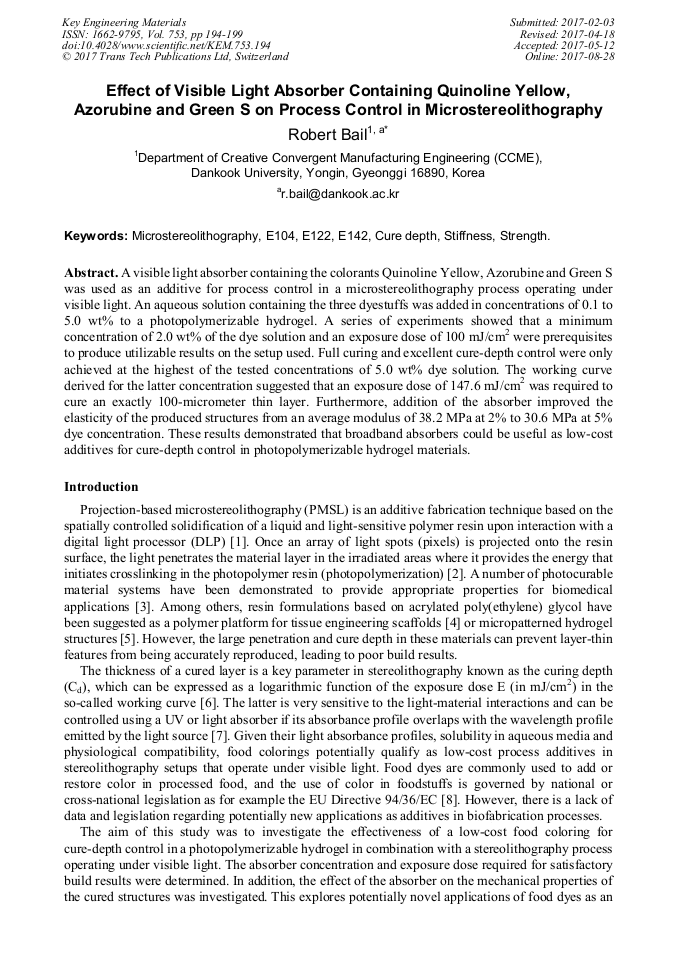
A visible light absorber containing the colorants Quinoline Yellow, Azorubine and Green S was used as an additive for process control in a microstereolithography process operating under visible light. An aqueous solution containing the three dyestuffs was added in concentrations of 0.1 to 5.0 wt% to a photopolymerizable hydrogel. A series of experiments showed that a minimum concentration of 2.0 wt% of the dye solution and an exposure dose of 100 mJ/cm2 were prerequisites to produce utilizable results on the setup used. Full curing and excellent cure-depth control were only achieved at the highest of the tested concentrations of 5.0 wt% dye solution. The working curve derived for the latter concentration suggested that an exposure dose of 147.6 mJ/cm2 was required to cure an exactly 100-micrometer thin layer. Furthermore, addition of the absorber improved the elasticity of the produced structures from an average modulus of 38.2 MPa at 2% to 30.6 MPa at 5% dye concentration. These results demonstrated that broadband absorbers could be useful as low-cost additives for cure-depth control in photopolymerizable hydrogel materials.
You might also be interested in these eBooks

Info:

Periodical:

Pages:

194-199

Citation:

Online since:

August 2017

Authors:

Export:

Price:

Permissions CCC:

Permissions PLS:

Сopyright:

© 2017 Trans Tech Publications Ltd. All Rights Reserved

Share:

Citation:

* - Corresponding Author

[1] A. Bertsch, S. Jiguet, P. Bernhard, P. Renaud, Microstereolithography: A review, Materials Research Society Symposium - Proc. 758 (2003) 3-15.

DOI: 10.1557/proc-758-ll1.1

Google Scholar

[2] C. Sun, N. Fang, D. M. Wu, X. Zhang, Projection micro-stereolithography using digital micro-mirror dynamic mask, Sens. Act. A Phys. 121(1) (2005) 113-120.

DOI: 10.1016/j.sna.2004.12.011

Google Scholar

[3] F. P. W. Melchels, J. Feijen, D. W. Grijpma, A review on stereolithography and its applications in biomedical engineering, Biomater. 31(24) (2010) 6121-6130.

DOI: 10.1016/j.biomaterials.2010.04.050

Google Scholar

[4] Y. Lu, G. Mapili, G. Suhali, S. Chen, K. Roy, A digital micro-mirror device-based system for the microfabrication of complex, spatially patterned tissue engineering scaffolds, J. Biomed. Mat. Res. Part A, 77(2) (2006) 396-405.

DOI: 10.1002/jbm.a.30601

Google Scholar

[5] K. Arcaute, B. K. Mann, R. B. Wicker, Practical Use of Hydrogels in Stereolithography for Tissue Engineering Applications, in: P.J. Bártolo (Ed. ), Stereolithography: Materials, Processes and Applications, Springer, New York, 2011, pp.299-332.

DOI: 10.1007/978-0-387-92904-0_12

Google Scholar

[6] P. F. Jacobs, Rapid Prototyping & Manufacturing - Fundamentals of Stereolithography, McGraw-Hills, New York, (1992).

Google Scholar

[7] J. Shao, Y. Huang, Q. Fan, Visible light initiating systems for photopolymerization: Status, development and challenges, Pol. Chem. 5(14) (2014) 4195-4210.

DOI: 10.1039/c4py00072b

Google Scholar

[8] A. Klepsch, European Parliament and Council Directive 94/36/EC on Colours for Use in Foodstuffs, Official Journal of the European Communities, Brussels, (1994).

Google Scholar

[9] ASTM Standard D 638, Ed. 2004, Standard Test Method for Tensile Properties of Plastics, ASTM International, West Conshohocken, USA (PA), (2004).

Google Scholar

[10] J. Choi, R. B. Wicker, S. Cho, C. Ha, S. Lee, Cure depth control for complex 3D microstructure fabrication in dynamic mask projection microstereolithographyRapid Prototyp. J. 15 (2009) 59-70.

DOI: 10.1108/13552540910925072

Google Scholar