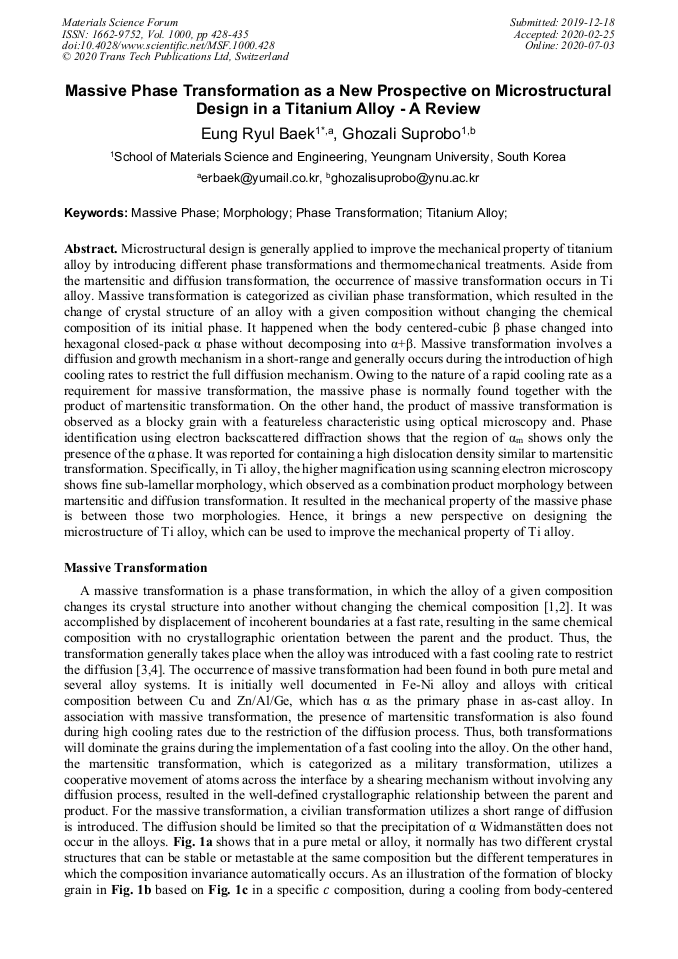
Massive Phase Transformation as a New Prospective on Microstructural Design in a Titanium Alloy - A Review

Article Preview

Abstract:

Microstructural design is generally applied to improve the mechanical property of titanium alloy by introducing different phase transformations and thermomechanical treatments. Aside from the martensitic and diffusion transformation, the occurrence of massive transformation occurs in Ti alloy. Massive transformation is categorized as civilian phase transformation, which resulted in the change of crystal structure of an alloy with a given composition without changing the chemical composition of its initial phase. It happened when the body centered-cubic β phase changed into hexagonal closed-pack α phase without decomposing into α+β. Massive transformation involves a diffusion and growth mechanism in a short-range and generally occurs during the introduction of high cooling rates to restrict the full diffusion mechanism. Owing to the nature of a rapid cooling rate as a requirement for massive transformation, the massive phase is normally found together with the product of martensitic transformation. On the other hand, the product of massive transformation is observed as a blocky grain with a featureless characteristic using optical microscopy and. Phase identification using electron backscattered diffraction shows that the region of αm shows only the presence of the α phase. It was reported for containing a high dislocation density similar to martensitic transformation. Specifically, in Ti alloy, the higher magnification using scanning electron microscopy shows fine sub-lamellar morphology, which observed as a combination product morphology between martensitic and diffusion transformation. It resulted in the mechanical property of the massive phase is between those two morphologies. Hence, it brings a new perspective on designing the microstructure of Ti alloy, which can be used to improve the mechanical property of Ti alloy.
You might also be interested in these eBooks

Info:

Periodical:

Materials Science Forum (Volume 1000)

Pages:

428-435

Citation:

Online since:

July 2020

Export:

Price:

Permissions CCC:

Permissions PLS:

Сopyright:

© 2020 Trans Tech Publications Ltd. All Rights Reserved

Share:

Citation:

* - Corresponding Author

[1] T. B. Massalski, Massive transformations, M. Science Eng, 25 (1976) 119–125.

Google Scholar

[2] A. Denquin, S. Naka, Phase Transformation Mechanisms Two-Phase Discontinuous Coarsening and Massive-Type Transformation, Acta Mater. 44 (1996) 353–365.

DOI: 10.1016/1359-6454(95)00168-6

Google Scholar

[3] T. Kumagai, E. Abe, M. Takeyama, M. Nakamura, Microstructural evolution of massively transformed γ-tial during isothermal aging, Scr. Mater. 36 (1997) 523–529.

DOI: 10.1016/s1359-6462(96)00416-2

Google Scholar

[4] Y. Zheng, R.E.A. Williams, S. Nag, R. Banerjee, H.L. Fraser, D. Banerjee, The effect of alloy composition on instabilities in the β phase of titanium alloys, Scr. Mater. 116 (2016) 49–52.

DOI: 10.1016/j.scriptamat.2016.01.024

Google Scholar

[5] H.I. Aaronson, Mechanisms of the massive transformation, Metall. Mater. Trans. A Phys. Metall. Mater. Sci. 33 (2002) 2285–2297.

DOI: 10.1007/s11661-002-0352-6

Google Scholar

[6] M. Plichta, J. Williams, H. Aaronson, On the existence of the β→αm transformation in the alloy systems Ti-Ag, Ti-Au, and Ti-Si, Metall. Trans. A. 8 (1977) 1885–1892.

DOI: 10.1007/bf02646561

Google Scholar

[7] M.R. Plichta, W.A.T. Clark, H.I. Aaronson, The nucleation kinetics, crystallography, and mechanism of the massive transformation, Metall. Trans. A. 15 (1984) 427–435.

DOI: 10.1007/bf02644966

Google Scholar

[8] T. Ahmed, H.J. Rack, Phase transformations during cooling in α+β titanium alloys, Mater. Sci. Eng. A. 243 (1998) 206–211.

Google Scholar

[9] S.L. Lu, M. Qian, H.P. Tang, M. Yan, J. Wang, D.H. StJohn, Massive transformation in Ti-6Al-4V additively manufactured by selective electron beam melting, Acta Mater. 104 (2016) 303–311.

DOI: 10.1016/j.actamat.2015.11.011

Google Scholar

[10] Z. Liu, S.L. Lu, H.P. Tang, M. Qian, L. Zhan, Characterization and decompositional crystallography of the massive phase grains in an additively-manufactured Ti-6Al-4V alloy, Mater. Charact. 127 (2017) 146–152.

DOI: 10.1016/j.matchar.2017.01.012

Google Scholar

[11] S.L. Semiatin, S.L. Knisley, P.N. Fagin, F. Zhang, D.R. Barker, Microstructure evolution during alpha-beta heat treatment of Ti-6Al-4V, Metall. Mater. Trans. A. 34 (2003) 8–10.

DOI: 10.1007/s11661-003-0300-0

Google Scholar

[12] G. Lütjering and J.C. Williams: Titanium, 2007, p.283–336.

Google Scholar

[13] J.D. Beal, R. Boyer, D. Sanders, T.B. Company, Forming of Titanium and Titanium Alloys, in: ASM Handbook 14B, Metalworking: Sheet Forming, ASM Int., 2006, p.656–669.

DOI: 10.31399/asm.hb.v14b.a0005146

Google Scholar

[14] G. Suprobo, N. Park, E.R. Baek, and S. Kim, Thermal Decomposition of Massive Phase to Fine Lamellar α/β in Ti-6Al-4V Additively Manufactured Alloy by Directed Energy Deposition, Metals and Materials International. accepted.

DOI: 10.1007/s12540-019-00304-4

Google Scholar

[15] G. Suprobo, N. Park, E.R. Baek, and S. Kim. Effect of Double Stage Solution Treatment on the Volume Fraction of Massive Phase (αm) as a New Method to Obtain a Fine Lamellar α/β in Ti-6Al-4V Alloy, Intermetallics 113 (2019) 106581.

DOI: 10.1016/j.intermet.2019.106581

Google Scholar