Enhancing the Properties of PVA-Based Hydrogel with Cellulose Nanofibers and Tartaric Acid for Safe Paper Conservation

Article Preview

Abstract:

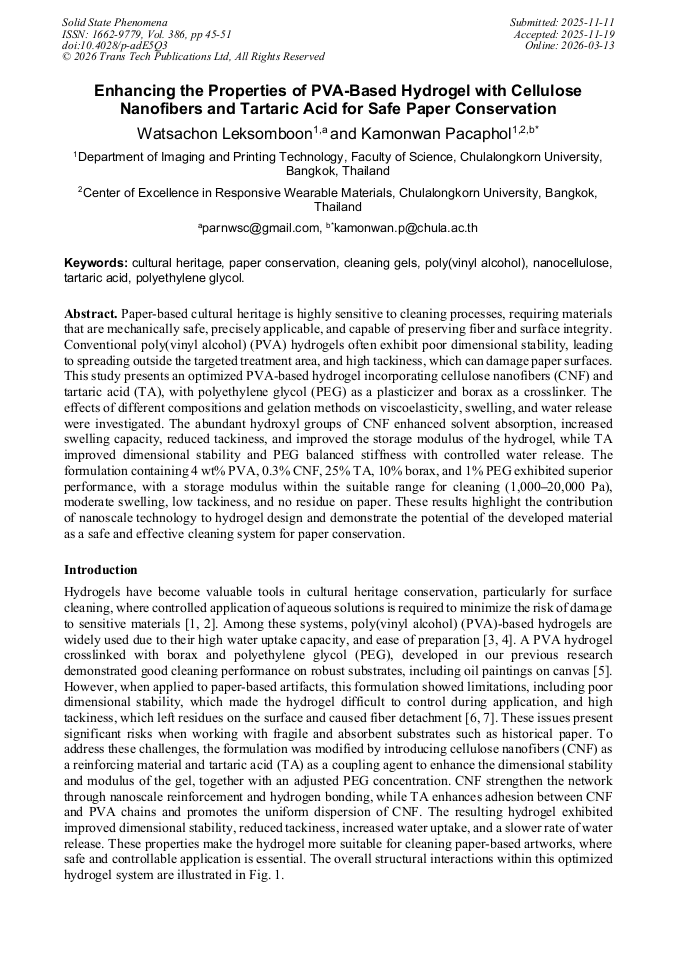
Paper-based cultural heritage is highly sensitive to cleaning processes, requiring materials that are mechanically safe, precisely applicable, and capable of preserving fiber and surface integrity. Conventional poly (vinyl alcohol) (PVA) hydrogels often exhibit poor dimensional stability, leading to spreading outside the targeted treatment area, and high tackiness, which can damage paper surfaces. This study presents an optimized PVA-based hydrogel incorporating cellulose nanofibers (CNF) and tartaric acid (TA), with polyethylene glycol (PEG) as a plasticizer and borax as a crosslinker. The effects of different compositions and gelation methods on viscoelasticity, swelling, and water release were investigated. The abundant hydroxyl groups of CNF enhanced solvent absorption, increased swelling capacity, reduced tackiness, and improved the storage modulus of the hydrogel, while TA improved dimensional stability and PEG balanced stiffness with controlled water release. The formulation containing 4 wt% PVA, 0.3% CNF, 25% TA, 10% borax, and 1% PEG exhibited superior performance, with a storage modulus within the suitable range for cleaning (1,000–20,000 Pa), moderate swelling, low tackiness, and no residue on paper. These results highlight the contribution of nanoscale technology to hydrogel design and demonstrate the potential of the developed material as a safe and effective cleaning system for paper conservation.
You might also be interested in these eBooks

Info:

Periodical:

Solid State Phenomena (Volume 386)

Pages:

45-51

Citation:

Online since:

March 2026

Export:

Price:

Permissions CCC:

Permissions PLS:

Сopyright:

© 2026 Trans Tech Publications Ltd. All Rights Reserved

Share:

Citation:

* - Corresponding Author

[1] D. Chelazzi and P. Baglioni: Langmuir Vol. 39 (2023), pp.10744-10755.

Google Scholar

[2] E. Guilminot: Gels Vol. 9 (2023), p.191.

Google Scholar

[3] R. Mastrangelo, D. Chelazzi, G. Poggi, E. Fratini, L.P. Buemi, M.L. Petruzzellis and P. Baglioni: Proc. Natl. Acad. Sci. U. S. A Vol. 117 (2020), pp.7011-7020.

DOI: 10.1073/pnas.1911811117

Google Scholar

[4] V. Stagno, A. Ciccola, R. Curini, P. Postorino, G. Favero and S. Capuani: Gels Vol. 7 (2021), p.265.

DOI: 10.3390/gels7040265

Google Scholar

[5] W. Leksomboon, D. Aht-Ong, P. Katemake and K. Pacaphol: Int. J. Polym. Anal. Charact Vol. 30 (2025), pp.531-542.

Google Scholar

[6] E. Al-Emam, H. Soenen, J. Caen and K. Janssens: Herit. Sci Vol. 8 (2020), p.106.

Google Scholar

[7] X. Liang, H. Zhong, H. Ding, B. Yu, X. Ma, X. Liu, C. Chong and J. He: Polym. J Vol. 16 (2024), p.2755.

Google Scholar

[8] K. Pacaphol, K. Seraypheap and D. Aht-Ong: Carbohydr. Polym Vol. 224 (2019), p.115167.

Google Scholar

[9] T. Tan, J. Zhou, X. Gao, X. Tang and H. Zhang: Ind. Crops. Prod Vol. 169 (2021), p.113641.

Google Scholar

[10] R. Mastrangelo, C. Montis, N. Bonelli, P. Tempesti and P. Baglioni: Phys. Chem. Chem. Phys Vol. 19 (2017), pp.23762-23772.

DOI: 10.1039/c7cp02662e

Google Scholar

[11] L. Jia, W. Liu, R. Fan and W. Wang: Int. J. Polym. Anal. Charact Vol. 28 (2023), pp.734-744.

Google Scholar

[12] R. Jalababu, S.S. Veni and K.V.N.S. Reddy: Int. J. Polym. Anal. Charact Vol. 24 (2019), pp.304-312.

Google Scholar

[13] K. Pachapol, P. Katemake, W. Bankeeree and N. Tse: Sci. Rep Vol. 15 (2025), p.25536.

Google Scholar

[14] W.X. Waresindo, H.R. Luthfianti, A. Priyanto, D.A. Hapidin, D. Edikresnha, A.H. Aimon, T. Suciati and K. Khairurrijal: Mater. Res. Express Vol. 10 (2023), p.024003.

DOI: 10.1088/2053-1591/acb98e

Google Scholar