Manufacture of Accurate Titanium Cranio-Facial Implants with High Forming Angle Using Single Point Incremental Forming

Article Preview

Abstract:

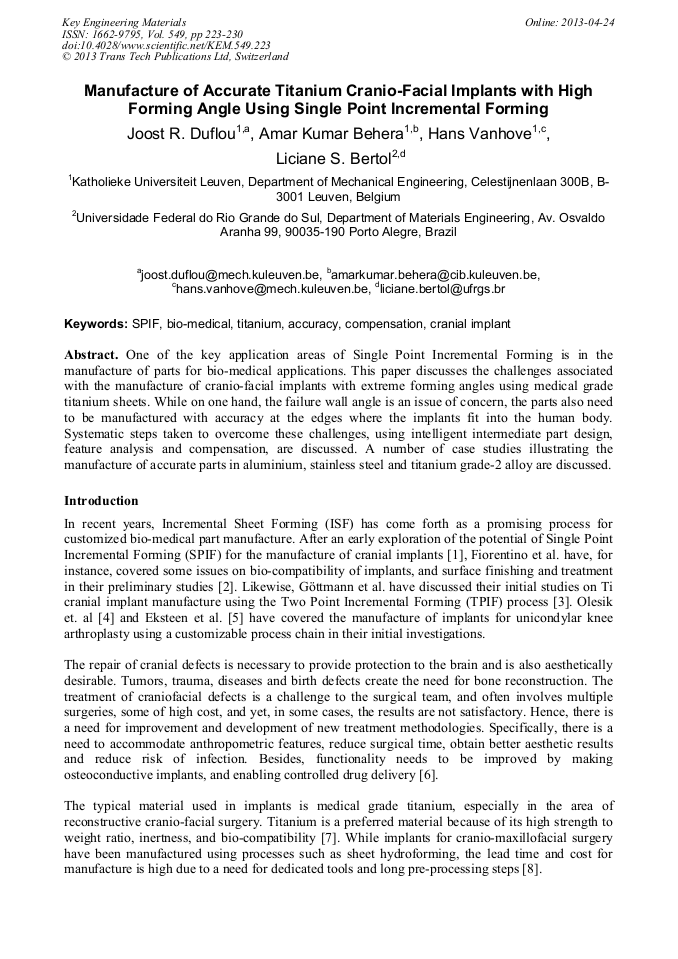
One of the key application areas of Single Point Incremental Forming is in the manufacture of parts for bio-medical applications. This paper discusses the challenges associated with the manufacture of cranio-facial implants with extreme forming angles using medical grade titanium sheets. While on one hand, the failure wall angle is an issue of concern, the parts also need to be manufactured with accuracy at the edges where the implants fit into the human body. Systematic steps taken to overcome these challenges, using intelligent intermediate part design, feature analysis and compensation, are discussed. A number of case studies illustrating the manufacture of accurate parts in aluminium, stainless steel and titanium grade-2 alloy are discussed.
You might also be interested in these eBooks

Info:

Periodical:

Pages:

223-230

Citation:

Online since:

April 2013

Export:

Price:

Permissions CCC:

Permissions PLS:

Сopyright:

© 2013 Trans Tech Publications Ltd. All Rights Reserved

Share:

Citation:

[1] J. Duflou, J. Verbert, Y. Tunckol, F. Gelaude, B. Lauwers. Proceedings of the 2nd International Conference on Manufacturing Engineering. (2005) 217-225

Google Scholar

[2] A. Fiorentino, R. Marzi, E. Ceretti, International Journal of Mechatronics and Manufacturing Systems. 5(1) (2012) 36-45.

Google Scholar

[3] A. Göttmann, M. Korinth, V. Schäfer, B. T. Araghi, M. Bambach, G. Hirt, Future Trends in Production Engineering. 5 (2013) 287-295.

DOI: 10.1007/978-3-642-24491-9_28

Google Scholar

[4] V. Oleksik, A. Pascu, C. Deac, R. Fleaca, M. Roman, O. Bologa, Proceedings of the 10th International Conference on Numerical Methods in Industrial Forming Processes. (2010) 1208-1216

DOI: 10.1063/1.3457520

Google Scholar

[5] P.D. Eksteen, A.F. Van der Merwe. CIE42 Proceedings. 131 (2012) 1-7

Google Scholar

[6] K. Kuroda, Masazumi Okido. Bioinorganic Chemistry and Applications. (2012) 7 pages

DOI: 10.1155/2012/730693

Google Scholar

[7] B. P. Bannon, E. E. Mild, Titanium Alloys for Biomaterial Application: An Overview, in: H. A. Luckey, F. Kubli, F. Kubli, Jr., Titanium Alloys in Surgical Implants: A Symposium ASTM STP 796 (1983) pp.7-16.

DOI: 10.1520/stp796-eb

Google Scholar

[8] L.C. Hieu, E. Bohez, J.V. Sloten, L.T. Hung, L. Khanh, N. Zlatov, P.D. Trung, IFMBE Proceedings. 27 (2010) 119-122.

DOI: 10.1007/978-3-642-12020-6_29

Google Scholar

[9] J. Jeswiet, F. Micari, G. Hirt, A. Bramley, J. Duflou, J. Allwood. CIRP Annals-Manufacturing Technology, 54(2) (2005) 623-649.

DOI: 10.1016/s0007-8506(07)60021-3

Google Scholar

[10] J.R. Duflou, J. Verbert, B. Belkassem, J. Gu, H. Sol, C. Henrard, A.M. Habraken, CIRP Annals - Manufacturing Technology. 57(1) (2008) 253-256.

DOI: 10.1016/j.cirp.2008.03.030

Google Scholar

[11] A. K. Behera, J. Verbert, B. Lauwers, J. R. Duflou. Computer-Aided Design, 45 (2013) 575-590

DOI: 10.1016/j.cad.2012.10.045

Google Scholar

[12] A. K. Behera, H. Vanhove, B. Lauwers, J. R. Duflou, Key Engineering Materials. 473 (2011) 881-888

DOI: 10.4028/www.scientific.net/kem.473.881

Google Scholar

[13] M. Bambach, B. T. Araghi, G. Hirt, Prod. Eng. Res. Devel., Vol. 3 (2009) 145-156

Google Scholar