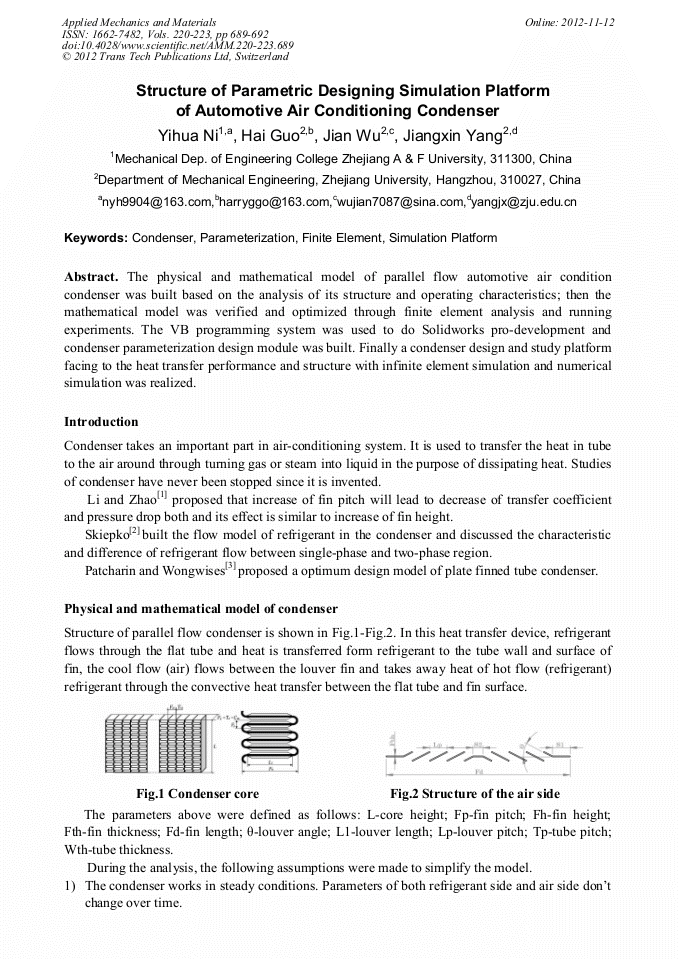
Structure of Parametric Designing Simulation Platform of Automotive Air Conditioning Condenser

Article Preview

Abstract:

The physical and mathematical model of parallel flow automotive air condition condenser was built based on the analysis of its structure and operating characteristics; then the mathematical model was verified and optimized through finite element analysis and running experiments. The VB programming system was used to do Solidworks pro-development and condenser parameterization design module was built. Finally a condenser design and study platform facing to the heat transfer performance and structure with infinite element simulation and numerical simulation was realized.
You might also be interested in these eBooks

Info:

Periodical:

Pages:

689-692

Citation:

Online since:

November 2012

Export:

Price:

Permissions CCC:

Permissions PLS:

Сopyright:

© 2012 Trans Tech Publications Ltd. All Rights Reserved

Share:

Citation:

[1] LI Kui-ning, ZHAO Jian-gang, LUO Hong. Analysis of heat transfer and optimal parameters of multi-louvered fin condenser [J]. Journal of Chongqing University (Natural Science Edition), 2005, 28(6):41-43

Google Scholar

[2] Skiepko T. Thermal design of automotive HVAC condensers for mixed flow regimes in mini-channels, Bialystok Technical University. Arch Thermodynamic 2006; 27:53–74. ISSN: 1231-0956

Google Scholar

[3] Patcharin S, Wongwises S. Optimal configuration of cross flow plate finned tube condenser based on the second law of thermodynamics. Int J Therm Sci 2008; 47:1473–81

DOI: 10.1016/j.ijthermalsci.2007.12.009

Google Scholar

[4] Dong JQ, Chen J, Chen Z, Zhang W, Zhou Y. Heat transfer and pressure drop correlations for the multi-louvered fin compact heat exchangers. Energy Convers Manage 2007; 48:150 Transfer 1996; 39:805–9.6–15

DOI: 10.1016/j.enconman.2006.11.023

Google Scholar

[5] Webb R L. Principles of Enhanced Heat Transfer [M]

Google Scholar