Fatigue Life Prediction of Vehicle Transmission Shaft Assembly without Intermediate Support
p.108
p.108
Study on the Influence of Pitch Diameter Ratio on Contact Mechanics Parameters between the ACSR Strand
p.113
p.113
First-Order Proportional Modification Parameters for Spiral Bevel Gears Manufactured by Spread Blade Method
p.118
p.118
Analysis on Fatigue for Aircraft Riveting Thin-Walled Components
p.122
p.122
Study on Influence of Nozzle Structure on Flow in Diesel Nozzle Orifice
p.127
p.127
Seismic Response Analysis of Long Span Cable-Stayed Bridge under Non-Uniform Excitation
p.131
p.131
Research of Global Boundary Optimization for Automobile Engine
p.136
p.136
Study on the Basic Configurations of Crank-Group Driving Mechanism
p.141
p.141
42CrMo Hard Surface Gear Intensity Tests and Modified Parameter Correction
p.145
p.145
Study on Influence of Nozzle Structure on Flow in Diesel Nozzle Orifice

Abstract:
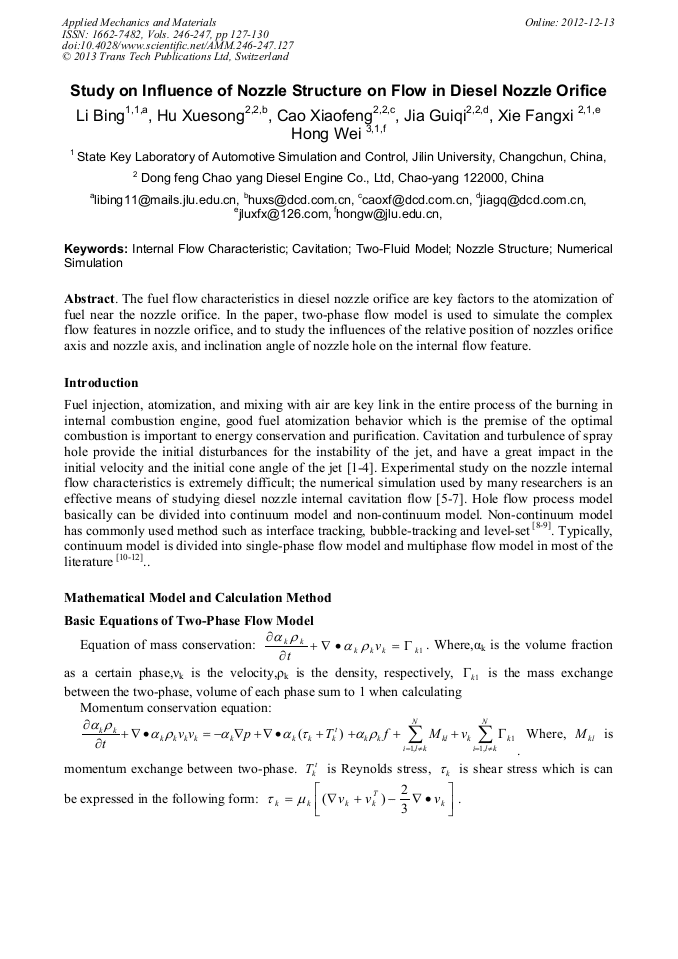
The fuel flow characteristics in diesel nozzle orifice are key factors to the atomization of fuel near the nozzle orifice. In the paper, two-phase flow model is used to simulate the complex flow features in nozzle orifice, and to study the influences of the relative position of nozzles orifice axis and nozzle axis, and inclination angle of nozzle hole on the internal flow feature.
You might also be interested in these eBooks
Info:
Periodical:
Applied Mechanics and Materials (Volumes 246-247)
Pages:
127-130
Citation:
Online since:
December 2012
Authors:
Price:
Сopyright:
© 2013 Trans Tech Publications Ltd. All Rights Reserved
Share:
Citation: