Study on the Influence of Pitch Diameter Ratio on Contact Mechanics Parameters between the ACSR Strand

Article Preview

Abstract:

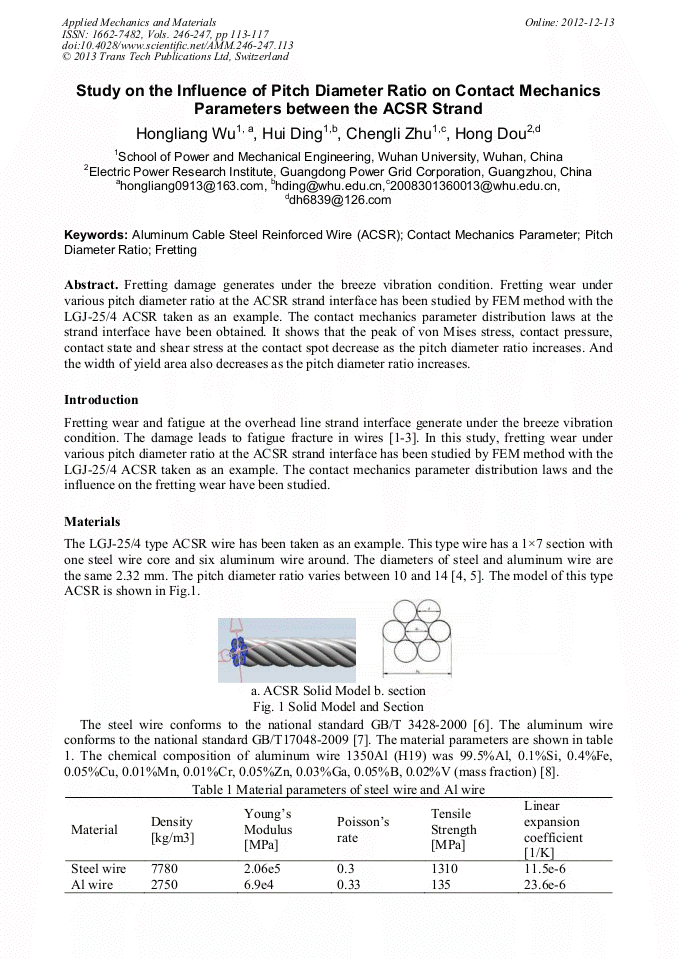
Fretting damage generates under the breeze vibration condition. Fretting wear under various pitch diameter ratio at the ACSR strand interface has been studied by FEM method with the LGJ-25/4 ACSR taken as an example. The contact mechanics parameter distribution laws at the strand interface have been obtained. It shows that the peak of von Mises stress, contact pressure, contact state and shear stress at the contact spot decrease as the pitch diameter ratio increases. And the width of yield area also decreases as the pitch diameter ratio increases.
You might also be interested in these eBooks

Info:

Periodical:

Pages:

113-117

Citation:

Online since:

December 2012

Export:

Price:

Permissions CCC:

Permissions PLS:

Сopyright:

© 2013 Trans Tech Publications Ltd. All Rights Reserved

Share:

Citation:

[1] X.Z. ZHAO, Q. ZHOU: Manufacturing Automation Vol. 33(2011), pp.122-125.

Google Scholar

[2] Z. R. Zhou et al: Fretting Wear (Science Press, Beijing. 2002).

Google Scholar

[3] D.K. ZHANG: Research of the steel wire fretting wear and its fatigue damage behavior (China Mining University Press, Xuzhou. 2005).

Google Scholar

[4] Z.T. ZHANG et al: Design theory of OHL (China Electric Power Press, Beijing. 2010).

Google Scholar

[5] H.Y. YU et al: Application and detection of power line equipment (China Electric Power Press, Beijing. 2007).

Google Scholar

[6] The national electric wire and cable standardization technical committee. GB/T 3428-2000 Galvanizing steel wire for OHL. China Standards Press, Beijing (2000), in press.

Google Scholar

[7] The national electric wire and cable standardization technical committee. GB/T 17048-2009 Hard Aluminum wire for OHL. China Standards Press, Beijing (2009), in press.

Google Scholar

[8] S.Y. ZHANG et al: The latest manual of metal materials brand, performance, usage and Chinese and foreign brands (China Science and Technology Culture Press, Beijing. 2005).

Google Scholar

[9] Z. WANG: Electric Power Construction Vol. 24 (2003), pp.29-32.

Google Scholar

[10] Y.D. GAO et al: ANSYS, mechanical engineering application essence 50 cases (Publishing House of Electronics Industry, Beijing. 2011).

Google Scholar