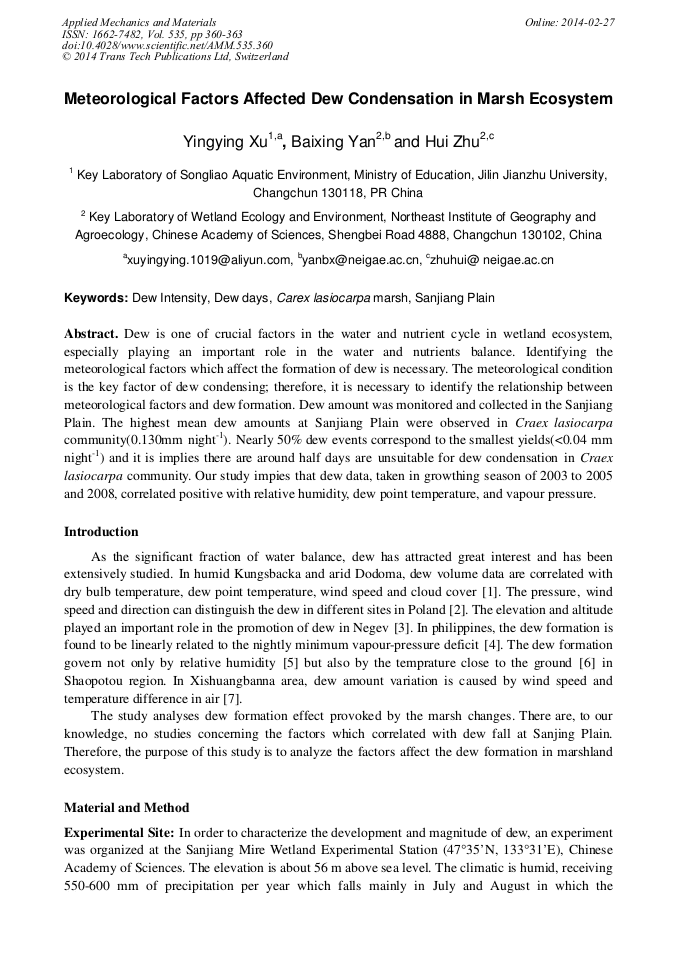
Meteorological Factors Affected Dew Condensation in Marsh Ecosystem

Article Preview

Abstract:

Dew is one of crucial factors in the water and nutrient cycle in wetland ecosystem, especially playing an important role in the water and nutrients balance. Identifying the meteorological factors which affect the formation of dew is necessary. The meteorological condition is the key factor of dew condensing; therefore, it is necessary to identify the relationship between meteorological factors and dew formation. Dew amount was monitored and collected in the Sanjiang Plain. The highest mean dew amounts at Sanjiang Plain were observed in Craex lasiocarpa community (0.130mm night-1). Nearly 50% dew events correspond to the smallest yields (<0.04 mm="" night="" sup="">-1) and it is implies there are around half days are unsuitable for dew condensation in Craex lasiocarpa community. Our study impies that dew data, taken in growthing season of 2003 to 2005 and 2008, correlated positive with relative humidity, dew point temperature, and vapour pressure.

You might also be interested in these eBooks

Info:

Periodical:

Pages:

360-363

Citation:

Online since:

February 2014

Export:

Price:

Permissions CCC:

Permissions PLS:

Сopyright:

© 2014 Trans Tech Publications Ltd. All Rights Reserved

Share:

Citation:

* - Corresponding Author

[1] N. Torbjorn, Initial experiments on dew collection in Sweden and Tanzania, Solar Energ. Mater. Solar Cells. 40 (1996) 23-32.

DOI: 10.1016/0927-0248(95)00076-3

Google Scholar

[2] K. Kamila, S. Costes, P. Zaneta, L. Dariusz , P. Piotr , M. Stanisław , N. Jacek, Application of linear discriminant analysis to the study of dew chemistry on the basis of samples collected in Poland(2004-2005), Cent. Eur. J. Chem. 7 (2009) 20-30.

Google Scholar

[3] K.J. Giora, Altitude dependent dew and fog in the Negev Desert, Israel, Agricultur. Forest Meteorol. 96 (1999) 1-8.

DOI: 10.1016/s0168-1923(99)00043-x

Google Scholar

[4] W.H. Luo, J. Goudriaan, Measuring dew formation and its threshold value for ner radiation loss on top leaces in a paddy rice crop by using the dewball: a new and simple instrument, Original Article. 44 (2000) 167-171.

DOI: 10.1007/s004840000071

Google Scholar

[5] Q. Feng, Q.Z. Gao, Priliminary study on condensation water in semi-humid sandyland, Arid Zone Res. 12(3) (1995) 72-77. (in Chinese).

Google Scholar

[6] H.S. Chen, Y.H. Kang, Condensed vapour and its role in the ecological environment of shapotou region, J. Arid Land Resour. Environ. 6(2) (1992) 63-72. (in Chinese).

Google Scholar

[7] W.J. Liu, K.Y. Zhang, G.M. Zhang, Canopy interceptive effect of dew and fog resources from dry season tropical rainforest in Xishuangbanna, Resour. Sci. 23(2) (2001) 75-80. (in Chinese).

Google Scholar

[8] B.X. Yan, W. Deng, Study on the dew resource in Sanjiang Plain, J. Nat. Resour. 19(6) (2004) 732-737. (in Chinese).

Google Scholar