Network-Coding-Based Mutually Cooperative Transmission in Deep Space Communications

Article Preview

Abstract:

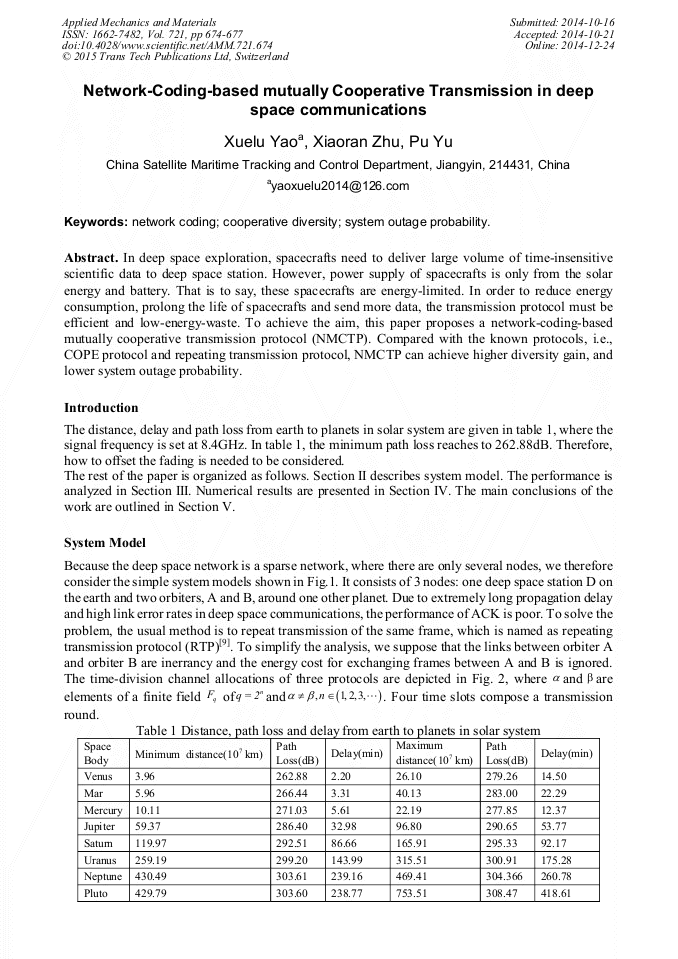
In deep space exploration, spacecrafts need to deliver large volume of time-insensitive scientific data to deep space station. However, power supply of spacecrafts is only from the solar energy and battery. That is to say, these spacecrafts are energy-limited. In order to reduce energy consumption, prolong the life of spacecrafts and send more data, the transmission protocol must be efficient and low-energy-waste. To achieve the aim, this paper proposes a network-coding-based mutually cooperative transmission protocol (NMCTP). Compared with the known protocols, i.e., COPE protocol and repeating transmission protocol, NMCTP can achieve higher diversity gain, and lower system outage probability.
You might also be interested in these eBooks

Info:

Periodical:

Pages:

674-677

Citation:

Online since:

December 2014

Export:

Price:

Permissions CCC:

Permissions PLS:

Сopyright:

© 2015 Trans Tech Publications Ltd. All Rights Reserved

Share:

Citation:

* - Corresponding Author

[1] A. Sendonaris, E. Erkip, and B. Aazhang, User cooperationdiversity–part I: system description, IEEE Trans. Commun., vol. 51, no. 11, Nov. 2003, p.1927–(1938).

DOI: 10.1109/tcomm.2003.818096

Google Scholar

[2] A. Sendonaris, E. Erkip, and B. Aazhang, User cooperation diversity–part II: implementation aspects and performance analysis, IEEE Trans. Commun., vol. 51, no. 11, Nov. 2003, p.1939–(1948).

DOI: 10.1109/tcomm.2003.819238

Google Scholar

[3] J. Laneman and G. Wornell, Distributed space-time-coded protocols for exploiting cooperative diversity in wireless networks, IEEE Trans. Inform. Theory, vol. 49, Oct. 2003, p.2415–2425.

DOI: 10.1109/tit.2003.817829

Google Scholar

[4] T. Hunter and A. Nostratinia, Diversity through coded cooperation, IEEE Trans. Wireless Commun., vol. 5, no. 2, Feb. 2006, p.283–289.

DOI: 10.1109/twc.2006.1611050

Google Scholar

[5] T. Hunter, S. Sanayei, and A. Nostratinia, Outage analysis of coded cooperation, IEEE Trans. Inform. Theory, vol. 52, no. 2, Feb. 2006, p.375–391.

DOI: 10.1109/tit.2005.862084

Google Scholar

[6] R. Ahlswede, N. Cai, R. Li, and R. W. Yeung, Network Information Flow, IEEE Trans. Inform. Theory, vol. 46, no. 4, July. 2000, pp.1204-1216.

DOI: 10.1109/18.850663

Google Scholar

[7] Tuan Tran, Thinh Nguyen, Bella Bose, Vinodh Gopal, a hybrid network coding technique for single-hop wireless networks, IEEE journal on selected areas in communications , vol. 27, no. 5, Jun. 2009, pp.685-698.

DOI: 10.1109/jsac.2009.090610

Google Scholar

[8] S. Katti, H. Rahul, W. Hu, D. Katabi, M. Medard, and J. Crowcroft, XORs in the Air: Practical Wireless Network Coding, IEEE/ACM Trans. Networking, vol. 16, no. 3, Jun. 2008, pp.497-510.

DOI: 10.1109/tnet.2008.923722

Google Scholar

[9] Li Shi-tang, Zheng Bao-yu, Huang Chuan, Cui Jing-wu, Performance of System Outage Based on Opportunistic Network Coding, vol. 31, no. 9, Sep. 2009, pp.2243-246.

Google Scholar