The Application of Tissue Engineering and Biological Materials on Exercise-Induced Meniscus Injury

Article Preview

Abstract:

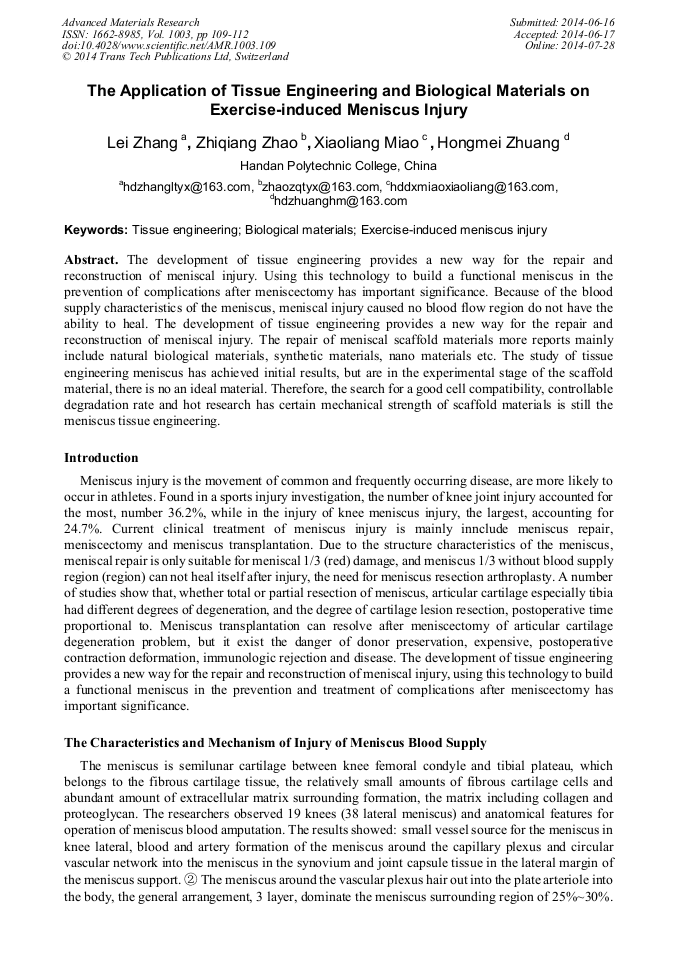
The development of tissue engineering provides a new way for the repair and reconstruction of meniscal injury. Using this technology to build a functional meniscus in the prevention of complications after meniscectomy has important significance. Because of the blood supply characteristics of the meniscus, meniscal injury caused no blood flow region do not have the ability to heal. The development of tissue engineering provides a new way for the repair and reconstruction of meniscal injury. The repair of meniscal scaffold materials more reports mainly include natural biological materials, synthetic materials, nanomaterials etc. The study of tissue engineering meniscus has achieved initial results, but are in the experimental stage of the scaffold material, there is no an ideal material. Therefore, the search for a good cell compatibility, controllable degradation rate and hot research has certain mechanical strength of scaffold materials is still the meniscus tissue engineering.
You might also be interested in these eBooks

Info:

Periodical:

Pages:

109-112

Citation:

Online since:

July 2014

Export:

Price:

Permissions CCC:

Permissions PLS:

Сopyright:

© 2014 Trans Tech Publications Ltd. All Rights Reserved

Share:

Citation:

* - Corresponding Author

[1] Melika Sarem, Fathollah Moztarzadeh, Masoud Mozafari, V. Prasad Shastri. Optimization strategies on the structural modeling of gelatin/chitosan scaffolds to mimic human meniscus tissue. Materials Science and Engineering: C, Volume 33, Issue 8, 1 December 2013, Pages 4777-4785.

DOI: 10.1016/j.msec.2013.07.036

Google Scholar

[2] P. Buma, N.N. Ramrattan, T.G. van Tienen, R.P.H. Veth. Tissue engineering of the meniscus. Biomaterials, Volume 25, Issue 9, April 2004, Pages 1523-1532.

DOI: 10.1016/s0142-9612(03)00499-x

Google Scholar

[3] Giuseppe Musumeci, Carla Loreto, Maria Luisa Carnazza, Venera Cardile, Rosalia Leonardi. Acute injury affects lubricin expression in knee menisci: An immunohistochemical study. Annals of Anatomy - Anatomischer Anzeiger, Volume 195, Issue 2, March 2013, Pages 151-158.

DOI: 10.1016/j.aanat.2012.07.010

Google Scholar

[4] Feini Qu, Jung-Ming G. Lin, John L. Esterhai, Matthew B. Fisher, Robert L. Mauck. Biomaterial-mediated delivery of degradative enzymes to improve meniscus integration and repair. Acta Biomaterialia, Volume 9, Issue 5, May 2013, Pages 6393-6402.

DOI: 10.1016/j.actbio.2013.01.016

Google Scholar

[5] Tony G. van Tienen, Gerjon Hannink, Pieter Buma. Meniscus Replacement Using Synthetic Materials. Clinics in Sports Medicine, Volume 28, Issue 1, January 2009, Pages 143-156.

DOI: 10.1016/j.csm.2008.08.003

Google Scholar

[6] Pascal Edouard, François Rannou, Emmanuel Coudeyre. Animal evidence for hyaluronic acid efficacy in knee trauma injuries. Review of animal-model studies. Physical Therapy in Sport, Volume 14, Issue 2, May 2013, Pages 116-123.

DOI: 10.1016/j.ptsp.2013.02.001

Google Scholar