Effects of Operational Parameters and Heat Treatments on the Aluminum-Steel Explosively Welded Composite Plates

Article Preview

Abstract:

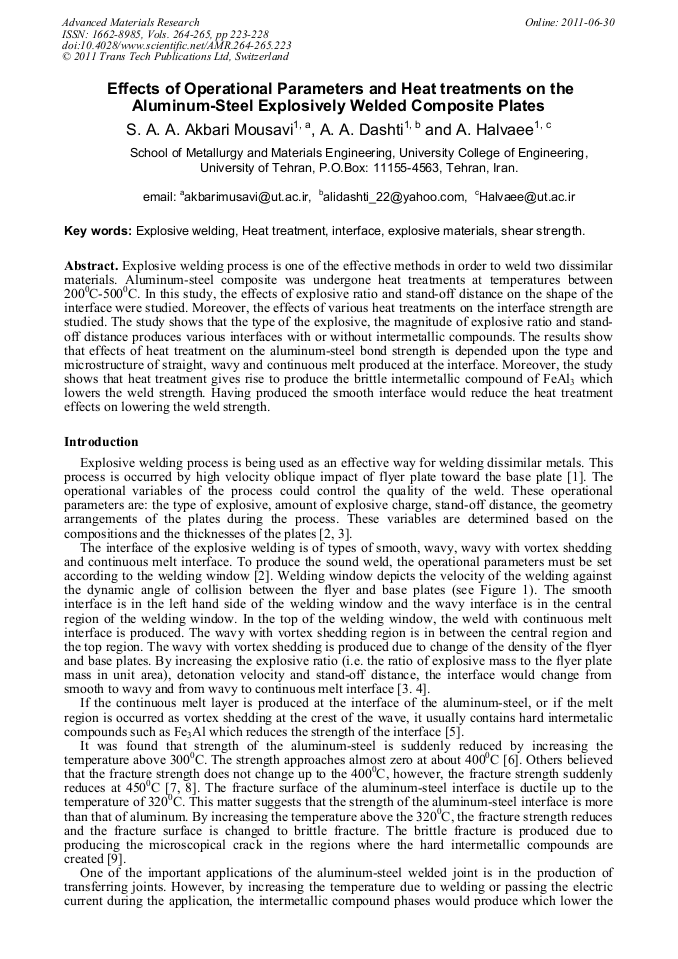
Explosive welding process is one of the effective methods in order to weld two dissimilar materials. Aluminum-steel composite was undergone heat treatments at temperatures between 2000C-5000C. In this study, the effects of explosive ratio and stand-off distance on the shape of the interface were studied. Moreover, the effects of various heat treatments on the interface strength are studied. The study shows that the type of the explosive, the magnitude of explosive ratio and standoff distance produces various interfaces with or without intermetallic compounds. The results show that effects of heat treatment on the aluminum-steel bond strength is depended upon the type and microstructure of straight, wavy and continuous melt produced at the interface. Moreover, the study shows that heat treatment gives rise to produce the brittle intermetallic compound of FeAl3 which lowers the weld strength. Having produced the smooth interface would reduce the heat treatment effects on lowering the weld strength.
You might also be interested in these eBooks

Info:

Periodical:

Advanced Materials Research (Volumes 264-265)

Pages:

223-228

Citation:

Online since:

June 2011

Export:

Price:

Permissions CCC:

Permissions PLS:

Сopyright:

© 2011 Trans Tech Publications Ltd. All Rights Reserved

Share:

Citation:

[1] ASM Handbook, Welding, Brazing and Soldering, Vol 6, 9th edition, (1983).

Google Scholar

[2] B. Crossland, Explosive welding of metals and its application, Clarendon Press, oxford (1982).

Google Scholar

[3] D. Jaramillo, A. Szecket and O. T. Inal, On the transition from a waveless to wavy interface in explosive welding, Mat. Sci. & and Eng., Vol. 91 (1987), 217-222.

DOI: 10.1016/0025-5416(87)90300-4

Google Scholar

[4] V. M. Kudinov and I. D. Zakharenko, Criteria for selecting the parameters of explosion welding, Welding Production (1985), No. 9, 1-3.

Google Scholar

[5] J. Banker and A. Nobili, Aluminum-steel electric transition joints , effect of temperature and time upon mechanical properties, TMS 131st Annual Meeting Seattle, USA, February 17-21 (2002).

Google Scholar

[6] HSB and A. Nobili, Electrical resistance of electric transition joints versus time and temperature, TMS 131st Annual Meeting Seattle, USA, February 17-21 (2002).

Google Scholar

[7] R. M. Chao and J. M. Yang, Interfacial toughness for the shipboard aluminum/steel structural transition joint, Marine Structures, Vol. 10 (1997), 353-362.

DOI: 10.1016/s0951-8339(96)00018-4

Google Scholar

[8] V. S. Sedykh, Mechanical properties of explosion welded steel-aluminum joints, Welding Production, No. 2 (1985), 17-18.

Google Scholar

[9] M. Turna and D. Hrivnakova, Structure of explosion welded joint in dissimilar materials, Welding Production, No. 9 (1985), 9-10.

Google Scholar

[10] J. Banker and A. Nobili, Electrical resistance of electric transition joints versus time and temperature, TMS 131st Annual Meeting Seattle, USA, February 17-21 (2002).

Google Scholar