Synthesis and Imidization of Polyamic Acid

Article Preview

Abstract:

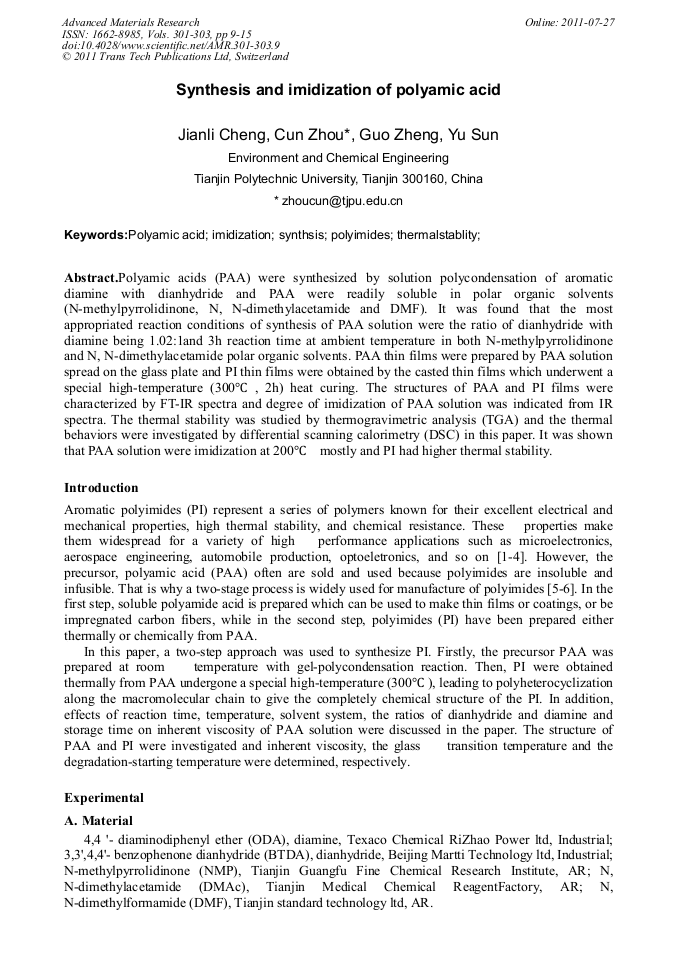
Polyamic acids (PAA) were synthesized by solution polycondensation of aromatic diamine with dianhydride and PAA were readily soluble in polar organic solvents (N-methylpyrrolidinone, N, N-dimethylacetamide and DMF). It was found that the most appropriated reaction conditions of synthesis of PAA solution were the ratio of dianhydride with diamine being 1.02:1and 3h reaction time at ambient temperature in both N-methylpyrrolidinone and N, N-dimethylacetamide polar organic solvents. PAA thin films were prepared by PAA solution spread on the glass plate and PI thin films were obtained by the casted thin films which underwent a special high-temperature (300°C, 2h) heat curing. The structures of PAA and PI films were characterized by FT-IR spectra and degree of imidization of PAA solution was indicated from IR spectra. The thermal stability was studied by thermogravimetric analysis (TGA) and the thermal behaviors were investigated by differential scanning calorimetry (DSC) in this paper. It was shown that PAA solution were imidization at 200°C mostly and PI had higher thermal stability.
You might also be interested in these eBooks

Info:

Periodical:

Advanced Materials Research (Volumes 301-303)

Pages:

9-15

Citation:

Online since:

July 2011

Export:

Price:

Permissions CCC:

Permissions PLS:

Сopyright:

© 2011 Trans Tech Publications Ltd. All Rights Reserved

Share:

Citation:

[1] Nian Du, Cheuk Wong, Michael Feurstein, and Omowunmi A. Sadik, Flexible Poly(amic acid) Conducting Polymers: Effect of Chemical Composition on Structural, Electrochemical, and Mechanical Properties, Langmiur, vol. 26, Jul. 2010, pp.14194-14202.

DOI: 10.1021/la101314j

Google Scholar

[2] Qing-Yuan Tang, Jie Chen, Y.C. Chan, and Y.C. Chan, Effect of carbon nanotubes and their dispersion on thermal curing of polyimide precursors, Polymer Degradation and Stability, vol. 95, 2010, pp.1672-1678.

DOI: 10.1016/j.polymdegradstab.2010.05.023

Google Scholar

[3] Giyoong Tae, Sung-Mog Kim , Young-MO Koo, Jong-Duk Kim, and Kyu-Jong Lee, Stability and transferability of monolayers of polyamic acid salts, Synthetic metals, vol. 71, 1995, pp.2097-2098, doi: 10. 101610379-6779(94)03184-8.

DOI: 10.1016/0379-6779(94)03184-8

Google Scholar

[4] P. Santhan Gopala Krishnan, Rohit H. Vora, and Tai-Shulg Chung, Synthesis, characterization and kinetic study of hydrolysis of polyamic acid derived from ODPA and m-tolidine and related compounds, Polymer, vol. 42, 2001, pp.5165-5174.

DOI: 10.1016/s0032-3861(01)00338-x

Google Scholar

[5] E. Hamciuc, C. Hamciuc, M. Bruma, and N. M. Belomoina, Synthesis and characterization of new poly[phenylquinoxaline(ether)imides, Russian Chemical Bulletin, International Edition, vol. 53, Sep. 2004, pp.2035-2040, doi: 10. 1007/s11172-005-0068-z.

DOI: 10.1007/s11172-005-0068-z

Google Scholar

[6] QIU JIN, TAKASHI, YAMASHITA, KAZUYUKI HORIE, RIKIO YOKOTA, and ITARU MITA, Polymides with Alicyclic Dimines.I. Syntheses and Thermal prpperties, Polymer Chemistry, vol. 31, 1993, pp.2345-2351, doi: 10. 1002/pola. 1993. 080310917.

DOI: 10.1002/pola.1993.080310917

Google Scholar

[7] Jae Chang Jung, Kwan Ku Lee, and Mu Shik Jhon, The dispersion of polymethylsilsesquinoxane into polyimide, Polymer Bulletin, vol. 36, 1996, pp.67-72, doi: 10. 1007/BF00296009.

DOI: 10.1007/bf00296009

Google Scholar

[8] J. O. Iroh, and W. Yuan, Surface properties of carbon fibres modified by electrodeposition of polyamic acid, Polymer, vol. 37, 1996, pp.4197-4203, doi: 10. 1016/0032-3861(98)00266-2.

DOI: 10.1016/0032-3861(96)00266-2

Google Scholar

[9] Tao Ma, Shujiang Zhang, Yanfeng Li, Fengchun Yang, Chenliang Gong, and Jiujiang Zhao, Synthesis and characterization of novel polyimides derived from 4-phenyl-2, 6-bis[3-(4-aminophenoxy)-phenyl]-pyridine diamine and aromatic dianhydrides, Polymer Degradation and Stability, vol. 95, 2010, pp.1244-1250.

DOI: 10.1016/j.polymdegradstab.2010.03.026

Google Scholar