p.19
p.23
p.28
p.32
p.36
p.41
p.46
p.51
p.56
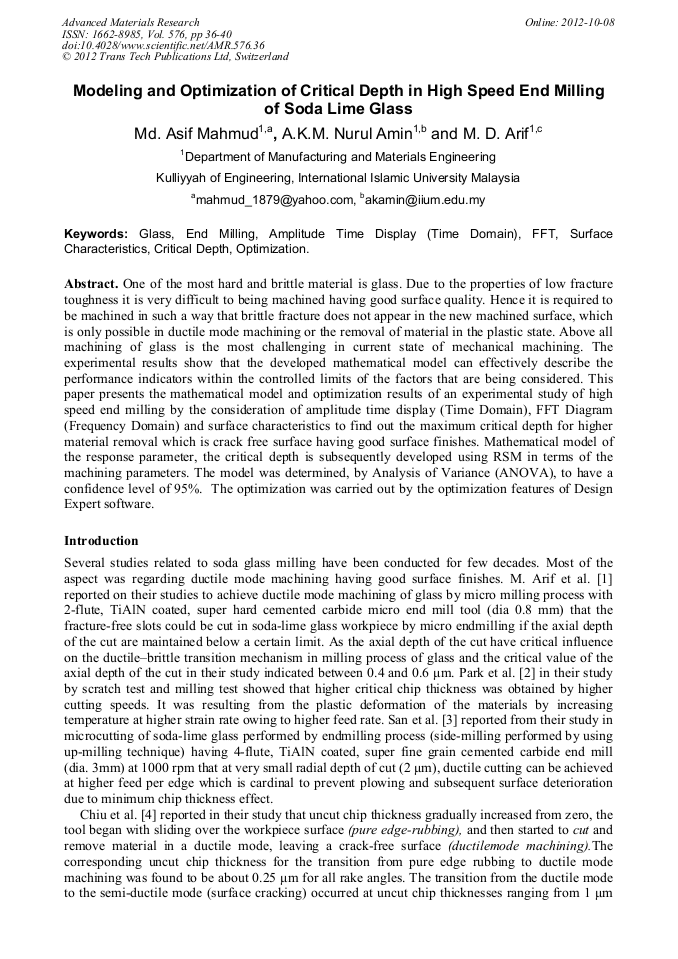
Modeling and Optimization of Critical Depth in High Speed End Milling of Soda Lime Glass

Abstract:
One of the most hard and brittle material is glass. Due to the properties of low fracture toughness it is very difficult to being machined having good surface quality. Hence it is required to be machined in such a way that brittle fracture does not appear in the new machined surface, which is only possible in ductile mode machining or the removal of material in the plastic state. Above all machining of glass is the most challenging in current state of mechanical machining. The experimental results show that the developed mathematical model can effectively describe the performance indicators within the controlled limits of the factors that are being considered. This paper presents the mathematical model and optimization results of an experimental study of high speed end milling by the consideration of amplitude time display (Time Domain), FFT Diagram (Frequency Domain) and surface characteristics to find out the maximum critical depth for higher material removal which is crack free surface having good surface finishes. Mathematical model of the response parameter, the critical depth is subsequently developed using RSM in terms of the machining parameters. The model was determined, by Analysis of Variance (ANOVA), to have a confidence level of 95%. The optimization was carried out by the optimization features of Design Expert software.
Info:
Periodical:
Pages:
36-40
DOI:
Citation:
Online since:
October 2012
Authors:
Price:
Сopyright:
© 2012 Trans Tech Publications Ltd. All Rights Reserved
Share:
Citation: