Study of Magnetic Abrasive Finishing Using Mechanically Alloyed Magnetic Abrasives

Article Preview

Abstract:

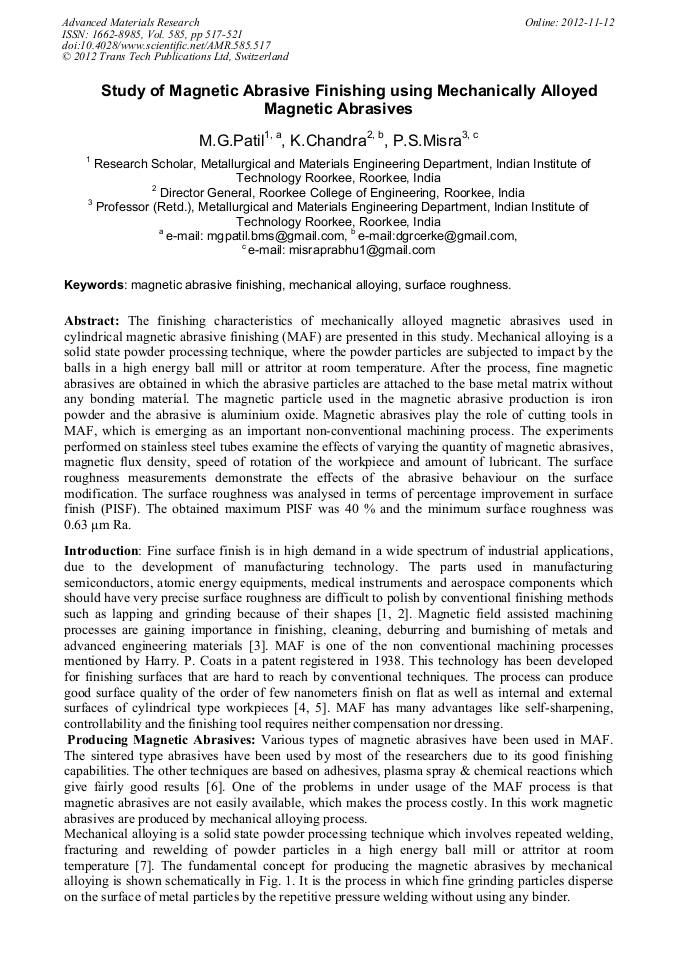
The finishing characteristics of mechanically alloyed magnetic abrasives used in cylindrical magnetic abrasive finishing (MAF) are presented in this study. Mechanical alloying is a solid state powder processing technique, where the powder particles are subjected to impact by the balls in a high energy ball mill or attritor at room temperature. After the process, fine magnetic abrasives are obtained in which the abrasive particles are attached to the base metal matrix without any bonding material. The magnetic particle used in the magnetic abrasive production is iron powder and the abrasive is aluminium oxide. Magnetic abrasives play the role of cutting tools in MAF, which is emerging as an important non-conventional machining process. The experiments performed on stainless steel tubes examine the effects of varying the quantity of magnetic abrasives, magnetic flux density, speed of rotation of the workpiece and amount of lubricant. The surface roughness measurements demonstrate the effects of the abrasive behaviour on the surface modification. The surface roughness was analysed in terms of percentage improvement in surface finish (PISF). The obtained maximum PISF was 40 % and the minimum surface roughness was 0.63 μm Ra.
You might also be interested in these eBooks

Info:

Periodical:

Pages:

517-521

Citation:

Online since:

November 2012

Export:

Price:

Permissions CCC:

Permissions PLS:

Сopyright:

© 2012 Trans Tech Publications Ltd. All Rights Reserved

Share:

Citation:

[1] Yan Wang, Dejin Hu, Study on the inner surface finishing of tubing by magnetic abrasive finishing, International Journal of Machine Tools & Manufacture, Vol. 45, (2005), pp.43-49.

DOI: 10.1016/j.ijmachtools.2004.06.014

Google Scholar

[2] H. Yamaguchi, T. Shinmura, Study of an internal magnetic abrasive finishing using a pole rotation system: Discussion of the characteristic abrasive behavior, Precision Engineering, Journal of the International Societies for Precision Engineering and Nanotechnology, 24(2000).

DOI: 10.1016/s0141-6359(00)00037-4

Google Scholar

[3] D.K. Singh, V.K. Jain, V. Raghuram, R. Komanduri, Analysis of surface texture generated by a flexible magnetic abrasive brush, Wear259, (2005), pp.1254-1261.

DOI: 10.1016/j.wear.2005.02.030

Google Scholar

[4] Shinmura. T, Takazava. K & Hatano. T, Study on Magnetic Abrasive Process – Application to Plane Finishing, Bulletin of Japan Society of Precision Engineering, Vol. 19(4), (1985), pp.289-291.

Google Scholar

[5] Yamaguchi. H, Shinmura. T, Study of the surface modification resulting from an internal magnetic abrasive finishing process, Wear 225-229, (1999), pp.246-255.

DOI: 10.1016/s0043-1648(99)00013-7

Google Scholar

[6] L. Singh, S.S. Khangura, P.S. Mishra, Performance of abrasives used in magnetically assisted finishing: a state of the art review, Int.J. Abrasive Technology. Vol. 3, No. 3, (2010), pp.215-227.

DOI: 10.1504/ijat.2010.034052

Google Scholar

[7] C. Suryanarayana, Mechanical alloying and milling, Progress in Materials Science 46, (2001) pp.1-184.

Google Scholar

[8] J.D. Kim, Polishing of Ultra-clean Inner Surfaces Using Magnetic Force, International Journal of Advanced Manufacturing Technology 21, (2003) pp.91-97.

DOI: 10.1007/s001700300011

Google Scholar