Research on Designing the Information Management Platform of Physical Education Based on B/S Model

Article Preview

Abstract:

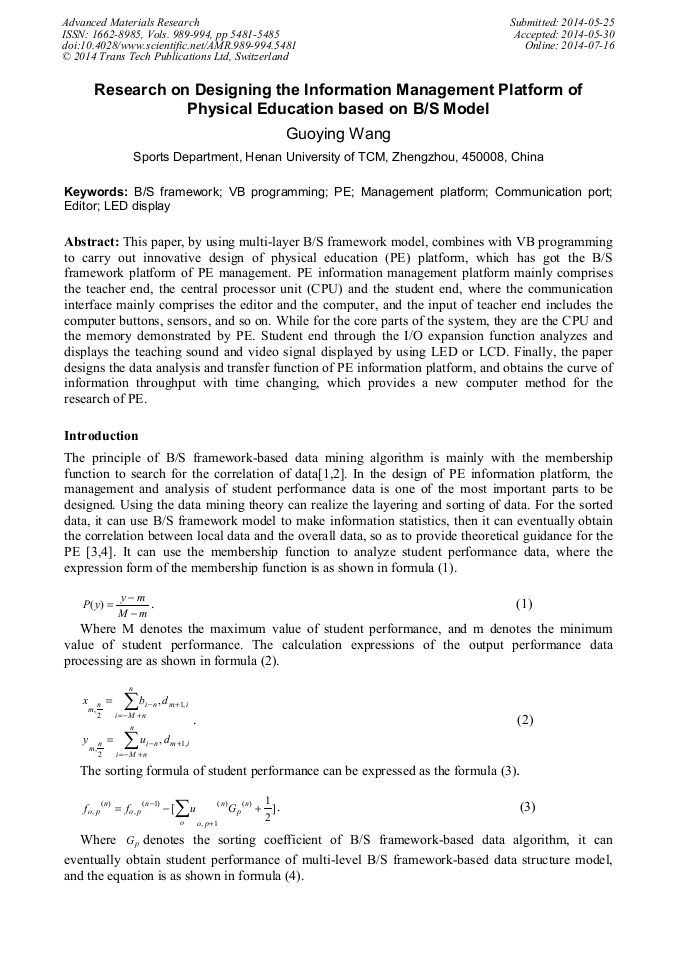
This paper, by using multi-layer B/S framework model, combines with VB programming to carry out innovative design of physical education (PE) platform, which has got the B/S framework platform of PE management. PE information management platform mainly comprises the teacher end, the central processor unit (CPU) and the student end, where the communication interface mainly comprises the editor and the computer, and the input of teacher end includes the computer buttons, sensors, and so on. While for the core parts of the system, they are the CPU and the memory demonstrated by PE. Student end through the I/O expansion function analyzes and displays the teaching sound and video signal displayed by using LED or LCD. Finally, the paper designs the data analysis and transfer function of PE information platform, and obtains the curve of information throughput with time changing, which provides a new computer method for the research of PE.

You might also be interested in these eBooks

Info:

Periodical:

Advanced Materials Research (Volumes 989-994)

Pages:

5481-5485

Citation:

Online since:

July 2014

Authors:

Export:

Price:

Permissions CCC:

Permissions PLS:

Сopyright:

© 2014 Trans Tech Publications Ltd. All Rights Reserved

Share:

Citation:

* - Corresponding Author

[1] Qian Yue, Shan Feng. Systematically analysis of calculation performance for genetic algorithm [J]. Chinese Journal of computers, 2011, 32(12): 2389-2392.

Google Scholar

[2] Junhua Li, Ming Li, Lihua Yuan. The pseudo parallel genetic algorithm based on clustering [J]. Pattern recognition and artificial intelligence, 2012, 22(2): 188-194.

Google Scholar

[3] Jian Zhuang, Qingyu Yang, Haifeng Du, Dehong Yu. High efficient complex system genetic algorithm [J]. Journal of software, 2010, 21(11): 2790-2801.

DOI: 10.3724/sp.j.1001.2010.03673

Google Scholar

[4] Shouwen Chen, Mingdong Li. An improved genetic algorithm and its simulation [J]. Computer Applications and Software, 2010, 27(9): 100-102.

Google Scholar

[5] Kang Wang, Xuesong Yan, Jian Jin, Zhigang Zhan. An improved genetic K-means clustering algorithm [J]. Computer & Digital Engineering, 2010, 38(1): 18-20.

Google Scholar

[6] Biao Wang, Chanlun Duan, Hao Wu, Yonggang Song. Research and application of rough sets and fuzzy sets [M]. Beijing: Publishing House of electronics industry, 2012: 1-8.

Google Scholar

[7] Guohui Li, Hui Chen, Bing Yang. Prediction query algorithm for data flow based on probabilistic model [J]. Computer science, 2011, 35 (4): 66-69.

Google Scholar

[8] Anlong Chen, Changjie Tang, Chang'an Yuan, Mingfang Zhu. Compression algorithm for multi-data stream based on Wavelet and coupling characteristics [J]. Journal of software, 2011, 18(2): 177-184.

Google Scholar

[9] Xueling Zhu, Jun Lan, Shouqi Li, Yan Jia. Anomaly detection for data stream based on tensor decomposition [J]. Computer engineering and science, 2013, 31(6): 75-78.

Google Scholar