p.379
p.385
p.399
p.411
p.419
p.435
p.451
p.459
p.465
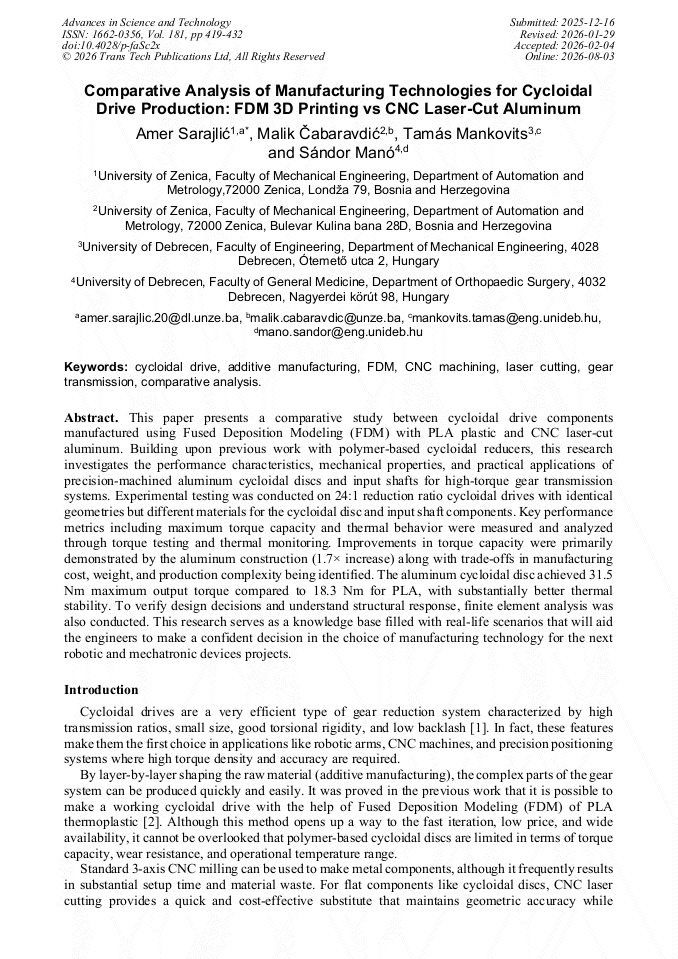
Comparative Analysis of Manufacturing Technologies for Cycloidal Drive Production: FDM 3D Printing vs CNC Laser-Cut Aluminum

Abstract:
This paper presents a comparative study between cycloidal drive components manufactured using Fused Deposition Modeling (FDM) with PLA plastic and CNC laser-cut aluminum. Building upon previous work with polymer-based cycloidal reducers, this research investigates the performance characteristics, mechanical properties, and practical applications of precision-machined aluminum cycloidal discs and input shafts for high-torque gear transmission systems. Experimental testing was conducted on 24:1 reduction ratio cycloidal drives with identical geometries but different materials for the cycloidal disc and input shaft components. Key performance metrics including maximum torque capacity and thermal behavior were measured and analyzed through torque testing and thermal monitoring. Improvements in torque capacity were primarily demonstrated by the aluminum construction (1.7× increase) along with trade-offs in manufacturing cost, weight, and production complexity being identified. The aluminum cycloidal disc achieved 31.5 Nm maximum output torque compared to 18.3 Nm for PLA, with substantially better thermal stability. To verify design decisions and understand structural response, finite element analysis was also conducted. This research serves as a knowledge base filled with real-life scenarios that will aid the engineers to make a confident decision in the choice of manufacturing technology for the next robotic and mechatronic devices projects.
Info:
Periodical:
Pages:
419-432
DOI:
Citation:
Online since:
August 2026
Authors:
Price:
Permissions CCC:
Permissions PLS:
Сopyright:
© 2026 Trans Tech Publications Ltd. All Rights Reserved
Share:
Citation: