Forging Process of Graphite Lubricated LED Lamp Heat Sink

Article Preview

Abstract:

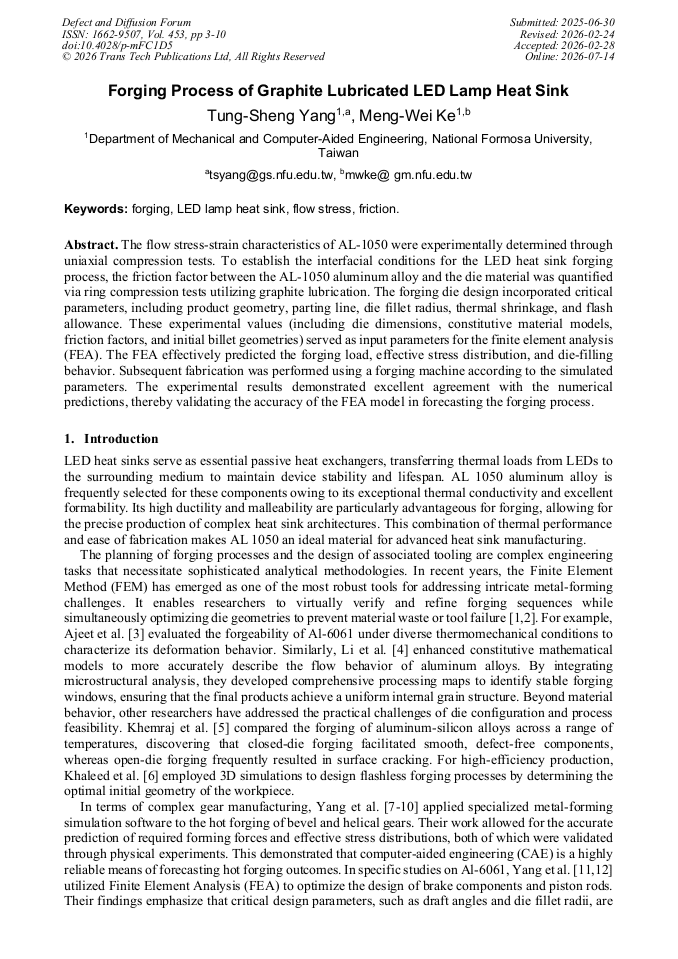
The stress-strain curves for AL-1050 were experimentally determined through compression tests. The friction factor between the AL-1050 aluminum alloy and the die material was subsequently obtained via ring compression tests, with graphite serving as the lubricant during the LED lamp heat sink forging process. The design of the forging dies for the LED lamp heat sink carefully considered several critical factors, including product geometry, parting line, die fillet radius, shrinkage, and flash. Subsequently, die dimensions, the stress-strain curve, the friction factor, and initial billet dimensions were utilized as input parameters for the finite element analysis (FEA) of the LED lamp heat sink's forging. The FEA successfully predicted the maximum forging load, effective stress distribution, and die-filling behavior of the LED heat sink during the forging process. Following the parameters established by the simulation, an LED lamp heat sink was fabricated using a forging machine. The experimental results showed excellent agreement with the simulation predictions, thereby validating the accuracy of the FEA model in forecasting the forging process.
You might also be interested in these eBooks

Info:

Periodical:

Pages:

3-10

Citation:

Online since:

July 2026

Export:

Price:

Permissions CCC:

Permissions PLS:

Сopyright:

© 2026 Trans Tech Publications Ltd. All Rights Reserved

Share:

Citation:

* - Corresponding Author

[1] T. Ishikawa, T. Ishiguro, N. Yukawa, T. Goto. CIRP Annals–Manu.Tech. Vol. 63 (2014), p.289.

Google Scholar

[2] Z. Wuhao, H. Xinghui, H. Lin. Proc. Eng. Vol. 207 (2017), p.442.

Google Scholar

[3] P.K. Ajeet, M.R. Saraf, K.C. Vora, S. M. Chau, Materials Today: Proceedings 2 (2015), p.3238.

Google Scholar

[4] P.W. Li, H.Z. Li, L. Huang, X.P. Liang, Z.X. Zhu: Trans. Nonferrous Met. Soc. China Vol. 27 (2017) p.1677.

Google Scholar

[5] Khemraj, A. K. Jha, S. N. Ojha, Materials Today: Proceedings 5 (2018), p.26955.

Google Scholar

[6] H. M. T. Khaleed, Z. Samad, A. R. Othman, M. A. Mujeebu, A. B. Abdullah, M. M. Zihad. J.Manu. Proc. Vol. 13 (2011), p.41.

Google Scholar

[7] T. S. Yang, N. C. Hwang and S. Y. Chang: J. Mech. Sci. and Tech. Vol. 21(2007), p.1566.

Google Scholar

[8] T. S. Yang, Proc. IMechE Part B: J.Engineering Manufacture Vol. 223 (2009), p.289.

Google Scholar

[9] T. S. Yang, S. Y. Chang, Z. X. Jiang, Steel Research International Vol. 81 (2010), p.334.

Google Scholar

[10] T. S. Yang, T. H. Yang, Applied Mechanics and Materials Vol. 284 (2013), p.894.

Google Scholar

[11] T.S. Yang, C. Chang and T. F. Zhang: Key Engineering Materials Vol. 901 (2021), p.176.

Google Scholar

[12] T.S. Yang, G.Y. Li, Z. Y. Li, J.W., Z.Z. Chen: Defect and Diffusion Forum Vol. 430 (2024), p.17.

Google Scholar

[13] T.S. Yang, J.C. Yeh: Journal of Physics: Conference Series, 2878 (2024) 012024.

Google Scholar