Predictive Maintenance for Mineral Processing Plant: A Machine Learning Approach for Coating Thickness Degradation in Seawater Pipelines

Article Preview

Abstract:

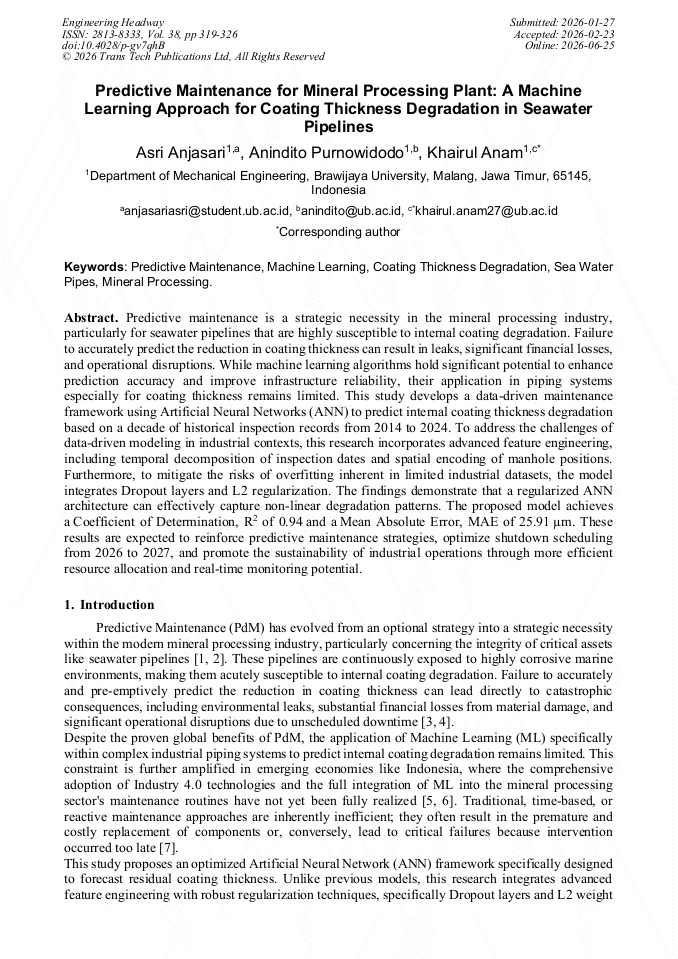
Predictive maintenance is a strategic necessity in the mineral processing industry, particularly for seawater pipelines that are highly susceptible to internal coating degradation. Failure to accurately predict the reduction in coating thickness can result in leaks, significant financial losses, and operational disruptions. While machine learning algorithms hold significant potential to enhance prediction accuracy and improve infrastructure reliability, their application in piping systems especially for coating thickness remains limited. This study develops a data-driven maintenance framework using Artificial Neural Networks (ANN) to predict internal coating thickness degradation based on a decade of historical inspection records from 2014 to 2024. To address the challenges of data-driven modeling in industrial contexts, this research incorporates advanced feature engineering, including temporal decomposition of inspection dates and spatial encoding of manhole positions. Furthermore, to mitigate the risks of overfitting inherent in limited industrial datasets, the model integrates Dropout layers and L2 regularization. The findings demonstrate that a regularized ANN architecture can effectively capture non-linear degradation patterns. The proposed model achieves a Coefficient of Determination, R2 of 0.94 and a Mean Absolute Error, MAE of 25.91 µm. These results are expected to reinforce predictive maintenance strategies, optimize shutdown scheduling from 2026 to 2027, and promote the sustainability of industrial operations through more efficient resource allocation and real-time monitoring potential.
You might also be interested in these eBooks

Info:

Periodical:

Engineering Headway (Volume 38)

Pages:

319-326

Citation:

Online since:

June 2026

Export:

Price:

Permissions CCC:

Permissions PLS:

Сopyright:

© 2026 Trans Tech Publications Ltd. All Rights Reserved

Share:

Citation:

* - Corresponding Author

[1] Alsyouf, I. (2023). Maintenance management and technology: A strategic approach for industrial plants. Journal of Quality in Maintenance Engineering.

Google Scholar

[2] ICMM. (2022). Critical Asset Integrity Management in the Mining and Metals Industry. International Council on Mining and Metals.

Google Scholar

[3] Naji, A., et al. (2024). Predictive Maintenance Strategies for Corrosive Environments in Mineral Processing. Corrosion Science & Technology.

Google Scholar

[4] Ministry of Energy and Mineral Resources Republic of Indonesia. (2023). Downstream Policy and Infrastructure Readiness for Sustainable Mining Operations.

Google Scholar

[5] Moraga, P., et al. (2023). Industry 4.0 Adoption in Emerging Economies: Challenges in the Mining Sector. International Journal of Production Economics.

Google Scholar

[6] Smith, J., & Doe, A. (2021). Machine Learning Applications for Pipeline Integrity: A Global Perspective. Journal of Pipeline Engineering.

Google Scholar

[7] Brown, M. (2022). Reactive vs. Predictive Maintenance: Cost-Benefit Analysis in Industrial Utilities. Reliability Engineering System Safety.

Google Scholar

[8] Goodfellow, I., Bengio, Y., & Courville, A. (2016). Deep Learning. MIT Press.

Google Scholar

[9] Zhang, L., et al. (2020). Time-Series Forecasting of Coating Degradation Using Neural Networks. Surface and Coatings Technology.

Google Scholar

[10] Wang, Y., et al. (2022). Spatial and Temporal Modeling of Pipeline Corrosion using Machine Learning. Journal of Infrastructure Systems.

Google Scholar

[11] Kumar, R. (2023). Optimizing Industrial Shutdown Schedules through Data-Driven Predictive Modeling. Journal of Process Control.

Google Scholar

[12] Anjasari, A. (2025). Prediction of Seawater Pipeline Coating Thickness Degradation using Machine Learning Methods.

Google Scholar

[13] Zhang, W., et al. (2022). The Role of Data Quality in Deep Learning-based Industrial Maintenance. Journal of Manufacturing Systems.

Google Scholar

[14] Schmidt, B., & Wang, L. (2023). Preprocessing Pipelines for Time-Series Forecasting in Corrosive Environments. International Journal of Prognostics and Health Management.

Google Scholar

[15] Goodfellow, I., Bengio, Y., & Courville, A. (2016). Deep Learning. MIT Press.

Google Scholar

[16] Srivastava, N., et al. (2014). Dropout: A Simple Way to Prevent Neural Networks from Overfitting. Journal of Machine Learning Research.

Google Scholar

[17] Prechelt, L. (2012). Early stopping but when? In: Neural Networks: Tricks of the Trade. Springer, Berlin, Heidelberg.

Google Scholar

[18] Chicco, D., et al. (2021). The coefficient of determination R-squared is more informative than SMAPE, MAE, and RMSE in regression analysis evaluation. PeerJ Computer Science.

DOI: 10.7717/peerj-cs.623

Google Scholar

[19] Jardine, A. K., et al. (2006). A review on machinery diagnostics and prognostics implementing condition-based maintenance. Mechanical Systems and Signal Processing.

DOI: 10.1016/j.ymssp.2005.09.012

Google Scholar

[20] Brownlee, J. (2018). Better Deep Learning: Train Faster, Reduce Overfitting, and Make Better Predictions. Machine Learning Mastery.

Google Scholar

[21] Callister, W. D., & Rethwisch, D. G. (2020). Materials Science and Engineering: An Introduction. Wiley.

Google Scholar