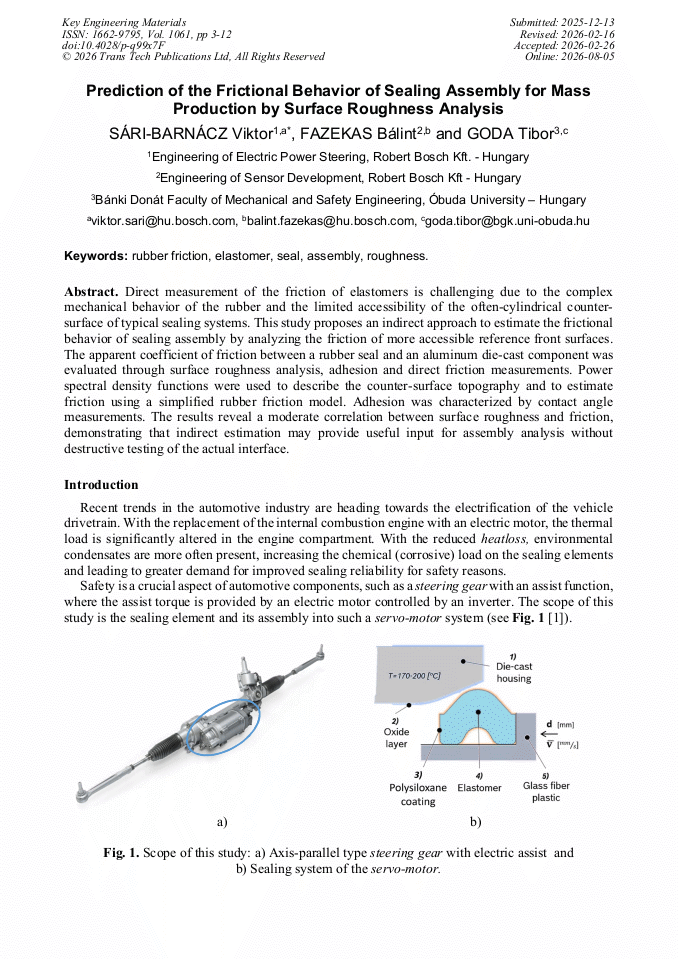
[1]
V. Sári-Barnácz and T. J. Goda, "Indirekt hiperelasztikus anyagmodell identifikáció autóipari gyártósor tömítésszerelési adatainak felhasználásával," Gép, vol. 75, no. 3–4, p.91–96, 2024.
DOI: 10.70750/GEP.2024.3-4.20
Google Scholar
[2]
F. P. Bowden, D. Tabor, and G. I. Taylor, "The area of contact between stationary and moving surfaces," Proc. R. Soc. Lond. Ser. Math. Phys. Sci., vol. 169, no. 938, p.391–413, Jan. 1997.
DOI: 10.1098/rspa.1939.0005
Google Scholar
[3]
A. Schallamach, "A theory of dynamic rubber friction," Wear, vol. 6, no. 5, p.375–382, Sep. 1963.
DOI: 10.1016/0043-1648(63)90206-0
Google Scholar
[4]
K. A. Grosch, "The Relation between the Friction and Visco-Elastic Properties of Rubber," Proc. R. Soc. Lond. Ser. A, vol. 274, p.21–39, Jun. 1963.
DOI: 10.1098/rspa.1963.0112
Google Scholar
[5]
J. A. Greenwood, "Constriction resistance and the real area of contact," Br. J. Appl. Phys., vol. 17, no. 12, p.1621, Dec. 1966.
DOI: 10.1088/0508-3443/17/12/310
Google Scholar
[6]
V. Popov and M. Heß, Method of Dimensionality Reduction in Contact Mechanics and Friction. 2015.
DOI: 10.1007/978-3-662-46160-0
Google Scholar
[7]
B. N. J. Persson, "Theory of rubber friction and contact mechanics," J. Chem. Phys., vol. 115, no. 8, p.3840–3861, Aug. 2001.
Google Scholar
[8]
B. N. J. Persson, O. Albohr, U. Tartaglino, A. I. Volokitin, and E. Tosatti, "On the nature of surface roughness with application to contact mechanics, sealing, rubber friction and adhesion," J. Phys. Condens. Matter, vol. 17, no. 1, pp. R1–R62, Jan. 2005.
DOI: 10.1088/0953-8984/17/1/R01
Google Scholar
[9]
R. Heise, "Friction between a temperature dependent viscoelastic body and a rough surface," Friction, vol. 4, no. 1, p.50–64, Mar. 2016.
DOI: 10.1007/s40544-016-0103-0
Google Scholar
[10]
M. Scaraggi and B. N. J. Persson, "General contact mechanics theory for randomly rough surfaces with application to rubber friction," J. Chem. Phys., vol. 143, no. 22, p.224111, Dec. 2015.
DOI: 10.1063/1.4936558
Google Scholar
[11]
A. Genovese, F. Farroni, A. Papangelo, and M. Ciavarella, "A Discussion on Present Theories of Rubber Friction, with Particular Reference to Different Possible Choices of Arbitrary Roughness Cutoff Parameters," Lubricants, vol. 7, no. 10, p.85, Oct. 2019.
DOI: 10.3390/lubricants7100085
Google Scholar
[12]
M. Ciavarella, "A simplified version of Persson's multiscale theory for rubber friction due to viscoelastic losses." arXiv, Feb. 02, 2017.
DOI: 10.1115/1.4036917
Google Scholar
[13]
A. Tiwari, N. Miyashita, N. Espallargas, and B. N. J. Persson, "Rubber friction: The contribution from the area of real contact," J. Chem. Phys., vol. 148, no. 22, p.224701, Jun. 2018.
DOI: 10.1063/1.5037136
Google Scholar
[14]
K. L. Johnson, K. Kendall, A. D. Roberts, and D. Tabor, "Surface energy and the contact of elastic solids," Proc. R. Soc. Lond. Math. Phys. Sci., vol. 324, no. 1558, p.301–313, Jan. 1997.
DOI: 10.1098/rspa.1971.0141
Google Scholar
[15]
V. L. Popov, Contact Mechanics and Friction. Springer Berlin, Heidelberg, 2010.
Google Scholar
[16]
F. Kaiser, D. Savio, and R. Bactavatchalou, "Modelling of Static and Dynamic Elastomer Friction in Dry Conditions," Lubricants, vol. 12, no. 7, Art. no. 7, Jul. 2024.
DOI: 10.3390/lubricants12070250
Google Scholar
[17]
T. D. B. Jacobs, T. Junge, and L. Pastewka, "Quantitative characterization of surface topography using spectral analysis," Surf. Topogr. Metrol. Prop., vol. 5, no. 1, p.013001, Jan. 2017.
DOI: 10.1088/2051-672X/aa51f8
Google Scholar
[18]
M. C. Röttger et al., "Contact.engineering—Create, analyze and publish digital surface twins from topography measurements across many scales," Surf. Topogr. Metrol. Prop., vol. 10, no. 3, p.035032, Sep. 2022.
DOI: 10.1088/2051-672X/ac860a
Google Scholar
[19]
D. K. Owens and R. C. Wendt, "Estimation of the surface free energy of polymers," J. Appl. Polym. Sci., vol. 13, no. 8, p.1741–1747, 1969.
DOI: 10.1002/app.1969.070130815
Google Scholar
[20]
D. H. Kaelble, "Dispersion-Polar Surface Tension Properties of Organic Solids," J. Adhes., Apr. 1970.
DOI: 10.1080/0021846708544582
Google Scholar
[21]
A. Tiwari, T. Tolpekina, H. van Benthem, M. K. Gunnewiek, and B. N. J. Persson, "Rubber Adhesion and Friction: Role of Surface Energy and Contamination Films," Front. Mech. Eng., vol. Volume 6-2020, 2021, Accessed: Nov. 24, 2025. [Online]. Available: https: //www.frontiersin.org/journals/mechanical-engineering/articles/.
DOI: 10.3389/fmech.2020.620233
Google Scholar