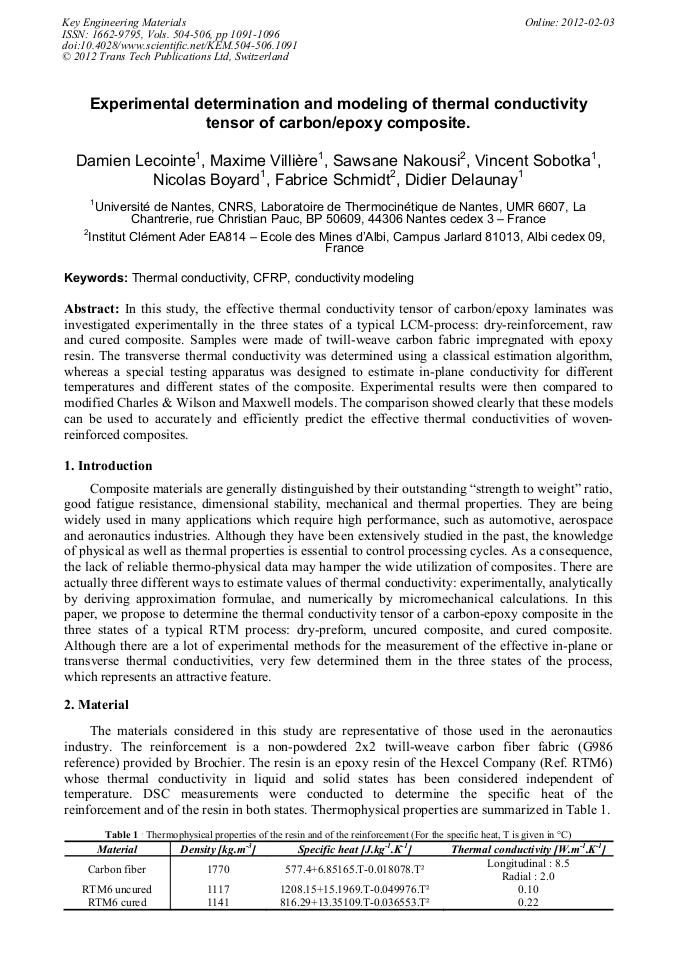
Experimental Determination and Modeling of Thermal Conductivity Tensor of Carbon/Epoxy Composite

Article Preview

Abstract:

In this study, the effective thermal conductivity tensor of carbon/epoxy laminates was investigated experimentally in the three states of a typical LCM-process: dry-reinforcement, raw and cured composite. Samples were made of twill-weave carbon fabric impregnated with epoxy resin. The transverse thermal conductivity was determined using a classical estimation algorithm, whereas a special testing apparatus was designed to estimate in-plane conductivity for different temperatures and different states of the composite. Experimental results were then compared to modified Charles & Wilson and Maxwell models. The comparison showed clearly that these models can be used to accurately and efficiently predict the effective thermal conductivities of woven-reinforced composites.
You might also be interested in these eBooks

Info:

Periodical:

Key Engineering Materials (Volumes 504-506)

Pages:

1091-1096

Citation:

Online since:

February 2012

Export:

Price:

Permissions CCC:

Permissions PLS:

Сopyright:

© 2012 Trans Tech Publications Ltd. All Rights Reserved

Share:

Citation:

[1] D. Lecointe, Caractérisation et simulation des processus de transferts lors d'injection de résine pour le procédé RTM, Ph. D. Thesis, Nantes University, (1999)

Google Scholar

[2] M. R. Kulkarni & R. P. Brady, Composites Science and Technology 57, A model of global thermal conductivity in laminated carbon-carbon composites, (1996)

DOI: 10.1016/s0266-3538(96)00116-9

Google Scholar

[3] R. Rolfes & U. Hammerschmidt, Composites Science and Technology 54, Transverse thermal conductivity of CFRP laminates: a numerical and experimental validation of approximation formulae, (1995)

DOI: 10.1016/0266-3538(95)00036-4

Google Scholar

[4] R. Pal, Composites Part A 39, On the Lewis-Nielsen model for thermal/electrical conductivity of composites, (2008)

Google Scholar

[5] B. N. Cox & G. Flanagan, National Aeronautics and Space Administration, Handbook of analytical methods for textile composites, (1997)

Google Scholar

[6] I. H. Tavman, Int. comm.. Heat and Mass Transfer, Vol 25, No. 5, pp.723-732, Effective thermal conductivity of isotropic polymer composites, (1998)

DOI: 10.1016/s0735-1933(98)00059-1

Google Scholar