p.1
p.7
p.13
p.19
p.27
p.33
p.39
p.45
Thermomechanical Testing and Precipitation Modelling of Al-Mg-Si Alloys for Hot Forming Applications

Abstract:
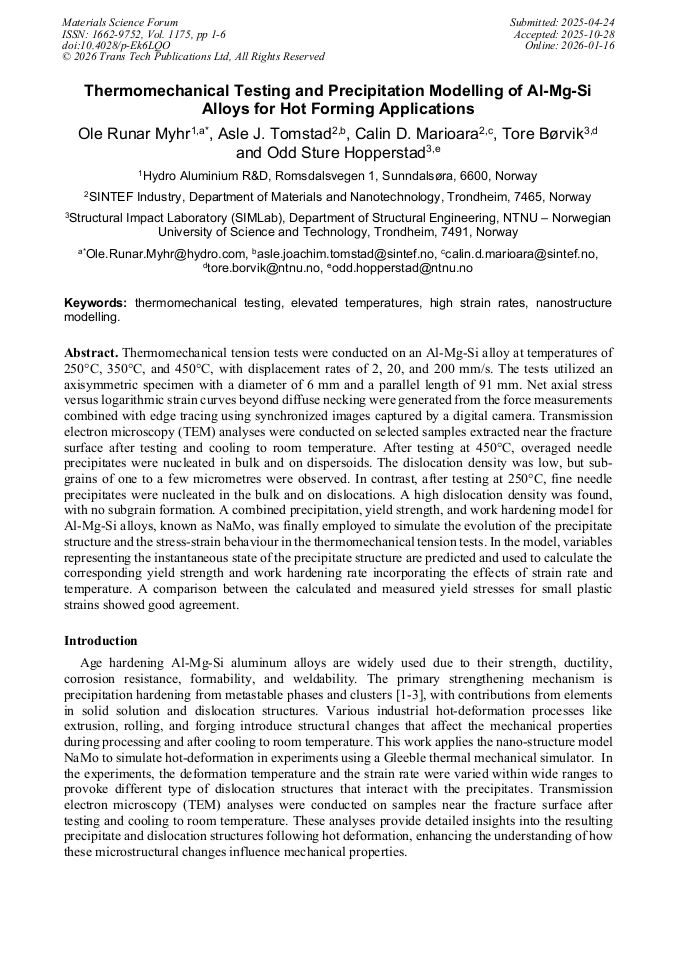
Thermomechanical tension tests were conducted on an Al-Mg-Si alloy at temperatures of 250°C, 350°C, and 450°C, with displacement rates of 2, 20, and 200 mm/s. The tests utilized an axisymmetric specimen with a diameter of 6 mm and a parallel length of 91 mm. Net axial stress versus logarithmic strain curves beyond diffuse necking were generated from the force measurements combined with edge tracing using synchronized images captured by a digital camera. Transmission electron microscopy (TEM) analyses were conducted on selected samples extracted near the fracture surface after testing and cooling to room temperature. After testing at 450°C, overaged needle precipitates were nucleated in bulk and on dispersoids. The dislocation density was low, but sub-grains of one to a few micrometres were observed. In contrast, after testing at 250°C, fine needle precipitates were nucleated in the bulk and on dislocations. A high dislocation density was found, with no subgrain formation. A combined precipitation, yield strength, and work hardening model for Al-Mg-Si alloys, known as NaMo, was finally employed to simulate the evolution of the precipitate structure and the stress-strain behaviour in the thermomechanical tension tests. In the model, variables representing the instantaneous state of the precipitate structure are predicted and used to calculate the corresponding yield strength and work hardening rate incorporating the effects of strain rate and temperature. A comparison between the calculated and measured yield stresses for small plastic strains showed good agreement.

Info:
Periodical:
Pages:
1-6
DOI:
Citation:
Online since:
January 2026
Price:
Сopyright:
© 2026 Trans Tech Publications Ltd. All Rights Reserved
Share:
Citation: