Characterization of High-Purity Nickel Single Crystals by Mechanical Spectroscopy before Irradiation Creep Tests

Article Preview

Abstract:

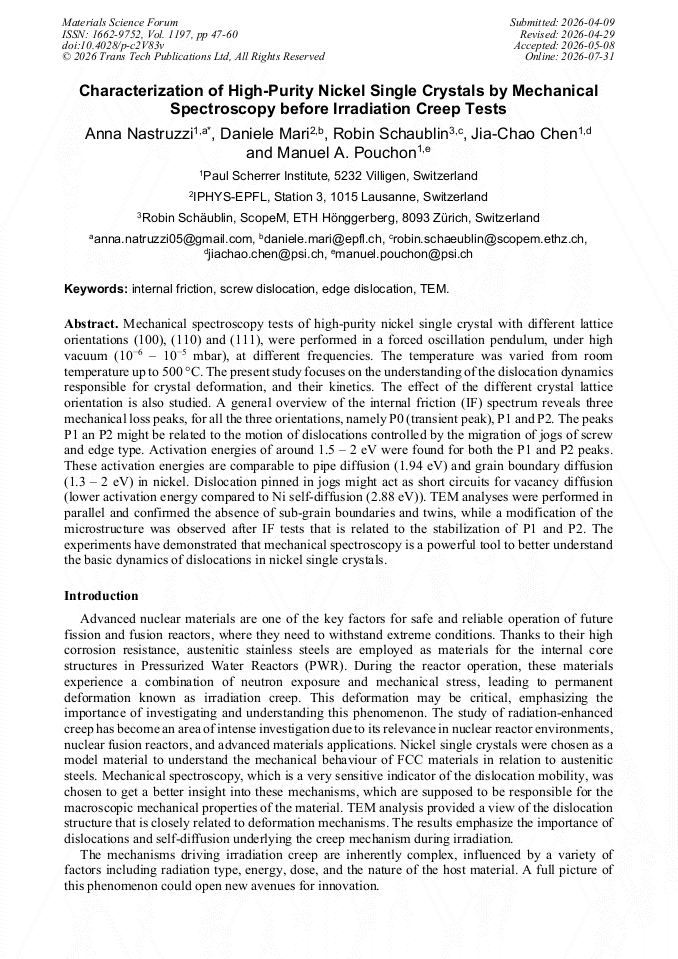
Mechanical spectroscopy tests of high-purity nickel single crystal with different lattice orientations (100), (110) and (111), were performed in a forced oscillation pendulum, under high vacuum (10−6 – 10−5 mbar), at different frequencies. The temperature was varied from room temperature up to 500 °C. The present study focuses on the understanding of the dislocation dynamics responsible for deformation, and their kinetics. The effect of the different crystal lattice orientation is also studied. A general overview of the internal friction (IF) spectrum reveals three mechanical loss peaks, for all the three orientations, namely P0 (transient peak), P1 and P2. P1 an P2 might be related to a motion of dislocations controlled by the migration of jogs of screw and edge type. Activation energies of around 1.5 – 2 eV were found for both the P1 and P2 peaks. These activation energies are comparable to pipe diffusion (1.94 eV) and grain boundary diffusion (1.3 – 2 eV) in nickel. Dislocation pinned in jogs might act as grain boundaries, enhancing the diffusion of vacancy (lower activation energy compared to Ni self-diffusion (2.88 eV)). TEM analyses were performed in parallel and confirmed the presence of dislocation jogs and the absence of sub-grain boundaries and twins. The experiments have demonstrated that mechanical spectroscopy is a powerful tool to better understand the basic dynamics of dislocations in nickel single crystals.
You might also be interested in these eBooks

Info:

Periodical:

Materials Science Forum (Volume 1197)

Pages:

47-60

Citation:

Online since:

July 2026

Export:

Price:

Permissions CCC:

Permissions PLS:

Сopyright:

© 2026 Trans Tech Publications Ltd. All Rights Reserved

Share:

Citation:

* - Corresponding Author

[1] A.S. Nowick, B.S. Berry, Anelastic in Crystalline Relaxation Solids, Academic Press, 1972.

Google Scholar

[2] R.M. Fuoss, J.G. Kirkwood, Electrical Properties of Solids. VIII. Dipole Moments in Polyvinyl Chloride-Diphenyl Systems, J. Am. Chem. Soc. 63 (1941) 385–394.

DOI: 10.1021/ja01847a013

Google Scholar

[3] E. Bonetti, E.G. Campari, L. Pasquini, E. Sampaolesi, Microstructure-related anelastic and magnetoelastic behavior of nanocrystalline nickel, J. Appl. Phys. 84 (1998) 4219–4226.

DOI: 10.1063/1.368639

Google Scholar

[4] R.R. Hasiguti, N. Igata, G. Kamoshita, Internal friction peaks in cold-worked metals, Acta Metall. 10 (1962) 442–447.

DOI: 10.1016/0001-6160(62)90023-8

Google Scholar

[5] A.W. Sommer, D.N. Beshers, Damping peaks in deformed nickel, J. Appl. Phys. 37 (1966) 4603–4614.

DOI: 10.1063/1.1708103

Google Scholar

[6] A. Rivière, J.P. Amirault, J. Woirgard, High Temperature Internal Friction and Dislocation Motion in Poly and Single Crystals of F.C.C. Metals, Le J. Phys. Colloq. 42 (1981) C5-439-C5-444.

DOI: 10.1051/jphyscol:1981565

Google Scholar

[7] A. Rivière, J. Woirgard, Etude du frottement intérieur à haute température de polycristaux et de monocristaux de nickel de haute pureté, Scr. Metall. 17 (1983) 269–273.

DOI: 10.1016/0036-9748(83)90155-2

Google Scholar

[8] I.S. Golovin, Mechanism of Damping Capacity of High-Chromium Steels and a-Fe and Its Dependence on Some External Factors, Metall. Mater. Trans. A. 25 (1994) 111–124.

DOI: 10.1007/bf02646680

Google Scholar

[9] P.Y. Li, Z.H. Cao, X.Y. Zhang, X.L. Wu, Y.N. Huang, X.K. Meng, Curie transition of NC nickel by mechanical spectroscopy and magnetization study, Chinese Phys. Lett. 26(2009)2–4.

Google Scholar

[10] A. Wolfenden, Internal friction in nickel near the Curie temperature, Scr. Metall. 12 (1978) 103–109.

DOI: 10.1016/0036-9748(78)90238-7

Google Scholar

[11] D. Prokoshkina, V.A. Esin, G. Wilde, S. V. Divinski, Grain boundary width, energy and self-diffusion in nickel: Effect of material purity, Acta Mater. 61 (2013) 5188–5197.

DOI: 10.1016/j.actamat.2013.05.010

Google Scholar

[12] K. Maier, H. Mehrer, E. Lessmann, W. Schüle, Self‐diffusion in nickel at low temperatures, Phys. Status Solidi. 78 (1976) 689–698.

DOI: 10.1002/pssb.2220780230

Google Scholar

[13] L.J. Wirth, A First Principles Study of Pipe Diffusion in Nickel., Wright State University, 2020.

Google Scholar

[14] R.F. Canon, J.P. Stark, Grain Boundary Self-Diffusion in Nickel, J. Appl. Phys. 40 (1969) 4366–4373.

DOI: 10.1063/1.1657200

Google Scholar

[15] M.L. Nó, C. Esnouf, J. San Juan, G. Fantozzi, Internal friction at medium temperature in high purity aluminium and its relation with the microstructure-II, Acta Metall. 36 (1988) 837–845.

DOI: 10.1016/0001-6160(88)90138-1

Google Scholar

[16] M.L. Nó, C. Esnouf, J. San Juan, G. Fantozzi, Internal friction at medium temperature in high purity aluminium and its relation with the microstructure-I, Acta Metall. 36 (1988) 827–836.

DOI: 10.1016/0001-6160(88)90137-x

Google Scholar

[17] A. Nastruzzi, Mechanisms of irradiation creep in nickel : a multi-technique experimental study, PhD Thesis n. 11213, EPFL, 2025.

Google Scholar