Properties of Oxide Formed on Aluminium in Aqueous Acetate Buffer

Article Preview

Abstract:

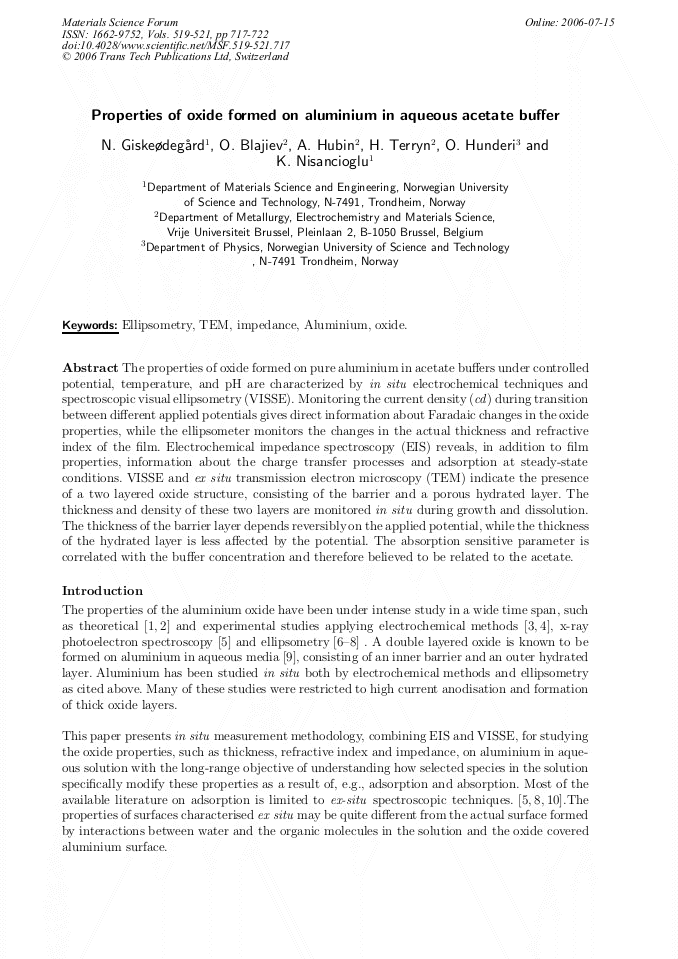
The properties of oxide formed on pure aluminium in acetate buffers under controlled potential, temperature, and pH are characterized by in situ electrochemical techniques and spectroscopic visual ellipsometry (VISSE). Monitoring the current density (cd) during transition between different applied potentials gives direct information about Faradaic changes in the oxide properties, while the ellipsometer monitors the changes in the actual thickness and refractive index of the film. Electrochemical impedance spectroscopy (EIS) reveals, in addition to film properties, information about the charge transfer processes and adsorption at steady-state conditions. VISSE and ex situ transmission electron microscopy (TEM) indicate the presence of a two layered oxide structure, consisting of the barrier and a porous hydrated layer. The thickness and density of these two layers are monitored in situ during growth and dissolution. The thickness of the barrier layer depends reversibly on the applied potential, while the thickness of the hydrated layer is less affected by the potential. The absorption sensitive parameter is correlated with the buffer concentration and therefore believed to be related to the acetate.
You might also be interested in these eBooks

Info:

Periodical:

Materials Science Forum (Volumes 519-521)

Pages:

717-722

Citation:

Online since:

July 2006

Export:

Price:

Permissions CCC:

Permissions PLS:

Сopyright:

© 2006 Trans Tech Publications Ltd. All Rights Reserved

Share:

Citation:

[1] Macdonald, D. and Urquidi-Macdonald, M. J. Electrochem. Soc. 137, 2395 (1990).

Google Scholar

[2] Vetter, K. J. Electrochim. Acta 16, 1923 (1971).

Google Scholar

[3] de Wit, J. and Lenderink, H. Electrochim. Acta 41, 1111-1119 (1996).

Google Scholar

[4] Valand, T. and Heusler, K. J. Electroanal. Chem. 149, 71-82 (1983).

Google Scholar

[5] Alexander, M. J. Elect. Spect. Rel. Phenom. 121, 19-32 (2001).

Google Scholar

[6] R. K¨otz, Schnyder, B., and C. Barbero. Thin Solid Films , 63 (1993).

Google Scholar

[7] Brevnov, D. A., Rao, G. V. R., Lopez, G., and Atanassov, P. B. Electrochim. Acta 49, 2487 (2004).

Google Scholar

[8] Gils, S. V., Melendres, C., and Terryn, H. Surf. Interface. Anal. 35, 387-394 (2003).

Google Scholar

[9] Takahashi, H. and Nagayama, M. Electrochim. Acta 23, 279 (1978).

Google Scholar

[10] van den Brand, J., Gils, S. V., Beentjes, P., Terryn, H., and de Wit, J. Appl. Surf. Sci. 235, 465-474 (2004).

DOI: 10.1016/j.apsusc.2004.05.002

Google Scholar

[11] Saevik, O., Yu, Y., Nordlien, J., and Nisancioglu, K. J. Electrochem. Soc. 152, B334-B341 (2005).

Google Scholar

[12] Palik, E. Academic Press, Boston (1991).

Google Scholar

[13] Azzam, R. and Bashara, N. North Holland, Amsterdam (1989).

Google Scholar

[14] Bai, L. and Conway, B. Electrochim. Acta 38, 1803-1815 (1993).

Google Scholar

[15] Macdonald, D. and Smedly, S. Electrochim. Acta 35, 1949-1956 (1990). This article was processed using the LATEX macro package with TTP style.

Google Scholar