p.202
p.209
p.215
p.223
p.232
p.239
p.245
p.252
p.257
Design of Moving Components of an Ultra Precision Machine Tool for Nanometric Machining

Abstract:
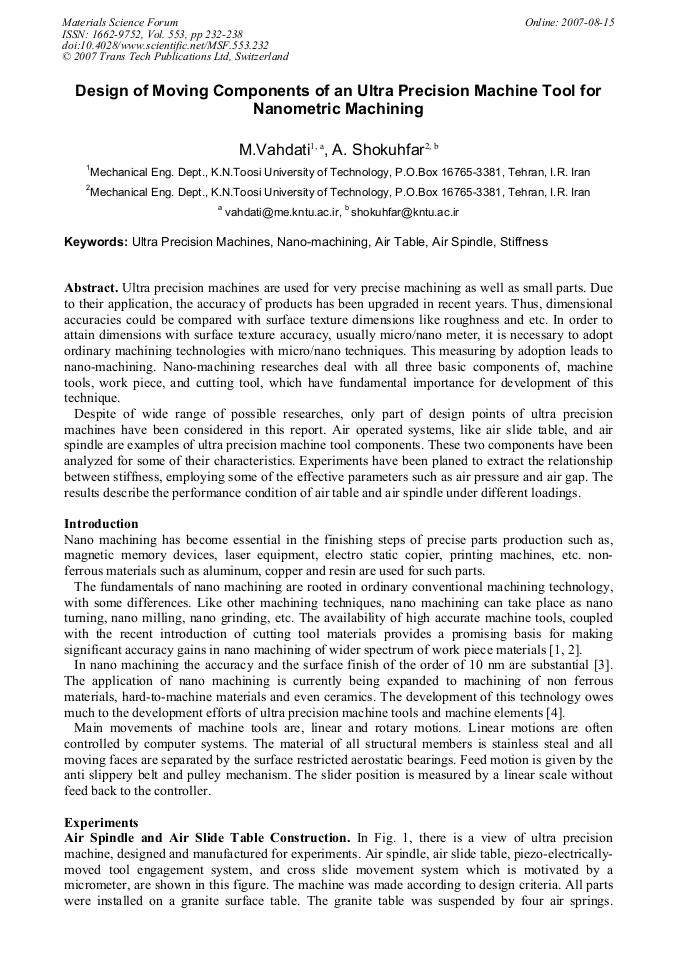
Ultra precision machines are used for very precise machining as well as small parts. Due to their application, the accuracy of products has been upgraded in recent years. Thus, dimensional accuracies could be compared with surface texture dimensions like roughness and etc. In order to attain dimensions with surface texture accuracy, usually micro/nano meter, it is necessary to adopt ordinary machining technologies with micro/nano techniques. This measuring by adoption leads to nano-machining. Nano-machining researches deal with all three basic components of, machine tools, work piece, and cutting tool, which have fundamental importance for development of this technique. Despite of wide range of possible researches, only part of design points of ultra precision machines have been considered in this report. Air operated systems, like air slide table, and air spindle are examples of ultra precision machine tool components. These two components have been analyzed for some of their characteristics. Experiments have been planed to extract the relationship between stiffness, employing some of the effective parameters such as air pressure and air gap. The results describe the performance condition of air table and air spindle under different loadings.
Info:
Periodical:
Pages:
232-238
DOI:
Citation:
Online since:
August 2007
Authors:
Keywords:
Price:
Сopyright:
© 2007 Trans Tech Publications Ltd. All Rights Reserved
Share:
Citation: