Comparative Study of Optical Silicon Nanomachining Experimental Results and MD Simulation Outputs

Article Preview

Abstract:

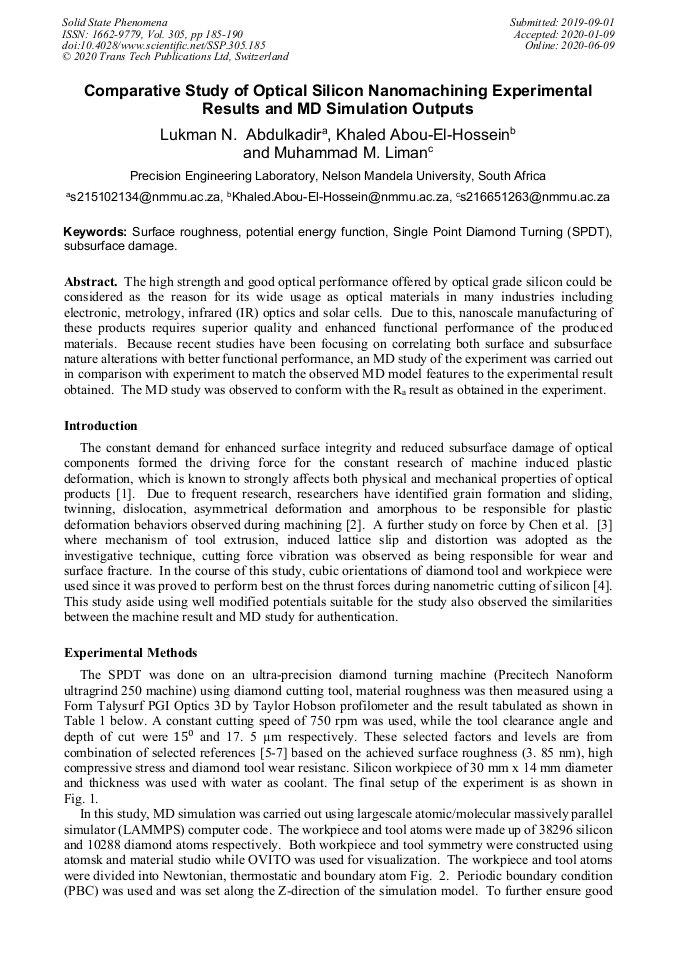
The high strength and good optical performance offered by optical grade silicon could be considered as the reason for its wide usage as optical materials in many industries including electronic, metrology, infrared (IR) optics and solar cells. Due to this, nanoscale manufacturing of these products requires superior quality and enhanced functional performance of the produced materials. Because recent studies have been focusing on correlating both surface and subsurface nature alterations with better functional performance, an MD study of the experiment was carried out in comparison with experiment to match the observed MD model features to the experimental result obtained. The MD study was observed to conform with the Ra result as obtained in the experiment.
You might also be interested in these eBooks

Info:

Periodical:

Solid State Phenomena (Volume 305)

Pages:

185-190

Citation:

Online since:

June 2020

Export:

Price:

Permissions CCC:

Permissions PLS:

Сopyright:

© 2020 Trans Tech Publications Ltd. All Rights Reserved

Share:

Citation:

* - Corresponding Author

[1] Abdulkadir L. N., Abou-El-Hossein K., Jumare A. I., Odedeyi P. B., Liman M. M., Olaniyan T. A.: The International Journal of Advanced Manufacturing Technology Vol. 96 (2018), pp.173-208.

DOI: 10.1007/s00170-017-1529-x

Google Scholar

[2] Abdulkadir L. N., Abou-El-Hossein K., Jumare A. I., Liman M. M., Olaniyan T. A., Odedeyi P. B.: The International Journal of Advanced Manufacturing Technology Vol. 98 (2018), pp.317-71.

DOI: 10.1007/s00170-018-2041-7

Google Scholar

[3] Chen Y., Fang F., Zhang X., Hu X.: American Journal of Nanotechnology Vol. 1 (2010), pp.62-7.

Google Scholar

[4] Goel S.: An atomistic investigation on the nanometric cutting mechanism of hard, brittle materials. Mechanical Engineering. Engineering and Physical Sciences, Heriot-Watt University: Heriot-Watt University, (2013).

DOI: 10.31256/nc9mp9n

Google Scholar

[5] Abdulkadir L. N. , Abou-El-Hossein K. : The International Journal of Advanced Manufacturing Technology Vol. (2018), pp.1-17.

Google Scholar

[6] Ayomoh M., Abou-El-Hossein K.: Surface finish in ultra-precision diamond turning of single-crystal silicon. Optifab 2015: International Society for Optics and Photonics, 2015. p. 96331I.

DOI: 10.1117/12.2194433

Google Scholar

[7] Tauhiduzzaman M., Veldhuis S. C.: Precision Engineering Vol. 38 (2014), pp.481-91.

Google Scholar

[8] Goel S., Kovalchenko A., Stukowski A., Cross G.: Acta Materialia Vol. 105 (2016), pp.464-78.

Google Scholar

[9] Kumagai T., Izumi S., Hara S., Sakai S.: Computational materials science Vol. 39 (2007), pp.457-64.

Google Scholar

[10] Han X., Lin B. , Yu S., Wang S.: Journal of materials processing technology Vol. 129 (2002), pp.105-8.

Google Scholar

[11] Guo X. , Li Q. , Liu T. , Kang R. , Jin Z. , Guo D. : Frontiers of Mechanical Engineering Vol. 12 (2017), pp.89-98.

Google Scholar

[12] Cui D. -D., Zhang L. -C.: Advances in Manufacturing Vol. 5 (2017), pp.20-34.

Google Scholar

[13] Mukaida M., Yan J.: International Journal of Machine Tools and Manufacture Vol. 115 (2017), pp.2-14.

Google Scholar