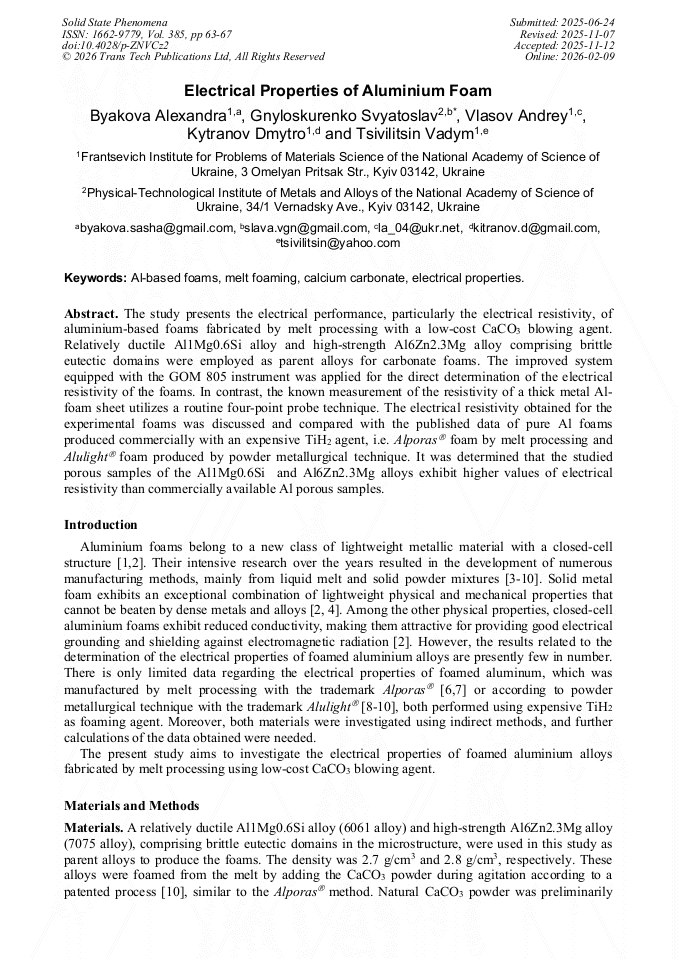
Electrical Properties of Aluminium Foam

Article Preview

Abstract:

The study presents electrical performance metrics, especially, electrical resistivity, of aluminium based foams. They were fabricated by melt processing with cheap CaCO3 blowing agent and compared to those produced commercially with an expensive TiH2. Relatively ductile Al1Mg0.6Si alloy and high strength Al6Zn2.3Mg alloy comprising brittle eutectic domains were employed as matrix alloys for carbonate foams manufacture, whereas only aluminium was used for production of hydride foams. The important difference concerns test method procedure employed for measuring the electrical properties of the foams. The novel system equipped by novel instrument GOM 805 was developed and used for direct determination of electrical resistivity of the foams. In contrast, the known measurement of a thick metal foam sheet resistivity concerns a routine four-point probe technique. The specific electrical resistivity obtained for the experimental foams was compared and discussed with the published data of the foams manufactured by melt processing with TiH2 of trade name AlporasÒ and prepared by powder metallurgical technique with trade mark AlulightÒ.It was established after comparative study that the present porous samples exhibit higher values of specific electrical resistivity then available in the market that may provide wider engineering application of the studied foams.
You might also be interested in these eBooks

Info:

Periodical:

Solid State Phenomena (Volume 385)

Pages:

63-67

Citation:

Online since:

February 2026

Export:

Price:

Permissions CCC:

Permissions PLS:

Сopyright:

© 2026 Trans Tech Publications Ltd. All Rights Reserved

Share:

Citation:

* - Corresponding Author

[1] J. Banhart, Manufacture, characterisation and application of cellular metals and metal foams, Progress in materials science. 46 (6) (2001) 559-632.

DOI: 10.1016/s0079-6425(00)00002-5

Google Scholar

[2] M.F. Ashby, A.G. Evans, N.A. Fleck et al., Metal Foams: A Design Guide, Butterworth Heinemann, Boston, USA, 2000.

Google Scholar

[3] L.P. Lefebvre, J. Banhart, D.C. Dunand, Porous metals and metallic foams: Current status and recent developments. Adv. Eng. Mater. 10 (2008) 775–787.

DOI: 10.1002/adem.200800241

Google Scholar

[4] L.J. Gibson. Metallic Foams: Structure, Properties, and Applications. In: Aref, H., Phillips, J.W. (eds) Mechanics for a New Mellennium. Springer, 2001.

Google Scholar

[5] Yu. Milman, A. Byakova, A. Sirko, S. Gnyloskurenko, T. Nakamura. Improvement of structure and deformation behaviour of high strength Al-Zn-Mg foam. Materials Science Forum. 519-521 (2006) 573–578.

DOI: 10.4028/www.scientific.net/msf.519-521.573

Google Scholar

[6] S. Akiyama, H. Ueno, K. Imagawa, A. Kitahara, S. Nagata, K. Morimoto, T. Nishikawa, M. Itoh, Foamed metal and method of producing same, USA Patent 4,713,277, 1987 (1986).

Google Scholar

[7] S. Akiyama, H. Ueno, K. Imagawa, A. Kitahara, S. Nagata, K. Morimoto, T. Nishikawa, M. Itoh, Foamed metal and method of producing same, European Patent 0 210 803, 1989 (1986).

Google Scholar

[8] P. Schaeffler. W. Rajner, D. Claar, et al. Production, Properties, and Applications of Alulight® Closed-Cell Aluminum Foams, Proceedings of the Fifth International Workshop on Advanced Manufacturing Technologies, 16-18 May 2005. London, Canada, 2005.

Google Scholar

[9] P. Schäffler, G. Hanko, H. Mitterer, P. Zach, Alulight Metal Foam Products. In Proceedings of the Porous Metals and Metallic Foams: Metfoam, Kyoto, Japan, 5–7 September 2007. L.P. Lefebvre, J. Banhart, D.C. Dunand, Eds. The Japan Institute of Metals: Kyoto, Japan, 2008, 7–10.

Google Scholar

[10] P. Schaeffler, Production, Properties, and Applications of Alulight® Closed-Cell Aluminum Foams. P. Schaeffler, W. Rajner, D. Claar, T. et al. Proceedings of the Fifth International Workshop on Advanced Manufacturing Technologies, 16-18 May 2005. London, Canada, 2005.

Google Scholar

[11] A. Byakova, A. Vlasov, S. Gnyloskurenko, N. Semenov. Method of producing foamed ingot from aluminium and aluminium alloys. UA Patent 127491 (2023).

Google Scholar