Hybrid Genetic Simulated Annealing Algorithm with its Application in Vehicle Routing Problem with Time Windows

Article Preview

Abstract:

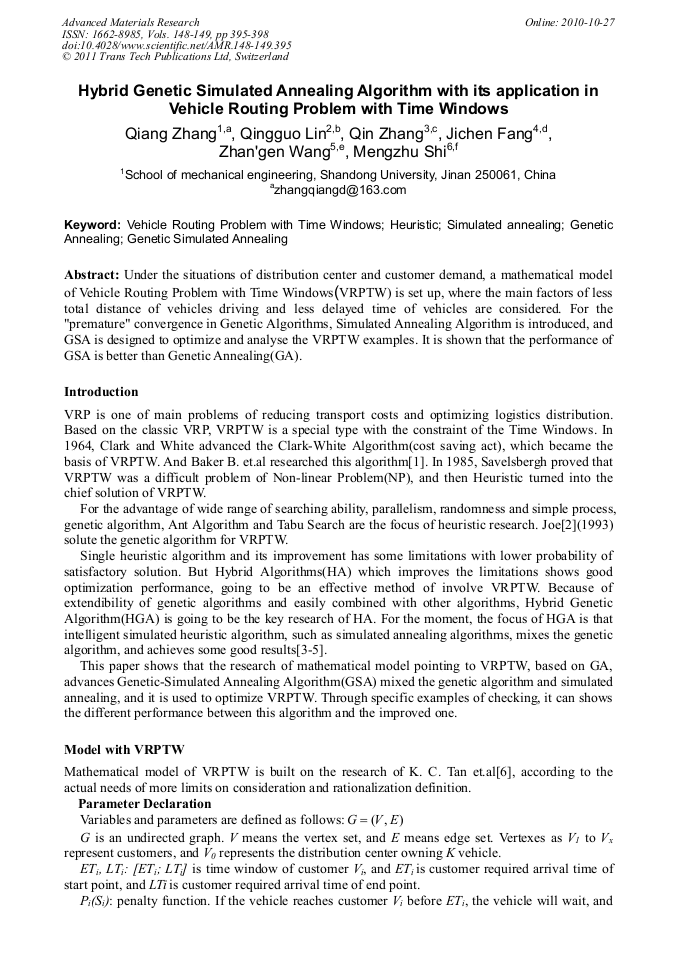
Under the situations of distribution center and customer demand, a mathematical model of Vehicle Routing Problem with Time Windows(VRPTW) is set up, where the main factors of less total distance of vehicles driving and less delayed time of vehicles are considered. For the "premature" convergence in Genetic Algorithms, Simulated Annealing Algorithm is introduced, and GSA is designed to optimize and analyse the VRPTW examples. It is shown that the performance of GSA is better than Genetic Annealing(GA).
You might also be interested in these eBooks

Info:

Periodical:

Advanced Materials Research (Volumes 148-149)

Pages:

395-398

Citation:

Online since:

October 2010

Export:

Price:

Permissions CCC:

Permissions PLS:

Сopyright:

© 2011 Trans Tech Publications Ltd. All Rights Reserved

Share:

Citation:

[1] B. Baker, A. Yechew, in: A Genetic Algorithm for the Vehicle Routing Problem[J] in: Computers Operations Research. (2003), pp.787-800.

DOI: 10.1016/s0305-0548(02)00051-5

Google Scholar

[2] L. Joe, L. Roger, in: Multiple Vehicle Routing with Time and Capacity Constrains Using Genetic Algorithms [A] in: Proceedings of the Fifth International Conference on Genetic Algorithms. (1993), pp.452-459.

Google Scholar

[3] Y.D. Yang, M.X. Lang, and S.J. Hu, in: Model with VRPTW and Improved Simulated Annealing Algorithm in Management Engineering. (2006), pp.104-107.

Google Scholar

[4] J. Berger, M. Barkaoui in: A Parallel Hybrid Genetic Algorithm for the Vehicle Routing Problem with Time Windows in: Working Paper. (2001).

Google Scholar

[5] O. Braysy, J. Berger in: A new hybrid evolutionary algorithm for the vehicle routing problem with time windows[Z] in: Route 2000 Workshop. (2000).

Google Scholar

[6] K. C. Tan, Y. H. Chew, L. H. Lee, in: A Hybrid Multiobjective Evolutionary Algorithm for Solving Vehicle Routing Problem with Time Windows[J] in: Computational Optimization and Applications. (2006), pp.115-151.

DOI: 10.1007/s10589-005-3070-3

Google Scholar