The Thermo-Mechanics Coupled Model of Polycrystalline Aggregates Based on Plastic Slip System in Crystals and their Interfaces

Article Preview

Abstract:

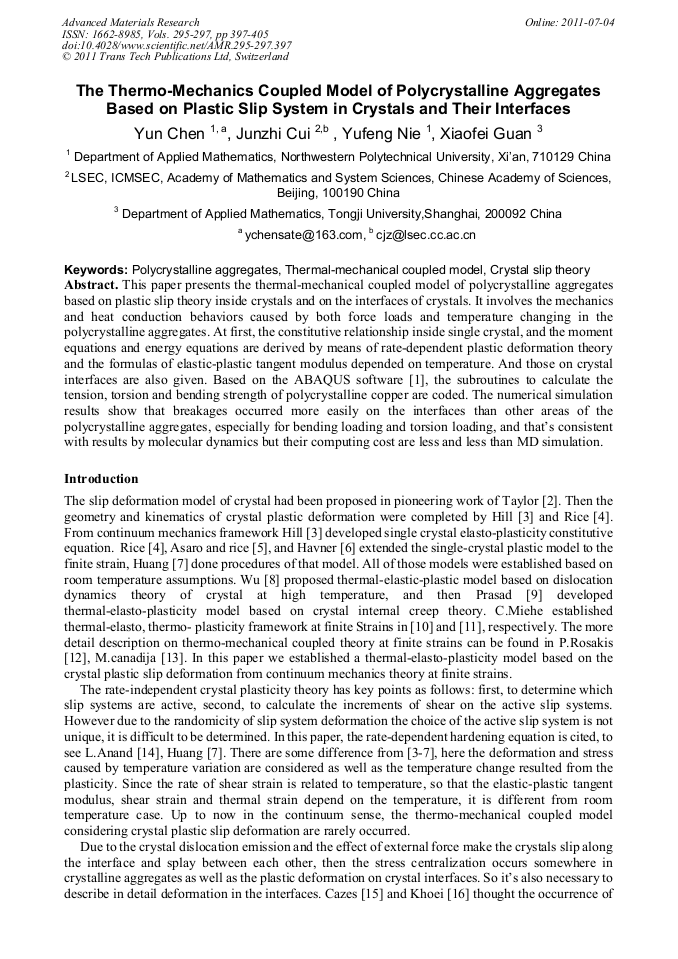
This paper presents the thermal-mechanical coupled model of polycrystalline aggregates based on plastic slip theory inside crystals and on the interfaces of crystals. It involves the mechanics and heat conduction behaviors caused by both force loads and temperature changing in the polycrystalline aggregates. At first, the constitutive relationship inside single crystal, and the moment equations and energy equations are derived by means of rate-dependent plastic deformation theory and the formulas of elastic-plastic tangent modulus depended on temperature. And those on crystal interfaces are also given. Based on the ABAQUS software [1], the subroutines to calculate the tension, torsion and bending strength of polycrystalline copper are coded. The numerical simulation results show that breakages occurred more easily on the interfaces than other areas of the polycrystalline aggregates, especially for bending loading and torsion loading, and that’s consistent with results by molecular dynamics but their computing cost are less and less than MD simulation.
You might also be interested in these eBooks

Info:

Periodical:

Advanced Materials Research (Volumes 295-297)

Pages:

397-405

Citation:

Online since:

July 2011

Export:

Price:

Permissions CCC:

Permissions PLS:

Сopyright:

© 2011 Trans Tech Publications Ltd. All Rights Reserved

Share:

Citation:

[1] ABAQUS Reference Manuals.

Google Scholar

[2] Taylor. G.I: J.Institute of Metals 62,307-324. (1938)

Google Scholar

[3] Hill. R: J.Mech.Phys.Solids 14, 95-102.(1966)

Google Scholar

[4] Rice. J.R: J.Mech.Phys.Solids 19, 433-455.(1971)

Google Scholar

[5] Asaro. R.J: J.Mech. Phys. Solids 25,309-338. (1977)

Google Scholar

[6] Havner. K.S: Finite Plastic deformation of crystalline solids, Cambridge University Press (1992)

Google Scholar

[7] Y.G. Huang: A user-material subroutine incorporating single crystal plasticity in the abaqus finite element program,Mech,178 (1991)

Google Scholar

[8] Y.Q. Wu, in: Sci China Ser G 39(9),1195-1203.(2009)

Google Scholar

[9] Sharat Chand Prasad: Constitutive modeling of creep of single crystal superalloys(2005)

Google Scholar

[10] C. Miehe: Comput.Methods Appl.Mech.Engrg120, 243-269.(1995)

Google Scholar

[11] J.C. Simo and C. Miehe: comput. Methods app.Mech.Engrg 98, 41-104.(1992)

Google Scholar

[12] P. Rosakis and A.J. Rosakis: J.Mech.Phys.Solids 48, 581-607.(2000)

Google Scholar

[13] M. Canadija and J. Brni: Int.J. Plas 20,1851–1874.( 2004)

Google Scholar

[14] L.Anand and M. Kothari: J.Mech.Phys.Solids 44(4),528-558.(1995)

Google Scholar

[15] F. Cazes and M. Coret: Int. J. of Solids and Structures 46,1476-1490.(2009)

Google Scholar

[16] A.R. Khoei and S.O.R. Biabanaki : Int. J. of Solids and Structures 46,287-310.(2009)

Google Scholar

[17] X.F. Guan and J.Z. Cui, in: A elasto-plasticity model and computational method for dynamic thermo-mechanical coupled multi-scale Analysis (2009)

Google Scholar

[18] J.D. Clayton: J. Mech.and Physics of solids 53,261-301.(2005).

Google Scholar

[19] L. Anand and M.E. Gurtin: Journal of the Mechanics and Physics of Solids 51,1015-1058.(2003)

Google Scholar

[20] Rosakis. P: J.Mech. Phys. Solids 581–607. (2000)

Google Scholar

[21] T.A. Laursen: Computational Contact and Impact Mechnaics ,Duke university,USA(2005)

Google Scholar

[22] L. Adam and J.P. Ponthot: International Journal of Solids and Structures 42,5615-5655.(2005)

Google Scholar

[23] Belytschko T., W.K. Liu and Moran. B:Nonlinear Finite Elements for Continua and Structures, John Wiley and Sons Ltd, London (2000)

Google Scholar

[24] Z.F. Yue, in: Strength design on turbine lamina structure of Ni-based single crystal [M].Beijing: Science publishing company(2008)

Google Scholar

[25] Y.Chen, J.Z. Cui, in: Acta Mechanica Solida Sinica, Accepted ( 2010)

Google Scholar

[26] Hirth J. P and Lothe. J: 2nd edition. New York: John Wiley& Sons (1982)

Google Scholar

[27] Y.J. Wei and L. Anand: J. Mech. Phys. Solids (52),2587-2616.(2004)

Google Scholar

[28] X. Tian, J.Z. Cui: Mode. Simu. Mater. Sci. and Eng , Accepted (2010)

Google Scholar