The Effect of Microstructure on Mechanical Properties and Fatigue Crack Growth Behavior of TC4-DT Alloy

Article Preview

Abstract:

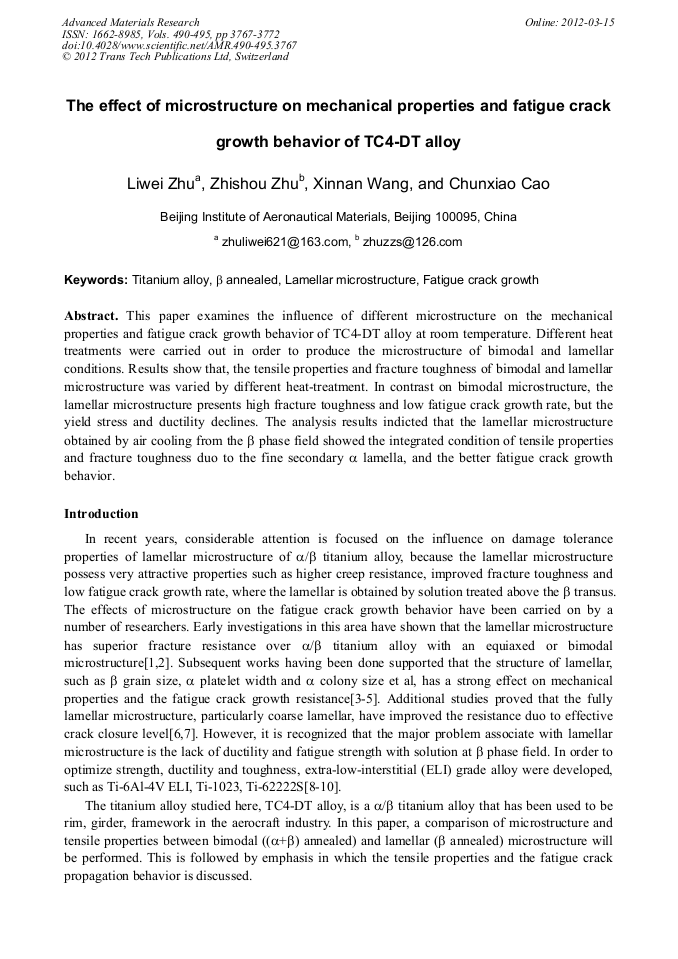
This paper examines the influence of different microstructure on the mechanical properties and fatigue crack growth behavior of TC4-DT alloy at room temperature. Different heat treatments were carried out in order to produce the microstructure of bimodal and lamellar conditions. Results show that, the tensile properties and fracture toughness of bimodal and lamellar microstructure was varied by different heat-treatment. In contrast on bimodal microstructure, the lamellar microstructure presents high fracture toughness and low fatigue crack growth rate, but the yield stress and ductility declines. The analysis results indicted that the lamellar microstructure obtained by air cooling from the  phase field showed the integrated condition of tensile properties and fracture toughness duo to the fine secondary  lamella, and the better fatigue crack growth behavior.
You might also be interested in these eBooks

Info:

Periodical:

Advanced Materials Research (Volumes 490-495)

Pages:

3767-3772

Citation:

Online since:

March 2012

Export:

Price:

Permissions CCC:

Permissions PLS:

Сopyright:

© 2012 Trans Tech Publications Ltd. All Rights Reserved

Share:

Citation:

[1] G.R. Yeder, L.A. Cooley, T.W. Crooker: Engineering Fracture Mechanics Vol. 11(1979), pp.805-816.

Google Scholar

[2] K. Sadananda, A.K. Vasudevan: International Journal of Fatigue Vol. 27 (2005), pp.1255-1266.

Google Scholar

[3] J.O. Peters, G Lutiering, Comparison of the fatigue and fracture of a+b and b titanium alloys. Metal Mater Trans, 2001, 32A: 2805-18.

Google Scholar

[4] Shikai Li, Baiqing Xong, Songxiao Hui: Materials Characterization Vol. 59 (2008), pp.397-401.

Google Scholar

[5] G. Schroeder,J. Albrecht, G. Luetjering: Materials Science and Engineering(2001), pp.602-606.

Google Scholar

[6] R. Filip, K. Kubiak, W. Ziaja: J Mater Process Technol Vol. 9(2003), p.133.

Google Scholar

[7] V. Sinha, W.O. Soboyejo: Materials Science and Engineering (2001), pp.607-612.

Google Scholar

[8] S. Shademan, V. Sinha: Mechanics of Materials Vol. 36(2004), p.161−175.

Google Scholar

[9] H.R. Phelps, J.R. Wood: Titanium' 92: Science and Technology [C]. Edited by Froes F H, Capian I. The Minerals, Metals &Materials Society, 1992. 193-199.

Google Scholar

[10] G. Terlinde H.J. Rathien: Metallurgical Transactions A Vol. 19A(1988), p.1037−1049.

Google Scholar

[11] Lutuerung G., Williams J.C., Titamiun (2nd). Spriger, (2007).

Google Scholar

[12] P.C. Paris, M. Gomez, W.E. Anderson: Trend in Engineering Vol. 13 (1961), pp.9-14.

Google Scholar