The Optimum Design for the New-Typed Auto-Eliminate Backlash Mechanism in Gear Transmission

Article Preview

Abstract:

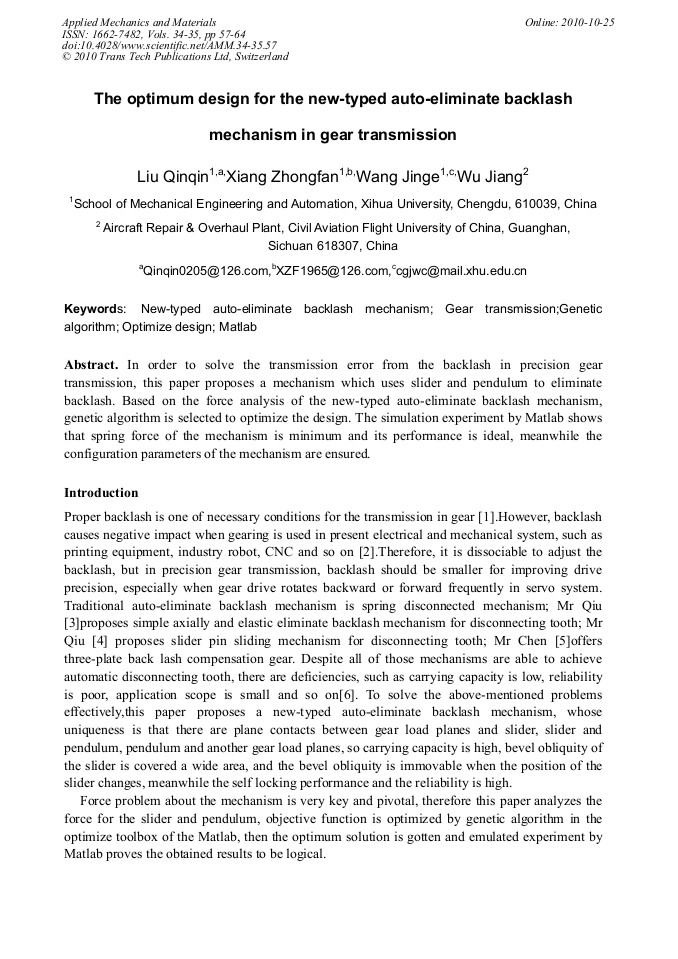
In order to solve the transmission error from the backlash in precision gear transmission, this paper proposes a mechanism which uses slider and pendulum to eliminate backlash. Based on the force analysis of the new-typed auto-eliminate backlash mechanism, genetic algorithm is selected to optimize the design. The simulation experiment by Matlab shows that spring force of the mechanism is minimum and its performance is ideal, meanwhile the configuration parameters of the mechanism are ensured.
You might also be interested in these eBooks

Info:

Periodical:

Pages:

57-64

Citation:

Online since:

October 2010

Export:

Price:

Permissions CCC:

Permissions PLS:

Сopyright:

© 2010 Trans Tech Publications Ltd. All Rights Reserved

Share:

Citation:

[1] Contemporary Mechanical Drive Handbook Editorial Committee, in: Contemporary Mechanical Drive Handbook. edtied by Machine Press, Beijing (2002).

Google Scholar

[2] Hong Lei, in: Meshing Analysis of Non-backlash Double Roller Enveloping Hourglass Worm Gearing, Journal of Xihua University (2008).

DOI: 10.3901/jme.2010.21.006

Google Scholar

[3] Qiu Jinlin, in : A Simple Axis Eliminate Backlash Method, Journal of Hong Zhou Mechanism (2000).

Google Scholar

[4] Qiu Xinqiao, Chen Jianguo, in: The Auto-compensation for the Backlash of Spur Gear, Mechanical Drive (2003).

Google Scholar

[5] Chen Jinggang, Jia Zhenxiu, in: Three-plate Back Lash Compensation Gear, Development & Innovation of machinery & ele-ctri-calproducts (2005).

Google Scholar

[6] Wu Jiang, in: Design & Machining of Non-backlash Double-Roller Enveloping Hourglass Worm Gear,edtied by XiHua University, Chengdu (2009).

Google Scholar

[7] Li Hanxing, Dian Maihong and Sui Mancang, in: The Optimum Design of The Petroleum Machinery Based on GA, Petroleum Machinery (1999).

Google Scholar

[8] Zhao Songping, Tong Jiexin, in: The Modern Design Method, edtied by Machine Press, Beijing (1996).

Google Scholar