Investigation on Fabrication of Glass Fiber Reinforced Polypropylene by Recycled FRTP and their Properties

Article Preview

Abstract:

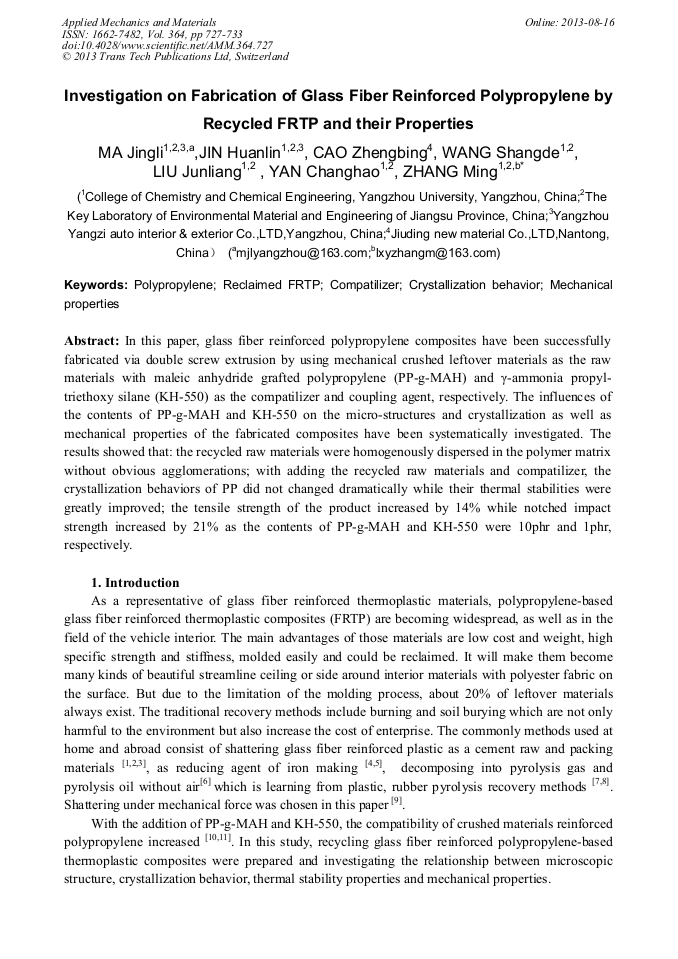
In this paper, glass fiber reinforced polypropylene composites have been successfully fabricated via double screw extrusion by using mechanical crushed leftover materials as the raw materials with maleic anhydride grafted polypropylene (PP-g-MAH) and γ-ammonia propyl-triethoxy silane (KH-550) as the compatilizer and coupling agent, respectively. The influences of the contents of PP-g-MAH and KH-550 on the micro-structures and crystallization as well as mechanical properties of the fabricated composites have been systematically investigated. The results showed that: the recycled raw materials were homogenously dispersed in the polymer matrix without obvious agglomerations; with adding the recycled raw materials and compatilizer, the crystallization behaviors of PP did not changed dramatically while their thermal stabilities were greatly improved; the tensile strength of the product increased by 14% while notched impact strength increased by 21% as the contents of PP-g-MAH and KH-550 were 10phr and 1phr, respectively.
You might also be interested in these eBooks

Info:

Periodical:

Pages:

727-733

Citation:

Online since:

August 2013

Export:

Price:

Permissions CCC:

Permissions PLS:

Сopyright:

© 2013 Trans Tech Publications Ltd. All Rights Reserved

Share:

Citation:

[1] In-Hee Hwang, Katsuya Kawamoto. Survey of carbonization facilities for municipal solid waste treatment in Japan [J]. Waste Management, 2010, 30 (7): 1423-1429.

DOI: 10.1016/j.wasman.2010.01.017

Google Scholar

[2] Li linkai. Recycling and utilization of thermosetting plastics [J]. Foreign plastics, 2004, 22 (6): 69-72.

Google Scholar

[3] J. Broekel,G. Scharr. The specialties of fiber-reinforced plastics in terms of product lifecycle management [J]. Journal of Materials Proeessing Teehnology 162-163(2005): 725-729.

DOI: 10.1016/j.jmatprotec.2005.02.226

Google Scholar

[4] Zhang yuxia. Recycling technology of thermosetting plastics [J]. China plastics, 1997, 5(3): 57-64.

Google Scholar

[5] Wang wenguang, Li jun. Recycling of waste thermosetting plastic[J]. Plastic science and technology, 1993, 5: 50-52.

Google Scholar

[6] H. Brukner, Wuppertal, U, Frank etc. Recycling of PUR-RRIM[J]. Kunststoffe, 1991, 81(9): 751-759.

Google Scholar

[7] George Marsh. Facing up to the recycling challenge [J]. Reinforced Plasties, 2001, (9): 22-26.

Google Scholar

[8] R.J. Ehrig. Plastics Recycling-Products and Processes[M]. New York: Hanser Publishers, (1992).

Google Scholar

[9] Shen zhen, Cheng puhui. Review and outlook of aviation composite technology development[C]. The 11th composite academic conference proceedings. Hefei: China science and technology university publishing,(2000).

Google Scholar

[10] Yu qi, Chen Ping, Lu Chun. Study on development process of interfaces in fiber reinforced composites[J]. Insulation materials, 2005, (2): 50-56.

Google Scholar

[11] Yang bangdong. Study on the Interface Crystallization Morphology of Glass fiber/Polypropylene Composite[D]. Zhengzhou, Zhengzhou university, (2010).

Google Scholar

[12] Li Huaxing. Analysis of glass fiber/PP/PE composite interface crystallization behavior by DSC[J]. Plastics industry, 1990, 3: 41-43.

Google Scholar

[13] Yanqin Shi, Feng Chen, et al. Crystallinity and thermal stability of LDH/polypropylene nanocomposites[J]. Applied Clay Science, 2010, 50: 87-91.

DOI: 10.1016/j.clay.2010.07.007

Google Scholar

[14] Zhang Xiaohong, Liu Yiqun, Gao Jianming, et al. Crystallization behavior of nylon 6 confined among ultrafine vulcanized rubber particles[J]. Polymor, 2004, 45(20): 6959-6925.

DOI: 10.1016/j.polymer.2004.08.012

Google Scholar

[15] Wang Ting. The research on Glass fiber reinforced polyurethane[J]. Chemical technology and development, 2010, 39(2): 18-20.

Google Scholar