Green Manufacturing: A Lever-Wedge Self-Locking Force Amplifying Clamping Device Driven by Linear Motor

Article Preview

Abstract:

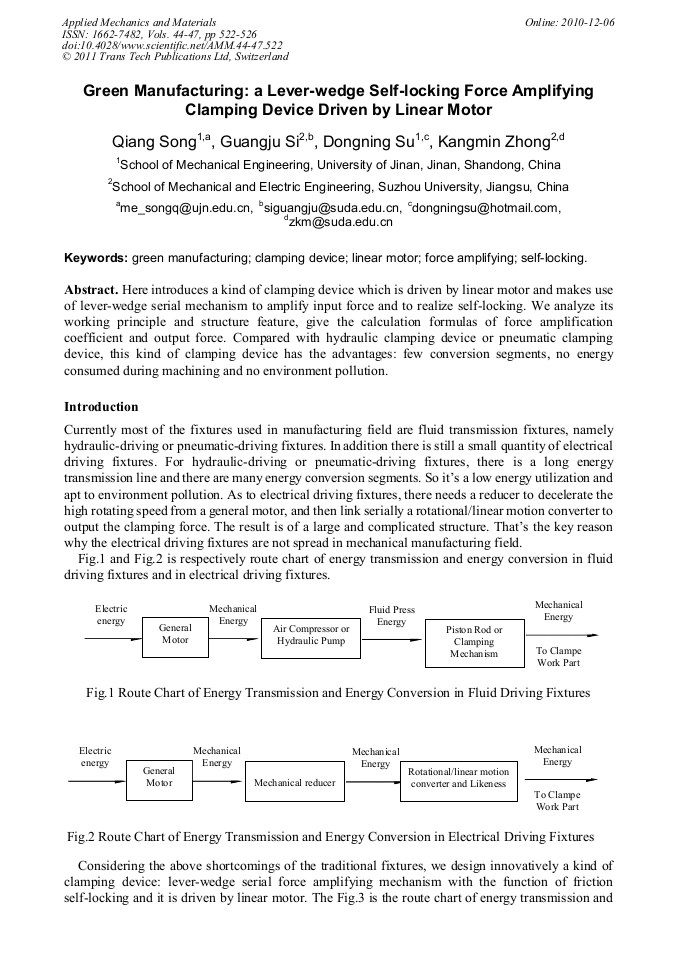
Here introduces a kind of clamping device which is driven by linear motor and makes use of lever-wedge serial mechanism to amplify input force and to realize self-locking. We analyze its working principle and structure feature, give the calculation formulas of force amplification coefficient and output force. Compared with hydraulic clamping device or pneumatic clamping device, this kind of clamping device has the advantages: few conversion segments, no energy consumed during machining and no environment pollution.
You might also be interested in these eBooks

Info:

Periodical:

Pages:

522-526

Citation:

Online since:

December 2010

Export:

Price:

Permissions CCC:

Permissions PLS:

Сopyright:

© 2011 Trans Tech Publications Ltd. All Rights Reserved

Share:

Citation:

[1] X.L. Long: Theory of Linear Motor and Design Method of Electromagnetism (Education Science Publishing House, Beijing 2006).

Google Scholar

[2] J.T. Zhu and J.Q. Qu: Actuator Motor (Machinery Industry Press, Beijing 1997).

Google Scholar

[3] Y.Y. Ye: Theory and Application of Linear Motor (Machinery Industry Press, Beijing 2000).

Google Scholar

[4] Y.Y. Ye: New Type Linear-driving Device and System (China Metallurgical Industry Press, Beijing 2002).

Google Scholar

[5] Q. Bo and K.M. Zhong: Eccentric Clamping Device Driven by Linear Motor.Light Industry Machinery, Vol. 45 (2007), pp.82-84.

Google Scholar

[6] C.F. Sun and K.M. Zhong: A Method of Resolving the Lack of Freedom For Hydraulic Fixture of Toggle-Levers With Rolling High Pair instead of Low Pair, Machine Tool & Hydraulics, Vol. 36( 2008), pp.255-256.

Google Scholar

[7] W.H. Lin and B.T. Chen: Design of Machine Tool (Press of State Defense Industry, Beijing 1987).

Google Scholar

[8] W. wang and K.M. Zhong: Self-locking Gag Based on Cylinder and Double Wedges, Modular Machine Tool & Automatic Manufacturing Technique, Vol. 07 (2006), pp.81-82.

Google Scholar