Research on the Improved Proportional Navigation Guidance Law Using CADET

Article Preview

Abstract:

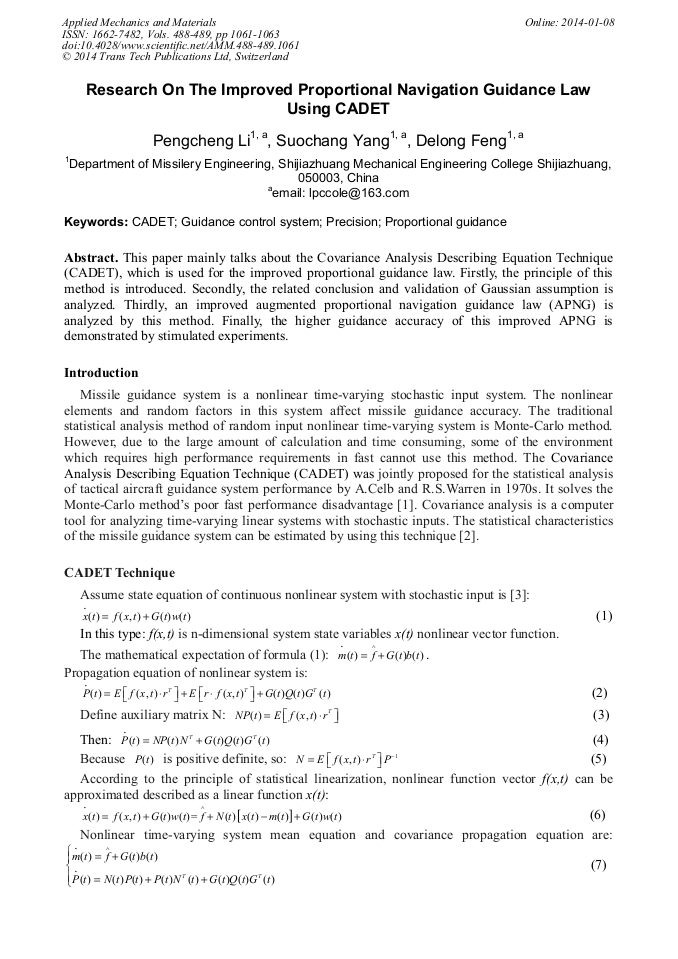
This paper mainly talks about the Covariance Analysis Describing Equation Technique (CADET), which is used for the improved proportional guidance law. Firstly, the principle of this method is introduced. Secondly, the related conclusion and validation of Gaussian assumption is analyzed. Thirdly, an improved augmented proportional navigation guidance law (APNG) is analyzed by this method. Finally, the higher guidance accuracy of this improved APNG is demonstrated by stimulated experiments.

You might also be interested in these eBooks

Info:

Periodical:

Pages:

1061-1063

Citation:

Online since:

January 2014

Export:

Price:

Permissions CCC:

Permissions PLS:

Сopyright:

© 2014 Trans Tech Publications Ltd. All Rights Reserved

Share:

Citation:

* - Corresponding Author

[1] Bi Kaibo, Wang Xiaodong, Liu Zhiping. Vehicle Guidance and Control and Matlab Simulation [M]. Beijing: National Defense Industry Press, 2009, 163-169.

Google Scholar

[2] Guo Qing, Yang Ming, Wang Zicai. Establishment and Simulation of Error Model for Interceptor's Terminal Guidace Phase [J]. Computer Simulation, 2007, 24(3): 58-61.

Google Scholar

[3] Zhou Weiwen, Liang Xiaogeng, Jia Xiaohong. Study on Missile Homing Loop Performance Analysis Methods [J]. Computer Simulation, 2012, 29(8): 45-49.

Google Scholar

[4] N A Shneydor. Missile Guidance and Pursuit [M]. Horwood Pub-lishing, Chichester, (1998).

Google Scholar

[5] Xu Jinxiang. Key Techniques of Terminal Correction Mortar Projectiles [J]. Journal of Beijing Institute of Technology, 2007, 16(2):168-172.

Google Scholar

[6] Froriep R, Joost D. Stocchastic Simulation Using Covarince Techniques: Modular Program Package for Nonlinear Missile Guidance [J]. Journal of Guidance and Control, 1984, 7(4): 509-512.

DOI: 10.2514/3.56373

Google Scholar

[7] Iain Matthews, Takahiro Ishikawa, Simon Baker. The Template Update Problem [C]. IEEE Transactions on Pattern Analysis and Machine Intelligence. 2004, 06(6): 810-815.

DOI: 10.1109/tpami.2004.16

Google Scholar