Traffic Control Strategy Research in Logistics Park

Article Preview

Abstract:

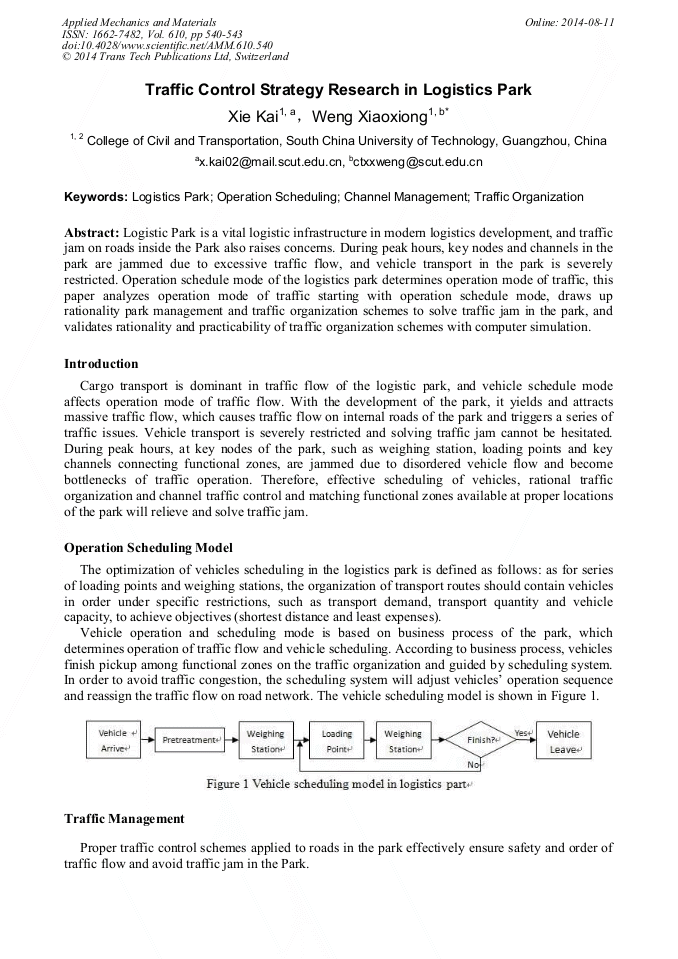
Logistic Park is a vital logistic infrastructure in modern logistics development, and traffic jam on roads inside the Park also raises concerns. During peak hours, key nodes and channels in the park are jammed due to excessive traffic flow, and vehicle transport in the park is severely restricted. Operation schedule mode of the logistics park determines operation mode of traffic, this paper analyzes operation mode of traffic starting with operation schedule mode, draws up rationality park management and traffic organization schemes to solve traffic jam in the park, and validates rationality and practicability of traffic organization schemes with computer simulation.
You might also be interested in these eBooks

Info:

Periodical:

Pages:

540-543

Citation:

Online since:

August 2014

Export:

Price:

Permissions CCC:

Permissions PLS:

Сopyright:

© 2014 Trans Tech Publications Ltd. All Rights Reserved

Share:

Citation:

* - Corresponding Author

[1] Wang Mei, Li Wenquan. Analysis and improvement of traffic organization condition of intersections in old town. [J]. Road Traffic Technique. 2009, 03: 154-157+161.

Google Scholar

[2] Song Yan, Zhou Wei. Traffic Capacity Valuation Method for Muti-phase Intersection. [J]. Transport Science and Technology. 2010, 18: 112-115.

Google Scholar

[3] Xu Jianmin, Traffic management and control [M]. China Communications Press, (2007).

Google Scholar

[4] Ye Yanxian, He Cao, Chen Lijun. Study of traffic jams improvement of intersections in urban areas in Wenjiang based on VISSIM. [J]. Road and Bus Transport. 2012, 02: 56-60.

Google Scholar

[5] Chen Ke. Traffic organization improvement of a de men Station intersection based on VISSIM. [J]. Traffic Standardization. 2011, 23: 161-164.

Google Scholar

[6] Li Chaoyang, Chen Guangyi. Research on the technologies of traffic organization planning for logistics parks. [J]. International Conference on Intelligent Computation Technology and Automation, ICICTA 2008, v 2, pp.438-441, (2008).

DOI: 10.1109/icicta.2008.345

Google Scholar