The Effect of Precipitated Phases on Creep Behavior

Article Preview

Abstract:

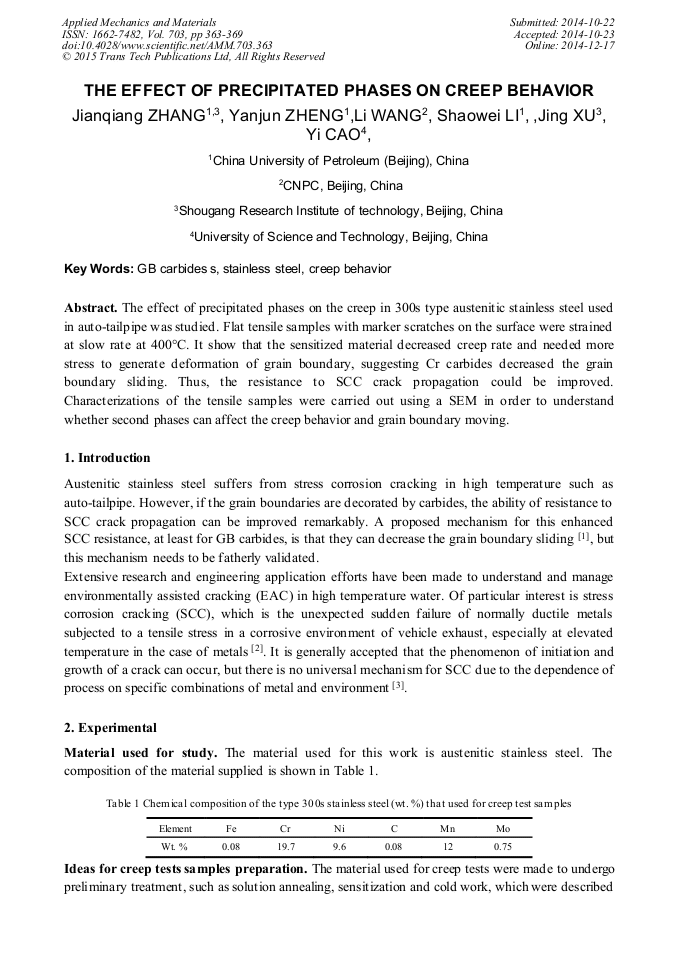
The effect of precipitated phases on the creep in 300s type austenitic stainless steel used in auto-tailpipe was studied. Flat tensile samples with marker scratches on the surface were strained at slow rate at 400°C. It show that the sensitized material decreased creep rate and needed more stress to generate deformation of grain boundary, suggesting Cr carbides decreased the grain boundary sliding. Thus, the resistance to SCC crack propagation could be improved. Characterizations of the tensile samples were carried out using a SEM in order to understand whether second phases can affect the creep behavior and grain boundary moving.
You might also be interested in these eBooks

Info:

Periodical:

Pages:

363-369

Citation:

Online since:

December 2014

Export:

Price:

Permissions CCC:

Permissions PLS:

Сopyright:

© 2015 Trans Tech Publications Ltd. All Rights Reserved

Share:

Citation:

* - Corresponding Author

[1] Arioka, K., et al., Intergranular Stress Corrosion Cracking Behavior of Austenitic Stainless Steels in Hydrogenated High Temperature Water. Corrosion, 2006. 61(01): pp.74-83.

DOI: 10.5006/1.3278254

Google Scholar

[2] Engelberg, D. L. Humphreys, F. J. and Marrow, T. J. The influence of low-strain thermo-mechanical processing on grain boundary network characteristics in type 304 austenitic stainless steel. School of Materials, the University of Manchester, Manchester M1 7HS, United Kingdom. Journal of Microscopy, Vol. 230, Pt 3 2008, p.435.

DOI: 10.1111/j.1365-2818.2008.02003.x

Google Scholar

[3] Sotoudeh, K. Diffusion creep and superplasticity in aluminum alloys. School of Materials. The University of Manchester, Grosvenor Street, Manchester M1 7HS, UK. (2009).

Google Scholar

[4] Tavares, S.S.M. Cindrafonseca, M.P. Influence of the starting condition on the kinetics of sensitization and loss of toughness in AISI 304 steel. Universidade Federal Fluminense Journal of Materials Science 38 (2003) 3527-3533.

Google Scholar