p.4091
p.4095
p.4099
p.4103
p.4109
p.4115
p.4120
p.4124
p.4129
Research on Interchange Ramp Circular Curve Radius Based on Land-Saving Method

Abstract:
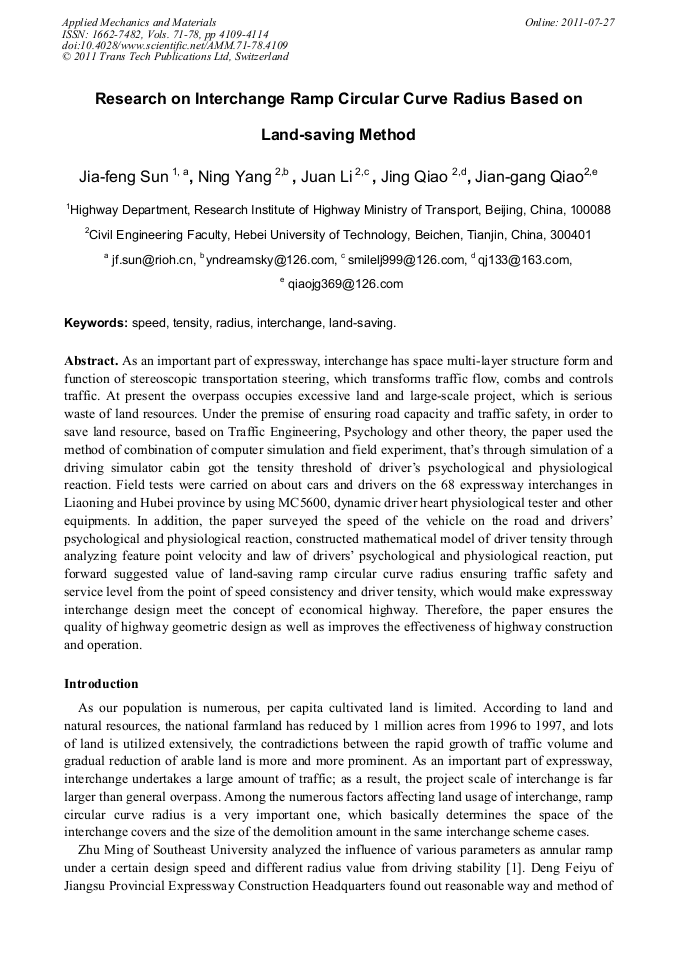
As an important part of expressway, interchange has space multi-layer structure form and function of stereoscopic transportation steering, which transforms traffic flow, combs and controls traffic. At present the overpass occupies excessive land and large-scale project, which is serious waste of land resources. Under the premise of ensuring road capacity and traffic safety, in order to save land resource, based on Traffic Engineering, Psychology and other theory, the paper used the method of combination of computer simulation and field experiment, that’s through simulation of a driving simulator cabin got the tensity threshold of driver’s psychological and physiological reaction. Field tests were carried on about cars and drivers on the 68 expressway interchanges in Liaoning and Hubei province by using MC5600, dynamic driver heart physiological tester and other equipments. In addition, the paper surveyed the speed of the vehicle on the road and drivers’ psychological and physiological reaction, constructed mathematical model of driver tensity through analyzing feature point velocity and law of drivers’ psychological and physiological reaction, put forward suggested value of land-saving ramp circular curve radius ensuring traffic safety and service level from the point of speed consistency and driver tensity, which would make expressway interchange design meet the concept of economical highway. Therefore, the paper ensures the quality of highway geometric design as well as improves the effectiveness of highway construction and operation.
Info:
Periodical:
Pages:
4109-4114
Citation:
Online since:
July 2011
Authors:
Keywords:
Price:
Сopyright:
© 2011 Trans Tech Publications Ltd. All Rights Reserved
Share:
Citation: