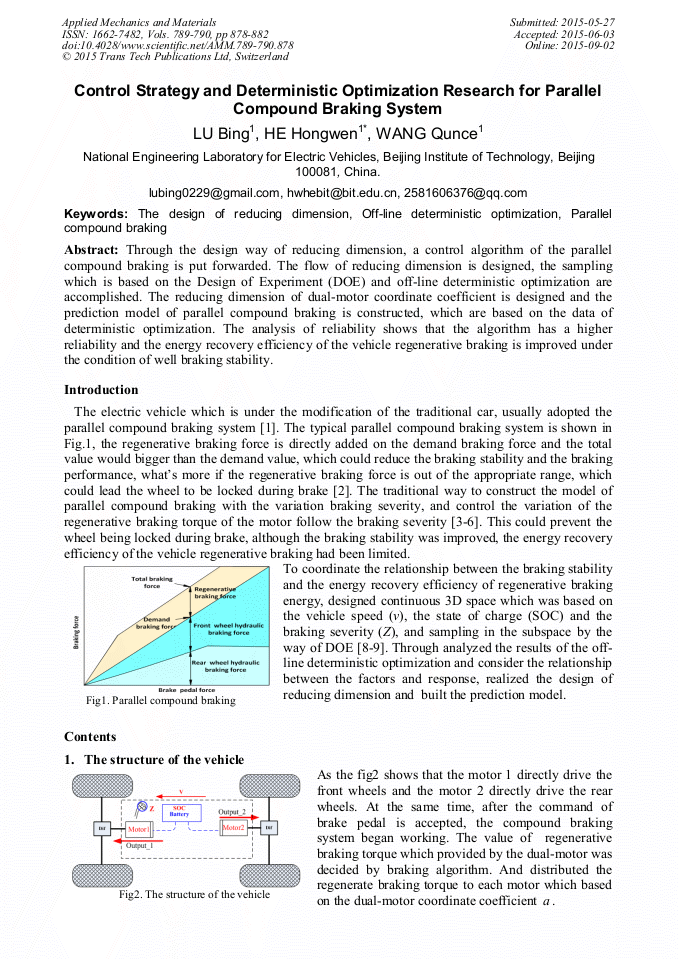
Control Strategy and Deterministic Optimization Research for Parallel Compound Braking System

Article Preview

Abstract:

Through the design way of reducing dimension, a control algorithm of the parallel compound braking is put forwarded. The flow of reducing dimension is designed, the sampling which is based on the Design of Experiment (DOE) and off-line deterministic optimization are accomplished. The reducing dimension of dual-motor coordinate coefficient is designed and the prediction model of parallel compound braking is constructed, which are based on the data of deterministic optimization. The analysis of reliability shows that the algorithm has a higher reliability and the energy recovery efficiency of the vehicle regenerative braking is improved under the condition of well braking stability.
You might also be interested in these eBooks

Info:

Periodical:

Pages:

878-882

Citation:

Online since:

September 2015

Export:

Price:

Permissions CCC:

Permissions PLS:

Сopyright:

© 2015 Trans Tech Publications Ltd. All Rights Reserved

Share:

Citation:

* - Corresponding Author

[1] ZHANG Peng, Reseach and realization of regenerative brake system for electric vehicle, [D], Harbin Institute of Technology, (2012).

Google Scholar

[2] Gao Yimin, Chen Liping, Ehsani Mehrdad. Investigation of the Effectiveness of Regenerative Braking for EV and HEV. Future Transportation Technology Conference & Exposition , (2002).

Google Scholar

[3] LI Dawei. The Control Strategy Study on in-wheel Motor driving system an braking-energy recovery of electric vehicle, [D]. Chongqing University of Technology, (2012).

Google Scholar

[4] Huang wan-you, Cheng yong, Cao hong. Energy feedback efficiency characteristics test and analysis of pure electric vehicle [J]. Chinese Journal of Mechanical Engineering, 2012, 48(12): 88-95.

Google Scholar

[5] Shu hong, Qing da-tong, Hu ming-hui, etc. The strategy of regenerative braking energy management for light-hybrid electric vehicle [J]. Chinese Journal of Mechanical Engineering, 2009, 45(1): 167-173.

DOI: 10.3901/jme.2009.01.167

Google Scholar

[6] Hellgren J, Jonasson E. Maximisation of brake energy regeneration in a hybrid electric parallel car[J]. International Journal of Electric and Hybrid Vehicles, 2007, 1(1): 95-121.

DOI: 10.1504/ijehv.2007.014449

Google Scholar

[7] GUO Hong-qiang, HE Hong-wen, LU Bing. Predictive model for cooperative braking system of electric vehicle, [J], the Report of Jilin University of Technology.

Google Scholar

[8] Park J S. Optimal Latin-hypercube designs for computer experiments [J]. Journal of statistical planning and inference, 1994, 39(1): 95-111.

DOI: 10.1016/0378-3758(94)90115-5

Google Scholar

[9] Guo jin-gang, Wang jun-ping, Cao bin-gang. Optimization Based Braking Force Distribution for Electric Vehicles [J]. Mechanical Science and Technology for Aerospace Engineering, 2011, 30(9): 1495-1499.

Google Scholar