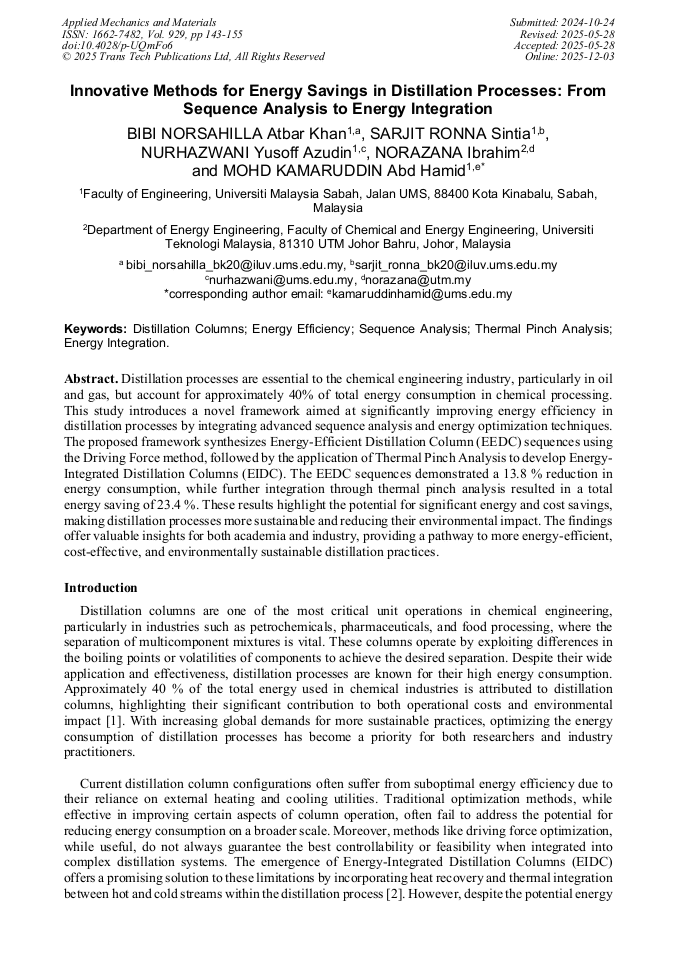
Innovative Methods for Energy Savings in Distillation Processes: From Sequence Analysis to Energy Integration

Article Preview

Abstract:

Distillation processes are essential to the chemical engineering industry, particularly in oil and gas, but account for approximately 40 % of total energy consumption in chemical processing. This study introduces a novel framework aimed at significantly improving energy efficiency in distillation processes by integrating advanced sequence analysis and energy optimization techniques. The proposed framework synthesizes Energy-Efficient Distillation Column (EEDC) sequences using the Driving Force method, followed by the application of Thermal Pinch Analysis to develop Energy-Integrated Distillation Columns (EIDC). The EEDC sequences demonstrated a 13.8 % reduction in energy consumption, while further integration through thermal pinch analysis resulted in a total energy saving of 23.4 %. These results highlight the potential for significant energy and cost savings, making distillation processes more sustainable and reducing their environmental impact. The findings offer valuable insights for both academia and industry, providing a pathway to more energy-efficient, cost-effective, and environmentally sustainable distillation practices.
You might also be interested in these eBooks

Info:

Periodical:

Pages:

143-155

Citation:

Online since:

December 2025

Export:

Price:

Permissions CCC:

Permissions PLS:

Сopyright:

© 2025 Trans Tech Publications Ltd. All Rights Reserved

Share:

Citation:

* - Corresponding Author

[1] Kiss, A. A. (2013). Advanced distillation technologies: Design, control, and applications. Journal of Chemical Engineering Research and Design, 91(1), 128-144

DOI: 10.1016/j.cherd.2012.08.011

Google Scholar

[2] Smith, R., & Linnhoff, B. (1988). The design of separators in the process industries: A study of energy-saving opportunities. Chemical Engineering Science, 43(2), 179-190

Google Scholar

[3] Mustafa, M. F., Zaine, M. Z., Ibrahim, N., Ibrahim, K. A., & Hamid, M. K. A. (2015). Optimal Synthesis of Energy Efficient Distillation Columns Sequence for Hydrocarbon Mixture Separation Process. Energy Procedia, 75, 1569 – 1574.

DOI: 10.1016/j.egypro.2015.07.352

Google Scholar

[4] Shahruddin, M. Z., Rahimi, A. N., Zubir, M. A., Zahran, M. F. I., Ibrahim, K. A., & Hamid, M. K. A. (2017). Energy Integrated Distillation Column Sequence by Driving Force Method and Pinch Analysis for Five Components Distillation. Energy Procedia, 142, 4085 – 4091.

DOI: 10.1016/j.egypro.2017.12.329

Google Scholar

[5] Olujić, Ž., Jödecke, M., Shilkin, A., Schuch, G., & Kaibel, G. (2009). Equipment improvement trends in distillation. Chemical Engineering and Processing: Process Intensification, 48(6), 1089-1104

DOI: 10.1016/j.cep.2008.09.008

Google Scholar

[6] Li, H., Wang, Y., & Yan, W. (2017). Integration of heat recovery in distillation columns for energy saving. Industrial & Engineering Chemistry Research, 56(47), 14067-14076

Google Scholar

[7] Yoo, H., Binns, M., Jang, M. S., Cho, H., & Kim, J. K. (2016). A design procedure for heat-integrated distillation column sequencing of natural gas liquid fractionation processes. Korean Journal of Chemical Engineering, 33(2), 405-415

DOI: 10.1007/s11814-015-0139-2

Google Scholar

[8] Al-Arfaj, M. A., & Luyben, W. L. (2002). Comparison of alternative control structures for high-purity distillation columns. Industrial & Engineering Chemistry Research, 41(17), 4353-4365

Google Scholar

[9] Shenvi, A., Diwekar, U., & Shastri, Y. (2012). Optimal design of distillation columns using advanced optimization techniques. Computers & Chemical Engineering, 36, 58-68

DOI: 10.1016/j.compchemeng.2011.09.008

Google Scholar

[10] Čuček, L., Pahor, B., & Kravanja, Z. (2015). Synthesis of heat-integrated distillation systems: A review of methods and applications. Energy, 90, 1577-1602

DOI: 10.1016/j.energy.2015.07.026

Google Scholar

[11] Fu, C., Wang, Y., & Luo, M. (2020). Improved energy efficiency in multicomponent distillation processes using hybrid methods. Separation and Purification Technology, 231, 115938

DOI: 10.1016/j.seppur.2019.115938

Google Scholar

[12] Smith, R. (2005). Chemical process design and integration. Wiley & Sons. ISBN: 978-0471486817.

Google Scholar

[13] Olujić, Ž., & Dejanović, I. (2017). Distillation: Energy efficiency improvements and process intensification opportunities. Current Opinion in Chemical Engineering, 17, 16-22

DOI: 10.1016/j.coche.2017.06.003

Google Scholar