p.67
p.81
p.87
p.93
p.105
p.119
p.131
p.143
p.155
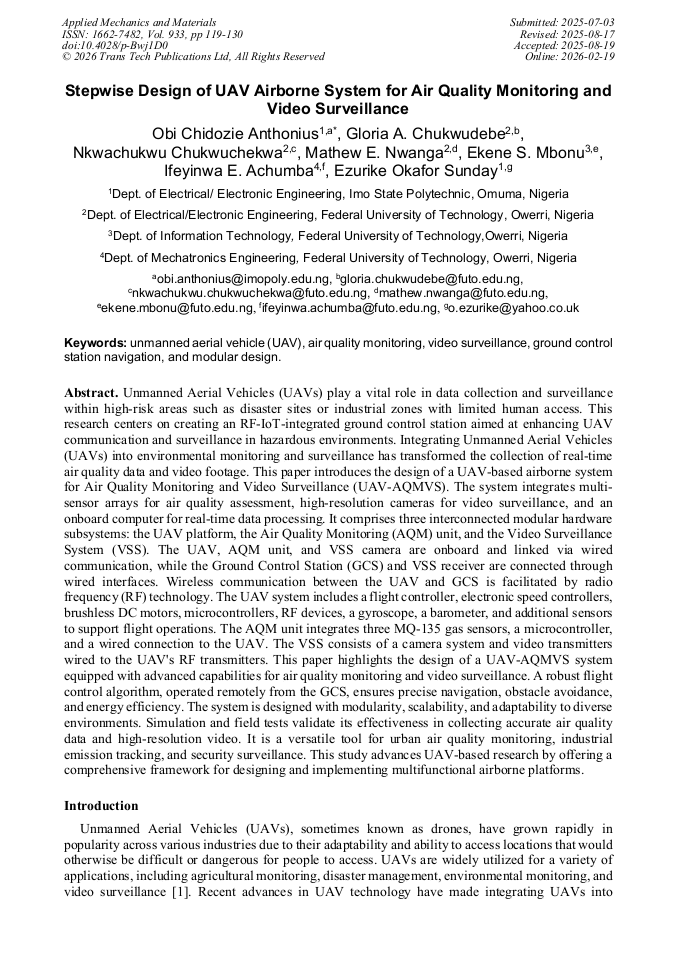
Stepwise Design of UAV Airborne System for Air Quality Monitoring and Video Surveillance

Abstract:
Unmanned Aerial Vehicles (UAVs) play a vital role in data collection and surveillance within high-risk areas such as disaster sites or industrial zones with limited human access. This research centers on creating an RF-IoT-integrated ground control station aimed at enhancing UAV communication and surveillance in hazardous environments. Integrating Unmanned Aerial Vehicles (UAVs) into environmental monitoring and surveillance has transformed the collection of real-time air quality data and video footage. This paper introduces the design of a UAV-based airborne system for Air Quality Monitoring and Video Surveillance (UAV-AQMVS). The system integrates multi-sensor arrays for air quality assessment, high-resolution cameras for video surveillance, and an onboard computer for real-time data processing. It comprises three interconnected modular hardware subsystems: the UAV platform, the Air Quality Monitoring (AQM) unit, and the Video Surveillance System (VSS). The UAV, AQM unit, and VSS camera are onboard and linked via wired communication, while the Ground Control Station (GCS) and VSS receiver are connected through wired interfaces. Wireless communication between the UAV and GCS is facilitated by radio frequency (RF) technology. The UAV system includes a flight controller, electronic speed controllers, brushless DC motors, microcontrollers, RF devices, a gyroscope, a barometer, and additional sensors to support flight operations. The AQM unit integrates three MQ-135 gas sensors, a microcontroller, and a wired connection to the UAV. The VSS consists of a camera system and video transmitters wired to the UAV's RF transmitters. This paper highlights the design of a UAV-AQMVS system equipped with advanced capabilities for air quality monitoring and video surveillance. A robust flight control algorithm, operated remotely from the GCS, ensures precise navigation, obstacle avoidance, and energy efficiency. The system is designed with modularity, scalability, and adaptability to diverse environments. Simulation and field tests validate its effectiveness in collecting accurate air quality data and high-resolution video. It is a versatile tool for urban air quality monitoring, industrial emission tracking, and security surveillance. This study advances UAV-based research by offering a comprehensive framework for designing and implementing multifunctional airborne platforms.
Info:
Periodical:
Pages:
119-130
DOI:
Citation:
Online since:
February 2026
Price:
Сopyright:
© 2026 Trans Tech Publications Ltd. All Rights Reserved
Share:
Citation: