Implementation of Differential Scanning Calorimetry when Studying Polymerization of Compounds Based on Glycolic Acid Ether
p.441
p.441
Histopathologic, Immunohistochemical Features and Profile of Viral Antigens in Patients with Myocarditis
p.447
p.447
Mass Determination Algorithms Using High Energy Digital Radiography
p.455
p.455
Study of Creep in Face-Centered Cubic Crystals under Constant Load and Constant Stress
p.460
p.460
Designing Fuzzy Systems to Predict Efficiency of the Non-Pharmacological Treatment
p.465
p.465
Interconnections between the Polarization Current and the Electromagnetic Signal of Rock Samples under Loading
p.471
p.471
Physicochemical Processes at Plasma Treatment of Quartz-Feldspar Raw Materials
p.474
p.474
Radiation Dose Measurement Technique of the X-Ray Source in the Process of Stabilization
p.478
p.478
Mathematical Models Describing the Absorption Mechanism of Cadmium Ions on the Modified Peat Sorbent
p.482
p.482
Designing Fuzzy Systems to Predict Efficiency of the Non-Pharmacological Treatment

Abstract:
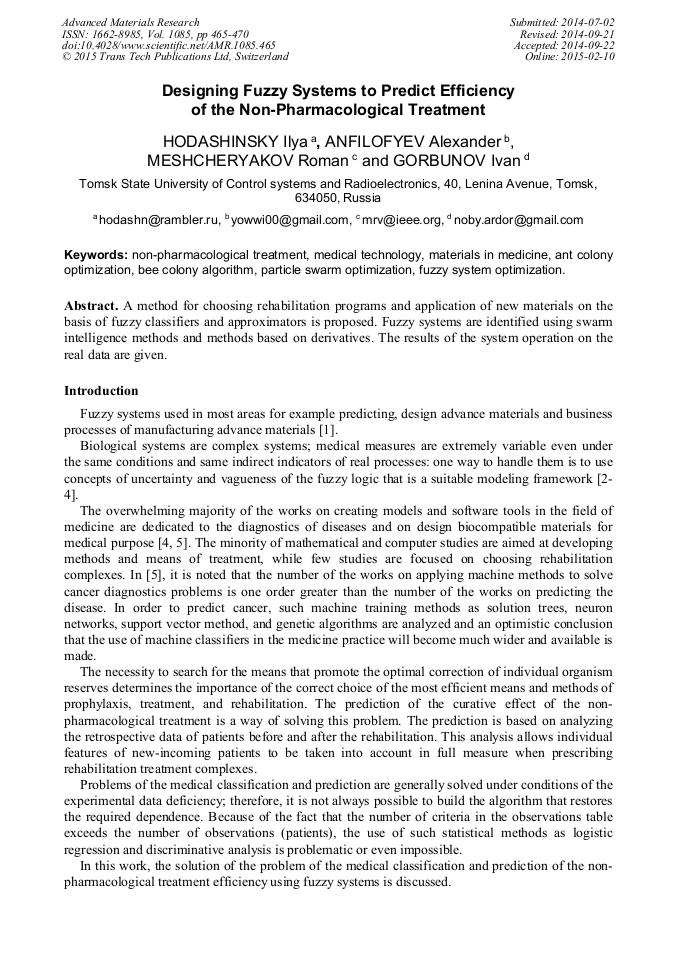
A method for choosing rehabilitation programs on the basis of fuzzy classifiers and approximators is proposed. Fuzzy systems are identified using swarm intelligence methods and methods based on derivatives. The results of the system operation on the real data are given.
You might also be interested in these eBooks

Info:
Periodical:
Advanced Materials Research (Volume 1085)
Pages:
465-470
DOI:
Citation:
Online since:
February 2015
Price:
Сopyright:
© 2015 Trans Tech Publications Ltd. All Rights Reserved
Share:
Citation: