Comparison of Three-Parameter Weibull Statistical Analysis of the Flexural Strength of Dense and Porous Sintered Clay

Article Preview

Abstract:

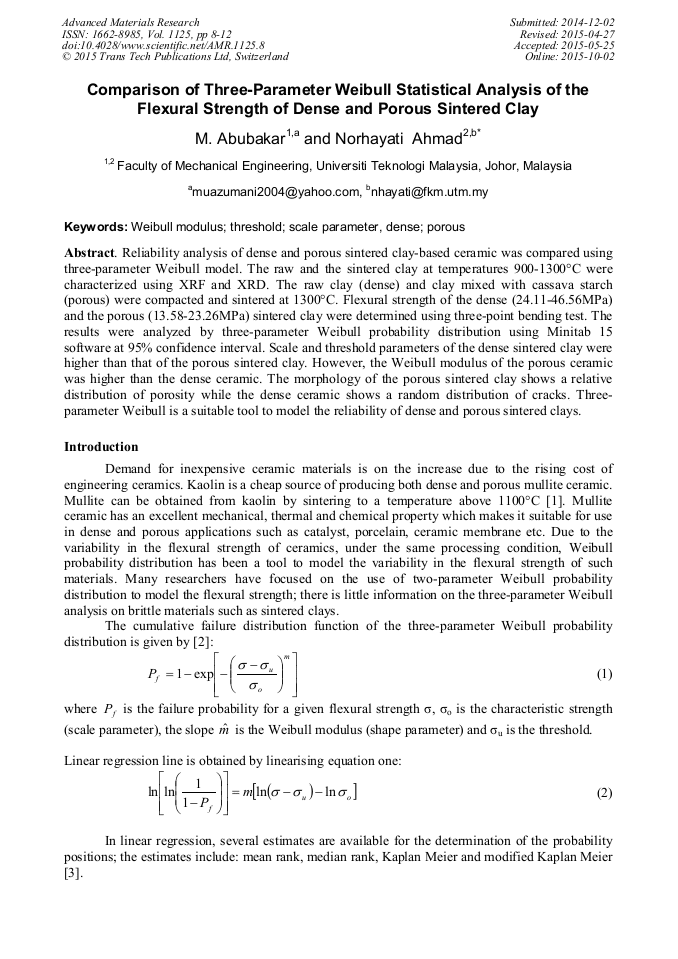
Reliability analysis of dense and porous sintered clay-based ceramic was compared using three-parameter Weibull model. The raw and the sintered clay at temperatures 900-1300°C were characterized using XRF and XRD. The raw clay (dense) and clay mixed with cassava starch (porous) were compacted and sintered at 1300°C. Flexural strength of the dense (24.11-46.56MPa) and the porous (13.58-23.26MPa) sintered clay were determined using three-point bending test. The results were analyzed by three-parameter Weibull probability distribution using Minitab 15 software at 95% confidence interval. Scale and threshold parameters of the dense sintered clay were higher than that of the porous sintered clay. However, the Weibull modulus of the porous ceramic was higher than the dense ceramic. The morphology of the porous sintered clay shows a relative distribution of porosity while the dense ceramic shows a random distribution of cracks. Three- parameter Weibull is a suitable tool to model the reliability of dense and porous sintered clays.
You might also be interested in these eBooks

Info:

Periodical:

Pages:

8-12

Citation:

Online since:

October 2015

Export:

Price:

Permissions CCC:

Permissions PLS:

Сopyright:

© 2015 Trans Tech Publications Ltd. All Rights Reserved

Share:

Citation:

* - Corresponding Author

[1] M. Abubakar, A.B. Aliyu, Norhayati Ahmad. Characterization of Nigerian clay as porous ceramic material. AMR, 256-260 (2014).

DOI: 10.4028/www.scientific.net/amr.845.256

Google Scholar

[2] Han, Z., Tang, L. C., Xu, J. & Li, Y., A three-parameter Weibull statistical analysis of the strength variation of bulk metallic glasses Scripta Mater, 61, 923(2009).

DOI: 10.1016/j.scriptamat.2009.07.038

Google Scholar

[3] F.K. Wang and J. Bert Keats, Improved percentile estimation for the two parameter Weibull distribution, Micronelectron Reliab 20, 883(1995).

DOI: 10.1016/0026-2714(94)00168-n

Google Scholar

[4] Standard Test Method for Flexural Strength of Advanced Ceramics at Ambient Temperature ASTM C1161-13.

Google Scholar

[5] Castelein, O. et al., 2001. The influence of heating rate on the thermal behaviour and mullite formation from a kaolin raw material. Ceram. Intern., 27, p.517–522.

DOI: 10.1016/s0272-8842(00)00110-3

Google Scholar

[6] Abubakar, M., Aliyu, A. B., & Ahmad,. Flexural Strength Analysis of Dense and Porous Sintered Clay Using Weibull Probability Distribution, AMM 761(2015), 347–351.

DOI: 10.4028/www.scientific.net/amm.761.347

Google Scholar

[7] Yu Fangli, Wang Huanrui, Yang Jianfeng and Gao Jiqiang, Effects of organic additives on microstructure and mechanical, Bull. Mater. Sci., 33.

Google Scholar

[3] 285–291 (2010).

Google Scholar

[8] Quinn JB, Quinn GD. A practical and systematic review of Weibull statistics for reporting strengths of dental materials. Dent mater : official publication of the Academy of Dental Materials., 26: 135-47 (2010).

DOI: 10.1016/j.dental.2009.09.006

Google Scholar