p.1707
p.1712
p.1716
p.1722
p.1726
p.1732
p.1735
p.1740
p.1744
Cleaner Dehairing Technology for Goatskins: Effects of Hydrosulfide and Peroxide on Enzyme Unhairing

Abstract:
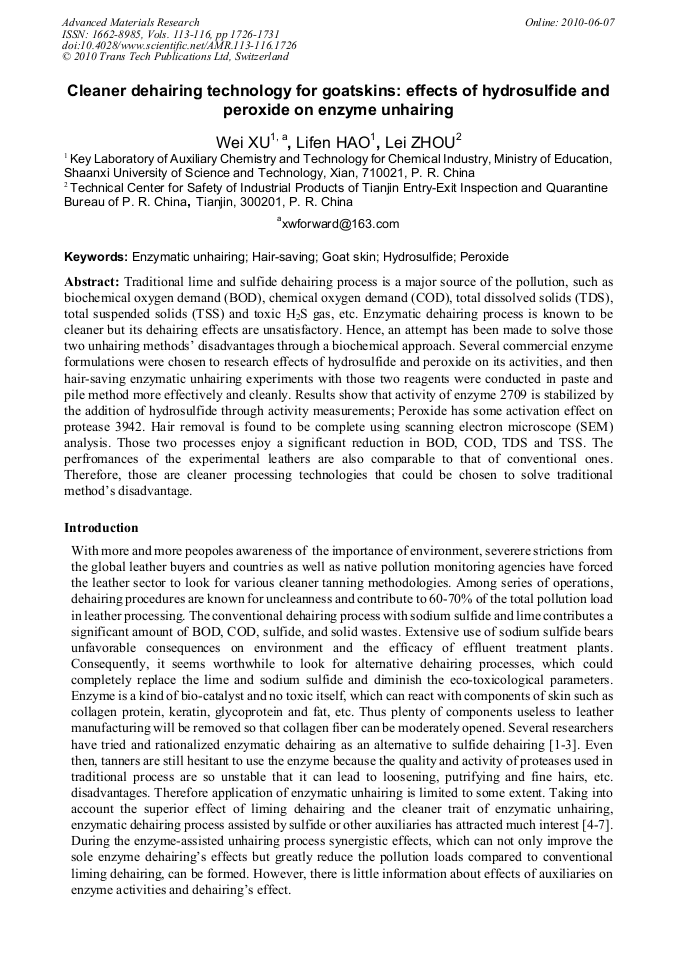
Traditional lime and sulfide dehairing process is a major source of the pollution, such as biochemical oxygen demand (BOD), chemical oxygen demand (COD), total dissolved solids (TDS), total suspended solids (TSS) and toxic H2S gas, etc. Enzymatic dehairing process is known to be cleaner but its dehairing effects are unsatisfactory. Hence, an attempt has been made to solve those two unhairing methods’ disadvantages through a biochemical approach. Several commercial enzyme formulations were chosen to research effects of hydrosulfide and peroxide on its activities, and then hair-saving enzymatic unhairing experiments with those two reagents were conducted in paste and pile method more effectively and cleanly. Results show that activity of enzyme 2709 is stabilized by the addition of hydrosulfide through activity measurements; Peroxide has some activation effect on protease 3942. Hair removal is found to be complete using scanning electron microscope (SEM) analysis. Those two processes enjoy a significant reduction in BOD, COD, TDS and TSS. The perfromances of the experimental leathers are also comparable to that of conventional ones. Therefore, those are cleaner processing technologies that could be chosen to solve traditional method’s disadvantage.
Info:
Periodical:
Pages:
1726-1731
Citation:
Online since:
June 2010
Authors:
Keywords:
Price:
Сopyright:
© 2010 Trans Tech Publications Ltd. All Rights Reserved
Share:
Citation: