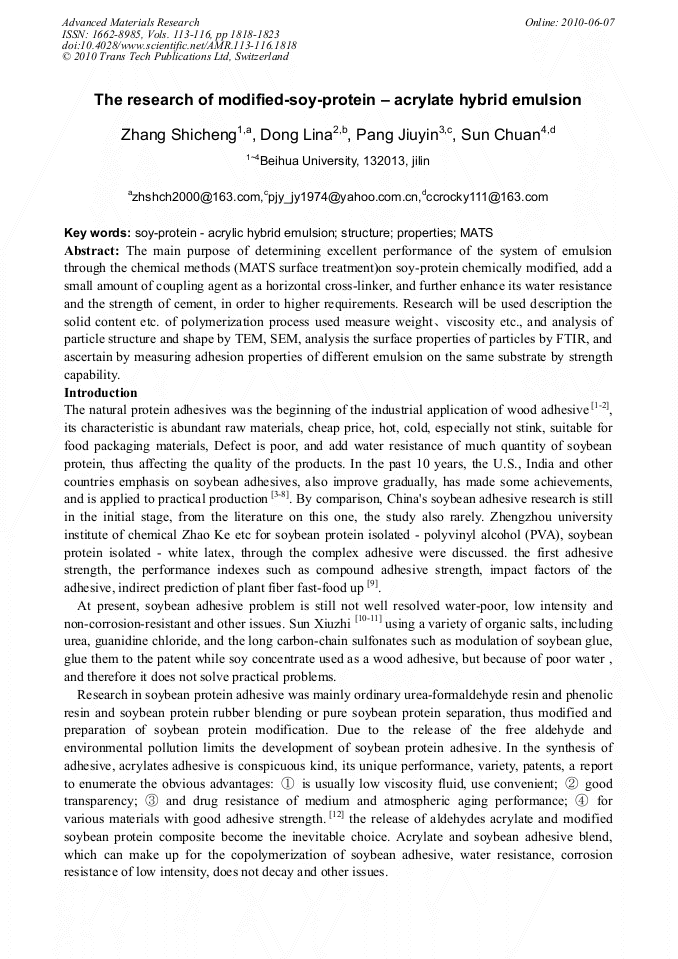
The Research of Modified-Soy-Protein – Acrylate Hybrid Emulsion

Article Preview

Abstract:

The main purpose of determining excellent performance of the system of emulsion through the chemical methods (MATS surface treatment)on soy-protein chemically modified, add a small amount of coupling agent as a horizontal cross-linker, and further enhance its water resistance and the strength of cement, in order to higher requirements. Research will be used description the solid content etc. of polymerization process used measure weight、viscosity etc., and analysis of particle structure and shape by TEM, SEM, analysis the surface properties of particles by FTIR, and ascertain by measuring adhesion properties of different emulsion on the same substrate by strength capability.
You might also be interested in these eBooks

Info:

Periodical:

Advanced Materials Research (Volumes 113-116)

Pages:

1818-1823

Citation:

Online since:

June 2010

Export:

Price:

Permissions CCC:

Permissions PLS:

Сopyright:

© 2010 Trans Tech Publications Ltd. All Rights Reserved

Share:

Citation:

[1] Zhang Liwu. Water-based adhesive [M]. Beijing: Chemical Industry Press, (2002).

Google Scholar

[2] Tang Xinghua. Wood adhesive [M]. Beijing: Chemical Industry Press, (2002).

Google Scholar

[3] Mo X Q, Hu J, Sun X S, et al. Compression and tensile strength of low-density straw- protein particleboard[J]. Industrial Croups and products, 2001, (14), 1~9.

DOI: 10.1016/s0926-6690(00)00083-2

Google Scholar

[4] Cheng E Z, Sun X Z, karr S G, Adhesive properties of modified soy-bean flour in wheat straw particleboard [J]. Composites; Part A; Applied Science and Manufacturing, 2004, 35(3): 297~302.

DOI: 10.1016/j.compositesa.2003.09.008

Google Scholar

[5] Lambuth A L Protein adhesives for wood [M], In: Pizzi A, Mittal K L. Vony and Wood Adhesive Technology. New York; Marcdel Dekker Inc, 1994, 259~281.

Google Scholar

[6] Zhong Z, Sun X S, Fang X, et al. Adhesion properties of soy-protein with fiber cardboard[J].J. Am. Oil Chen. Soc., 2001, (78): 37~41.

DOI: 10.1007/s11746-001-0216-0

Google Scholar

[7] Zhong Z K, Sun X S, Wang D H. et al. Wet strength and water resistance of modified soy-protein adhesives and effects of drying treatment [J]. Jamal of Polymers and Environment. 2003, 11(4): 137~144.

Google Scholar

[8] Hettiarachchy N S, Kalapathy U, Myers D J. Alkali-Modified Soy-Protein with Improved.

Google Scholar

[9] Adhesive and Hydrophobic Properties[J].J. Am. Oil. Chem. Soc., 1995, 72(12): 1461~1464.

Google Scholar

[10] Zhao Ke, Hao Xufeng, Liu Dazhuang. Soybean protein isolate complex adhesive developed [J]. Zhengzhou University of Technology, 2000, 21 (1): 15 ~ 18.

Google Scholar

[11] Sun Xiuzhi, KeBian. Shear Strength and Water Resist stance of modified Soy-Protein Adhesives [J]. JAOCS, 1999, 76(8): 977-980.

Google Scholar

[12] Sun X, Bian K. Modified soy-protein adhesives [P]. US. Pat. 6, 497, 760. (2002).

Google Scholar

[13] Zhang Junying, etc. Acrylate adhesives [M]. Beijing: Chemical Industry Press, (2006).

Google Scholar