An Anti-Collision Risk Assessment Method for Single-Row Wellheads in Vertical Well Section of Cluster Well

Article Preview

Abstract:

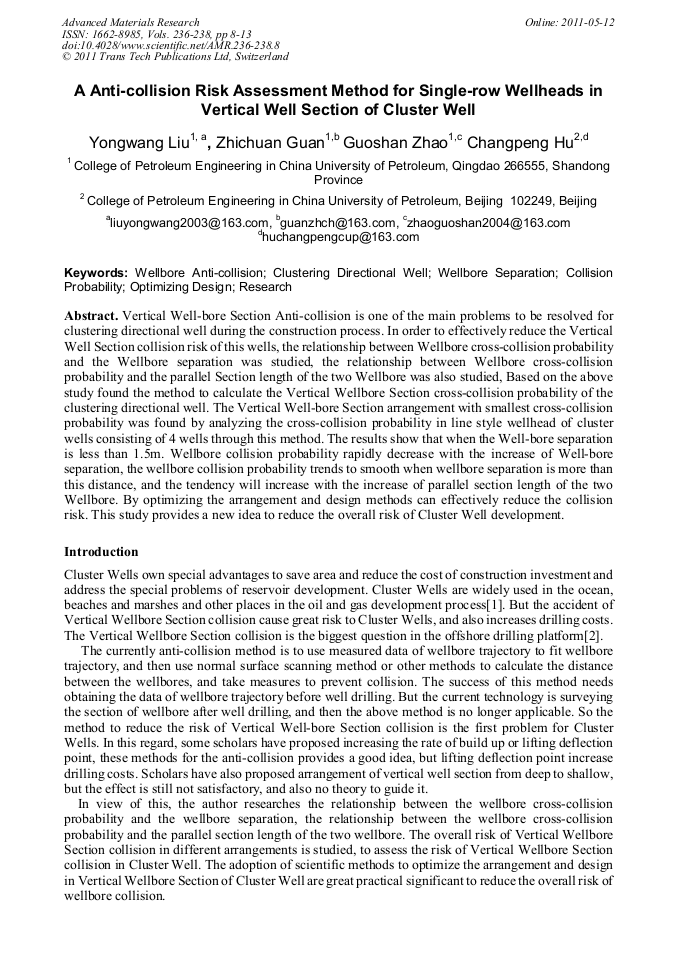
Vertical Well-bore Section Anti-collision is one of the main problems to be resolved for clustering directional well during the construction process. In order to effectively reduce the Vertical Well Section collision risk of this wells, the relationship between Wellbore cross-collision probability and the Wellbore separation was studied, the relationship between Wellbore cross-collision probability and the parallel Section length of the two Wellbore was also studied, Based on the above study found the method to calculate the Vertical Wellbore Section cross-collision probability of the clustering directional well. The Vertical Well-bore Section arrangement with smallest cross-collision probability was found by analyzing the cross-collision probability in line style wellhead of cluster wells consisting of 4 wells through this method. The results show that when the Well-bore separation is less than 1.5m. Wellbore collision probability rapidly decrease with the increase of Well-bore separation, the wellbore collision probability trends to smooth when wellbore separation is more than this distance, and the tendency will increase with the increase of parallel section length of the two Wellbore. By optimizing the arrangement and design methods can effectively reduce the collision risk. This study provides a new idea to reduce the overall risk of Cluster Well development.
You might also be interested in these eBooks

Info:

Periodical:

Advanced Materials Research (Volumes 236-238)

Pages:

8-13

Citation:

Online since:

May 2011

Export:

Price:

Permissions CCC:

Permissions PLS:

Сopyright:

© 2011 Trans Tech Publications Ltd. All Rights Reserved

Share:

Citation:

[1] HOU Baofu. The oil field and its advantages of Cluster well. Oilfield Surface Engineering. 1990,9(5):7-8.

Google Scholar

[2] WEI Gang, ZHANG Chunlin, SHAO Mingren. Anti-collision technology of concentrated wellhead clustering directional well. Inner Monggulia Petrochemical Industry, 2010,34 (2):99-101.

Google Scholar

[3] LU Xuezhong, YIN Wei. Design and Construction Techniques of Directional wells (cluster well). Exploration Engineering (Rock & Soil Drilling and Tunneling), 2001 Supplement: 218-220.

Google Scholar

[4] National Petroleum and Chemistry Industry Bureau. SY/T 6396-1999 Requirements for Cluster Drilling Hole Anticollision Technology. Beijing: Petroleum Industry Press, (1999)

Google Scholar

[5] Benny Poedjono, Guy J.Lombardo, W.Philips. Anti-collision Risk Management Standard for Well Placement. SPE 121040 , 2009.

DOI: 10.2118/121040-ms

Google Scholar

[6] Nitin Sharma, Mike McDonald, Jeffrey Mohammed, et al. Optimizing Directional Drilling While Minimizing the Risk of Well Collision in Offshore Drilling . SPE124246 , 2009.

DOI: 10.2118/124246-ms

Google Scholar

[7] Andrew G.Brooks. A New Look at Wellbore Collision Probability. SPE 116155 , 2008.

Google Scholar

[8] WANG Heng, CUI Yonghui. Accident Experience and Exhortation on Well Collision from Cao-4 Clustering Wells. Drilling& Production Technology, 2007, 30(4): 151-151, 158.

Google Scholar

[9] WANG Zhi-hua, Tom A.Ingils. Planning Directional Wells Through a High-Density Cluster of Existing Wells. SPE 17594, 1990.

DOI: 10.2118/17594-pa

Google Scholar

[10] B. Poedjono, G. Akinniranye, G. Conran, et al. Minimizing the Risk of Well Collisions in Land and Offshore Drilling. SPE/IADC 108279, 2007.

DOI: 10.2118/108279-ms

Google Scholar

[11] LIU Yongwang, GUAN ZhiChuan, LIANG Haiming, et al. Segment Selection Effect on Directional Well Trajectory Fitting Accuracy and Accurate Measurement Method. Oil Drilling & Production Technology, 2010,32(4):16-21.

Google Scholar

[12] CHEN Tinggen ,GUAN Zhichuan. Theory and technology of drilling engineering. Dongying : The Press of China University of Petroleum , ,2006 : 186-192. ( in Chinese)

Google Scholar

[13] HAN Zhiyong. Design and Calculation of Directional Drilling. Dongying : The Press of the China University of Petroleum , 2007 : 117-141. ( in Chinese)

Google Scholar