Method for Modeling Ultrasonic Driving Circuit and Designing Matching Network

Article Preview

Abstract:

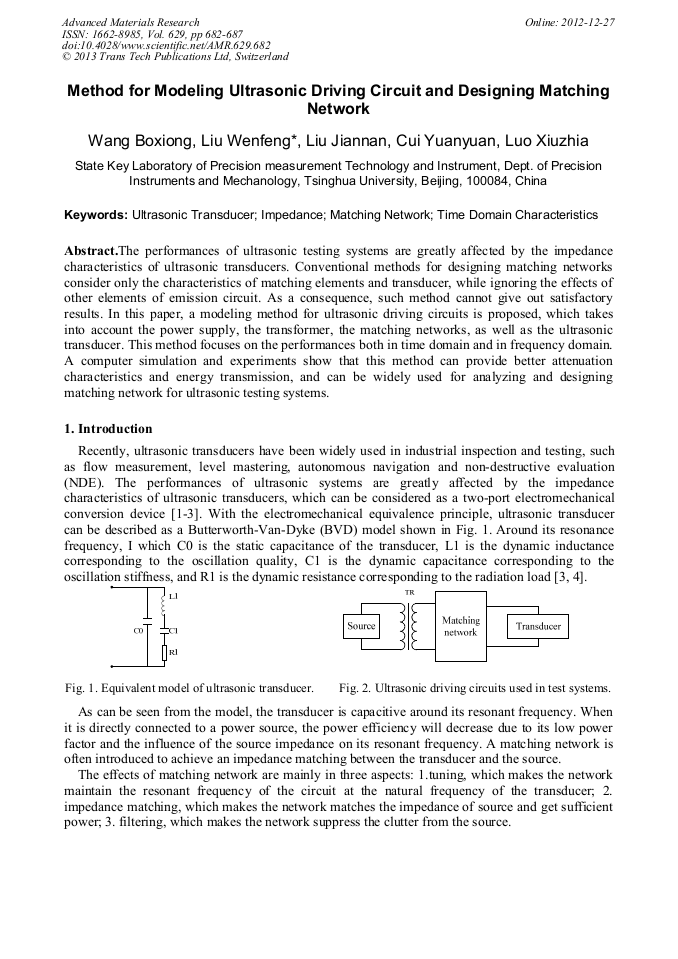
The performances of ultrasonic testing systems are greatly affected by the impedance characteristics of ultrasonic transducers. Conventional methods for designing matching networks consider only the characteristics of matching elements and transducer, while ignoring the effects of other elements of emission circuit. As a consequence, such method cannot give out satisfactory results. In this paper, a modeling method for ultrasonic driving circuits is proposed, which takes into account the power supply, the transformer, the matching networks, as well as the ultrasonic transducer. This method focuses on the performances both in time domain and in frequency domain. A computer simulation and experiments show that this method can provide better attenuation characteristics and energy transmission, and can be widely used for analyzing and designing matching network for ultrasonic testing systems.

You might also be interested in these eBooks

Info:

Periodical:

Pages:

682-687

Citation:

Online since:

December 2012

Export:

Price:

Permissions CCC:

Permissions PLS:

Сopyright:

© 2013 Trans Tech Publications Ltd. All Rights Reserved

Share:

Citation:

[1] Patist, A. and D. Bates, Ultrasonic innovations in the food industry: From the laboratory to commercial production. Innovative Food Science and Emerging Technologies, 2008. 9(2): pp.147-154.

DOI: 10.1016/j.ifset.2007.07.004

Google Scholar

[2] Liu W., et al., Ultrasonic ranging system with large sensing range and high accuracy. Proceeding of 9th International Symposium on Test and Measurement, 2011, pp.442-445.

Google Scholar

[3] Gallego-Juarez, J.A., et al., Power ultrasonic transducers with extensive radiators for industrial processing. Ultrasonics Sonochemistry, 2010. 17(6): pp.953-964.

DOI: 10.1016/j.ultsonch.2009.11.006

Google Scholar

[4] Hauptmann, P., N. Hoppe, and A. Puttmer, Application of ultrasonic sensors in the process industry. Measurement Science and Technology, 2002. 13(8): pp. R73-R83.

DOI: 10.1088/0957-0233/13/8/201

Google Scholar

[5] Capineri, L., et al., Ultrasonic transducers as a black-box: equivalent circuit synthesis and matching network design. Ultrasonics, Ferroelectrics and Frequency Control, IEEE Transactions on, 1993. 40(6): pp.694-703.

DOI: 10.1109/58.248213

Google Scholar

[6] Garcia-Rodriguez, M., et al., Low Cost Matching Network for Ultrasonic Transducers, in International Congress on Ultrasonics, Proceedings, L.G. Garreton, Editor. 2010, Elsevier Science Bv: Amsterdam. pp.1025-1031.

Google Scholar

[7] Wu, J., et al., Novel primary series matching scheme for piezoelectric ultrasonic transducer. Jilin Daxue Xuebao (Gongxueban)/Journal of Jilin University (Engineering and Technology Edition), 2009. 39(6): pp.1641-1645.

Google Scholar

[8] Colak, I., et al. Design and simulation of a drive system for speed control of travelling wave ultrasonic motor. in 2010 International Symposium on Power Electronics, Electrical Drives, Automation and Motion, SPEEDAM 2010, June 14, 2010 - June 16, 2010. 2010. Pisa, Italy: IEEE Computer Society.

DOI: 10.1109/speedam.2010.5544766

Google Scholar

[9] Lewis Jr, G.K. and W.L. Olbricht, Design and characterization of a high-power ultrasound driver with ultralow-output impedance. Review of Scientific Instruments, 2009. 80(11): pp.114704-8.

DOI: 10.1063/1.3258207

Google Scholar