p.547
p.551
p.557
p.562
p.567
p.573
p.579
p.585
p.589
Electrical Treeing and Morphological Analysis of Epoxy Nanocomposites with Different Concentrations of Silica Nanofillers

Abstract:
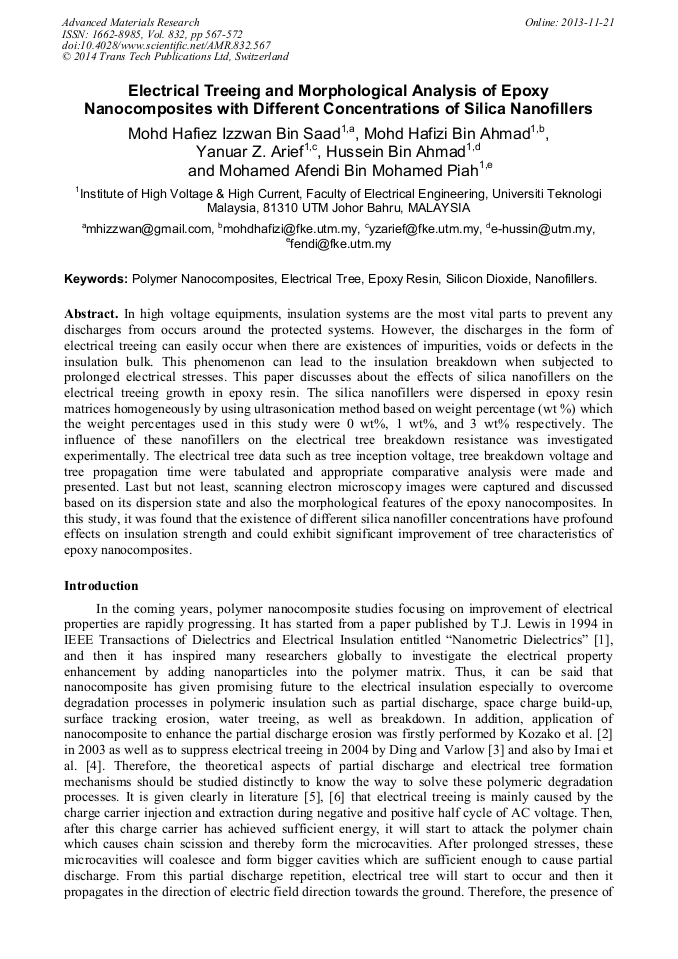
In high voltage equipments, insulation systems are the most vital parts to prevent any discharges from occurs around the protected systems. However, the discharges in the form of electrical treeing can easily occur when there are existences of impurities, voids or defects in the insulation bulk. This phenomenon can lead to the insulation breakdown when subjected to prolonged electrical stresses. This paper discusses about the effects of silica nanofillers on the electrical treeing growth in epoxy resin. The silica nanofillers were dispersed in epoxy resin matrices homogeneously by using ultrasonication method based on weight percentage (wt %) which the weight percentages used in this study were 0 wt%, 1 wt%, and 3 wt% respectively. The influence of these nanofillers on the electrical tree breakdown resistance was investigated experimentally. The electrical tree data such as tree inception voltage, tree breakdown voltage and tree propagation time were tabulated and appropriate comparative analysis were made and presented. Last but not least, scanning electron microscopy images were captured and discussed based on its dispersion state and also the morphological features of the epoxy nanocomposites. In this study, it was found that the existence of different silica nanofiller concentrations have profound effects on insulation strength and could exhibit significant improvement of tree characteristics of epoxy nanocomposites.
Info:
Periodical:
Pages:
567-572
DOI:
Citation:
Online since:
November 2013
Price:
Сopyright:
© 2014 Trans Tech Publications Ltd. All Rights Reserved
Share:
Citation: