Research on Applied-Information Technology in Hierarchical Network Security Protocols Designing Based on Public Key

Article Preview

Abstract:

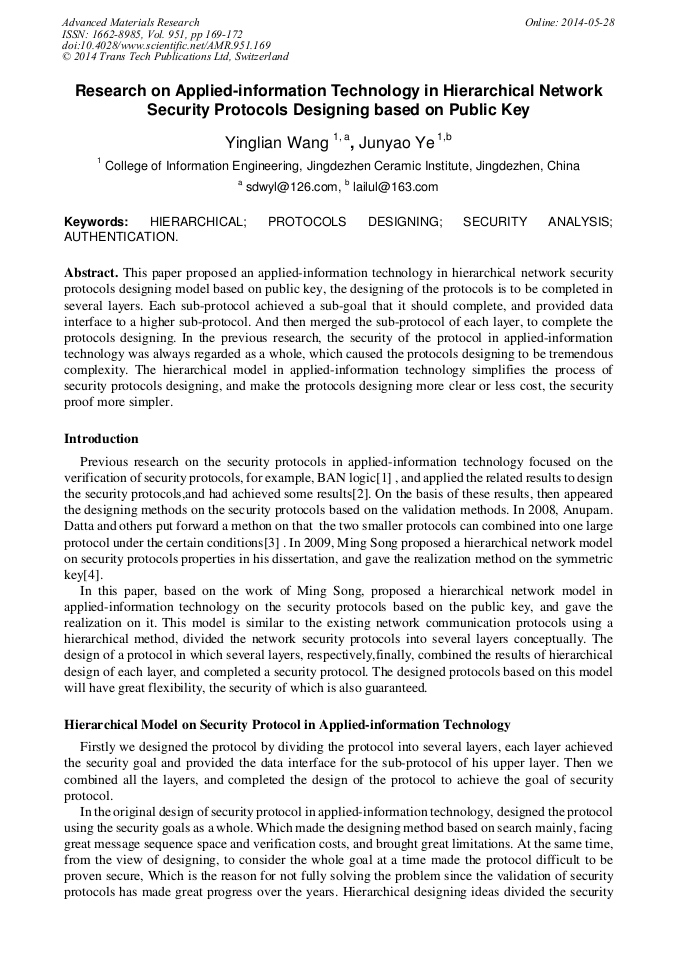
This paper proposed an applied-information technology in hierarchical network security protocols designing model based on public key, the designing of the protocols is to be completed in several layers. Each sub-protocol achieved a sub-goal that it should complete, and provided data interface to a higher sub-protocol. And then merged the sub-protocol of each layer, to complete the protocols designing. In the previous research, the security of the protocol in applied-information technology was always regarded as a whole, which caused the protocols designing to be tremendous complexity. The hierarchical model in applied-information technology simplifies the process of security protocols designing, and make the protocols designing more clear or less cost, the security proof more simpler.

You might also be interested in these eBooks

Info:

Periodical:

Pages:

169-172

Citation:

Online since:

May 2014

Export:

Price:

Permissions CCC:

Permissions PLS:

Сopyright:

© 2014 Trans Tech Publications Ltd. All Rights Reserved

Share:

Citation:

* - Corresponding Author

[1] M. Burrows, M. Abadi and R. Needham. A logic of authentication[J]. ACM Transactions on Computer Systems. Vol. 8, No. 1, P18-36, (1990).

Google Scholar

[2] Abadi, M. and Needham, R. 1996. Prudent engineering practice for cryptographic protocols[J]. IEEE Trans. Softw. Eng. 22, 1 (Jan. ), 6-15.

DOI: 10.1109/32.481513

Google Scholar

[3] Datta. A, Derek. A, Mitchell.J. C, Pavlovic. D: A derivation system for security protocols and its logical formalization[C]. Computer Security Foundations Workshop, 2008. Proceedings. 21th IEEE, Stanford Univ., CA, USA.

DOI: 10.1109/csfw.2003.1212708

Google Scholar

[4] Ming Song,Design and Verification Research on Security Protocols[D],Department of Computer Science, Tsinghua University,(2009).

Google Scholar

[5] ISO/IEC 2nd DIS 11770-3. Key Management-Part 3: Mechanisms Using Asymmetric Techniques[S]. Intemational Organization for Standardization, (1997).

Google Scholar

[6] Song Dawn xiaodong, Berezin sergey, perrig Adrian. Athena: a novel approach to efficient automatic security protocol analysis[J]. Journal of Computer Security, 2005, 9(1/2): 47-74.

DOI: 10.3233/jcs-2001-91-203

Google Scholar

[7] Stoller S D. A bound on attacks on payment protocols[C]. Proceedings of the 16th Annual IEEE Symposium on Logic in Computer Science(LICS). IEEE Computer Society Press, 2001: 61-70.

DOI: 10.1109/lics.2001.932483

Google Scholar

[8] Gordon A, Jeffrey A. Authenticity by typing for security protocols[C]. 14th IEEE Computer Security Foundations Workshop(CSFW-14). 2001: 145-159.

DOI: 10.1109/csfw.2001.930143

Google Scholar

[9] Guttman J D, Thayer F J. Authentication tests[C]. IEEE Symposium on Security and Privacy, 2000: 96-109.

Google Scholar