A New Characterization Measure of the Degradation of Power Battery Based on Declining Point
p.186
p.186
Research on Thermal Balance with Critical Density in the Zero-Range Process with many Defect Sites
p.191
p.191
Research on Thermal Balance with One-Dimensional Zero-Range Process Model (ZRP) and Dynamics
p.195
p.195
Thermodynamics Analysis and Mathematic Proof of the Error of the Equivalent Enthalpy Drop Partial Quantitative Method (EEDPQM)
p.199
p.199
Analysis on Petrophysical Properties of the Shale Gas Reservoir
p.208
p.208
Study on Influencing Factors of Thermal Analysis Experiment on Coal Oxidation and Spontaneous Combustibility
p.213
p.213
Parameter Matching and Simulation for Powertrain System of Pure Electric City Bus
p.218
p.218
Influence of Flap Deflection Angle on Wind Turbine Airfoil with Trailing Edge Flaps
p.222
p.222
Research on Mining Engineering with Dual Gradient High Inclination-Angle Fully Mechanized Mining Technology
p.231
p.231
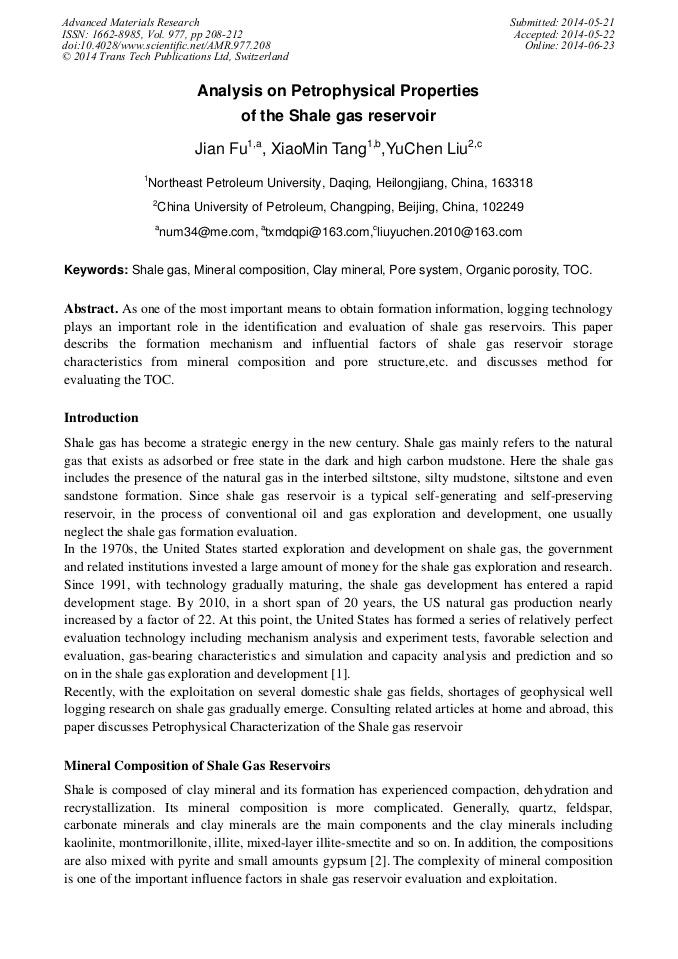
Analysis on Petrophysical Properties of the Shale Gas Reservoir

Abstract:
As one of the most important means to obtain formation information, logging technology plays an important role in the identification and evaluation of shale gas reservoirs. This paper describs the formation mechanism and influential factors of shale gas reservoir storage characteristics from mineral composition and pore structure,etc. and discusses method for evaluating the TOC.
You might also be interested in these eBooks

Info:
Periodical:
Advanced Materials Research (Volume 977)
Pages:
208-212
DOI:
Citation:
Online since:
June 2014
Authors:
Keywords:
Price:
Сopyright:
© 2014 Trans Tech Publications Ltd. All Rights Reserved
Share:
Citation: