Study on the Setting Characteristics, Mechanical Properties, and Volumetric Stability of Alkali-Activated Metakaolin-Based Composite Materials

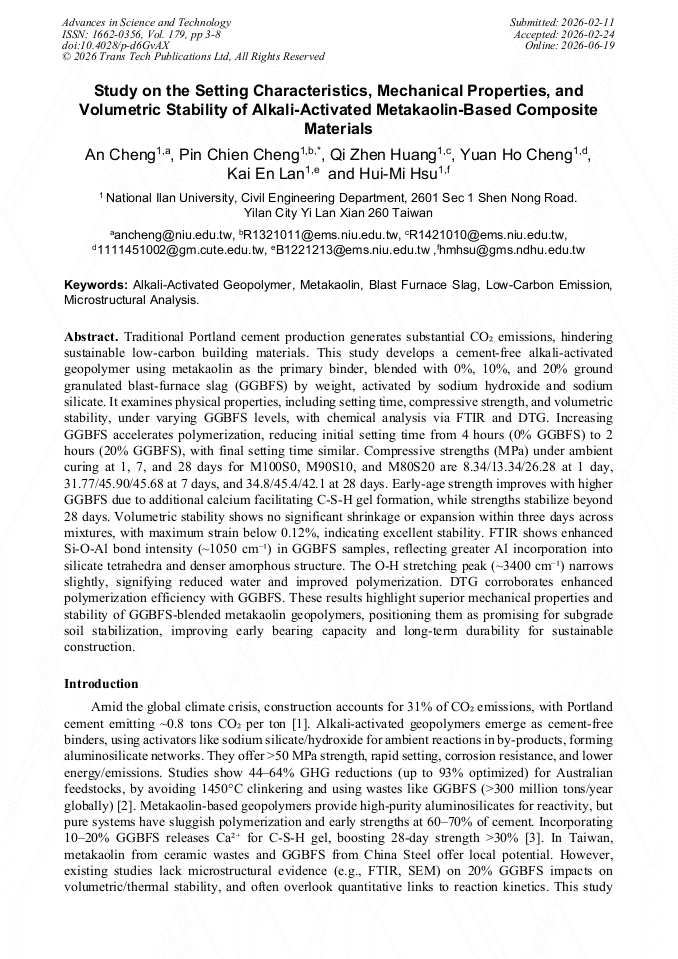
Article Preview

Abstract:

Traditional Portland cement production generates substantial CO₂ emissions, hindering sustainable low-carbon building materials. This study develops a cement-free alkali-activated geopolymer using metakaolin as the primary binder, blended with 0%, 10%, and 20% ground granulated blast-furnace slag (GGBFS) by weight, activated by sodium hydroxide and sodium silicate. It examines physical properties, including setting time, compressive strength, and volumetric stability, under varying GGBFS levels, with chemical analysis via FTIR and DTG. Increasing GGBFS accelerates polymerization, reducing initial setting time from 4 hours (0% GGBFS) to 2 hours (20% GGBFS), with final setting time similar. Compressive strengths (MPa) under ambient curing at 1, 7, and 28 days for M100S0, M90S10, and M80S20 are 8.34/13.34/26.28 at 1 day, 31.77/45.90/45.68 at 7 days, and 34.8/45.4/42.1 at 28 days. Early-age strength improves with higher GGBFS due to additional calcium facilitating C-S-H gel formation, while strengths stabilize beyond 28 days. Volumetric stability shows no significant shrinkage or expansion within three days across mixtures, with maximum strain below 0.12%, indicating excellent stability. FTIR shows enhanced Si-O-Al bond intensity (~1050 cm⁻¹) in GGBFS samples, reflecting greater Al incorporation into silicate tetrahedra and denser amorphous structure. The O-H stretching peak (~3400 cm⁻¹) narrows slightly, signifying reduced water and improved polymerization. DTG corroborates enhanced polymerization efficiency with GGBFS. These results highlight superior mechanical properties and stability of GGBFS-blended metakaolin geopolymers, positioning them as promising for subgrade soil stabilization, improving early bearing capacity and long-term durability for sustainable construction.
You might also be interested in these eBooks

Info:

Periodical:

Pages:

3-8

Citation:

Online since:

June 2026

Export:

Price:

Permissions CCC:

Permissions PLS:

Сopyright:

© 2026 Trans Tech Publications Ltd. All Rights Reserved

Share:

Citation:

* - Corresponding Author

[1] Kim, H., et al. (2025). A Study on the Shrinkage and Compressive Strength of GGBFS and Metakaolin Based Geopolymer under Different NaOH Concentrations. Materials, 17(7), 1567.

DOI: 10.3390/ma17051181

Google Scholar

[2] Hadi, H., et al. (2025). A systematic review of metakaolin-based alkali-activated and geopolymer concrete: A step toward green concrete. Reviews on Advanced Materials Science, 44(1), 20240076.

DOI: 10.1515/rams-2024-0076

Google Scholar

[3] Kim, H., et al. (2024). A Study on the Shrinkage and Compressive Strength of GGBFS and Metakaolin Based Geopolymer under Different NaOH Concentrations. Materials, 17(7), 1567.

DOI: 10.3390/ma17051181

Google Scholar

[4] Wang, L., et al. (2024). Effect of GGBFS on the mechanical properties of metakaolin-based geopolymer concrete. Journal of Building Engineering, 92, 109678.

Google Scholar

[5] Shi, Z., et al. (2022). Composition design and characterization of alkali-activated Slag/Metakaolin mortars with various Na₂O content and activator modulus. Frontiers in Built Environment, 8, 1020217.

Google Scholar

[6] Albidah, A., et al. (2023). Strength Development and Durability of Metakaolin Geopolymer Mortar with GGBFS. Minerals, 13(7), 857.

Google Scholar

[7] Hadi, H., et al. (2025). A systematic review of metakaolin-based alkali-activated and geopolymer concrete: A step toward green concrete. Reviews on Advanced Materials Science, 44 (1), 20240076.

DOI: 10.1515/rams-2024-0076

Google Scholar

[8] Zhang, Y., et al. (2024). Evaluation of the thermal stability of metakaolin-based geopolymers with different Si/Al ratios. Cement and Concrete Composites, 149, 105492.

Google Scholar

[9] Assi, L., et al. (2023). Enhancing Freeze–Thaw Resistance of Alkali-Activated Slag by Incorporating Metakaolin. ACS Omega, 8(25), 22647-22657.

DOI: 10.1021/acsomega.3c01600

Google Scholar

[10] Albidah, A., et al. (2025). Compressive strength prediction of fly ash/slag-based geopolymer concrete using deep learning. Developments in the Built Environment, 22, 100536.

DOI: 10.1016/j.dibe.2025.100736

Google Scholar