p.23
p.31
p.41
p.47
p.55
p.63
p.69
p.77
p.85
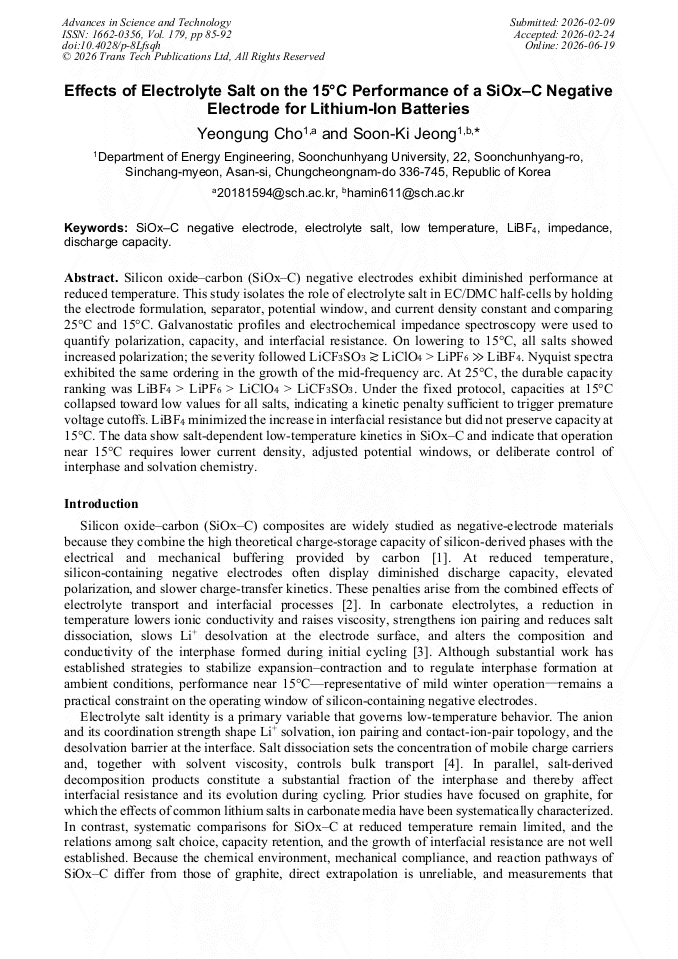
Effects of Electrolyte Salt on the 15°C Performance of a SiOx–C Negative Electrode for Lithium-Ion Batteries

Abstract:
Silicon oxide–carbon (SiOx–C) negative electrodes exhibit diminished performance at reduced temperature. This study isolates the role of electrolyte salt in EC/DMC half‑cells by holding the electrode formulation, separator, potential window, and current density constant and comparing 25°C and 15°C. Galvanostatic profiles and electrochemical impedance spectroscopy were used to quantify polarization, capacity, and interfacial resistance. On lowering to 15°C, all salts showed increased polarization; the severity followed LiCF3SO3 ≳ LiClO4 > LiPF6 ≫ LiBF4. Nyquist spectra exhibited the same ordering in the growth of the mid‑frequency arc. At 25°C, the durable capacity ranking was LiBF4 > LiPF6 > LiClO4 > LiCF3SO3. Under the fixed protocol, capacities at 15°C collapsed toward low values for all salts, indicating a kinetic penalty sufficient to trigger premature voltage cutoffs. LiBF4 minimized the increase in interfacial resistance but did not preserve capacity at 15°C. The data show salt-dependent low-temperature kinetics in SiOx–C and indicate that operation near 15°C requires lower current density, adjusted potential windows, or deliberate control of interphase and solvation chemistry.
Info:
Periodical:
Pages:
85-92
DOI:
Citation:
Online since:
June 2026
Authors:
Price:
Сopyright:
© 2026 Trans Tech Publications Ltd. All Rights Reserved
Share:
Citation: